My NASA Data Teacher Keys


The keys that are available are listed in alphabetical order. We are still developing keys for some resources. If you have a specific request for something you cannot find, please contact us at larc-mynasadata@mail.nasa.gov.
- Air Quality Index in Fresno, CA
-
Link to Air Quality Index in Fresno, CA
Link to Air Quality Index in Fresno, CA Interactive Model Teacher Key
- Air Quality StoryMap
-
Link to Air Quality StoryMap
Link to Air Quality StoryMap Teacher Key
- Air Temperatures Around the World
-
Link to Air Temperatures around the World
- Check with your instructor on how to submit your answers.
- What does surface air temperature anomaly mean? (Surface air temperature anomaly refers to how much warmer or cooler the air temperature near the surface of Earth is compared to the long term average of surface air temperatures.)
- What is the range of values shown on the scale bar? (The values in the scale bars display a range of -4.1 to 5.2.) Explain what those values mean? (These numbers show how much cooler (negative values) or warmer (positive values) the surface air temperature measurements were in January 2000-2020 vs. surface air temperature measurements taken over a longer period of time in the past (the 30-year period from 1951 to 1980).
- Identify the locations on the map where you would find the highest and lowest values (the extremes) of the data. (The highest values seen in the data are mostly in the high latitudes (Arctic and Antarctic zones) and located over areas of land. The lowest values seen in the data are typically found in ocean areas.)
- Explain why your selected locations experience these extremes while other parts of the world do not. (Answers will vary.)
- Albedo Card Sort
-
The teacher displays the bar chart of Surface Albedo Values from the slides for students to compare their predictions.
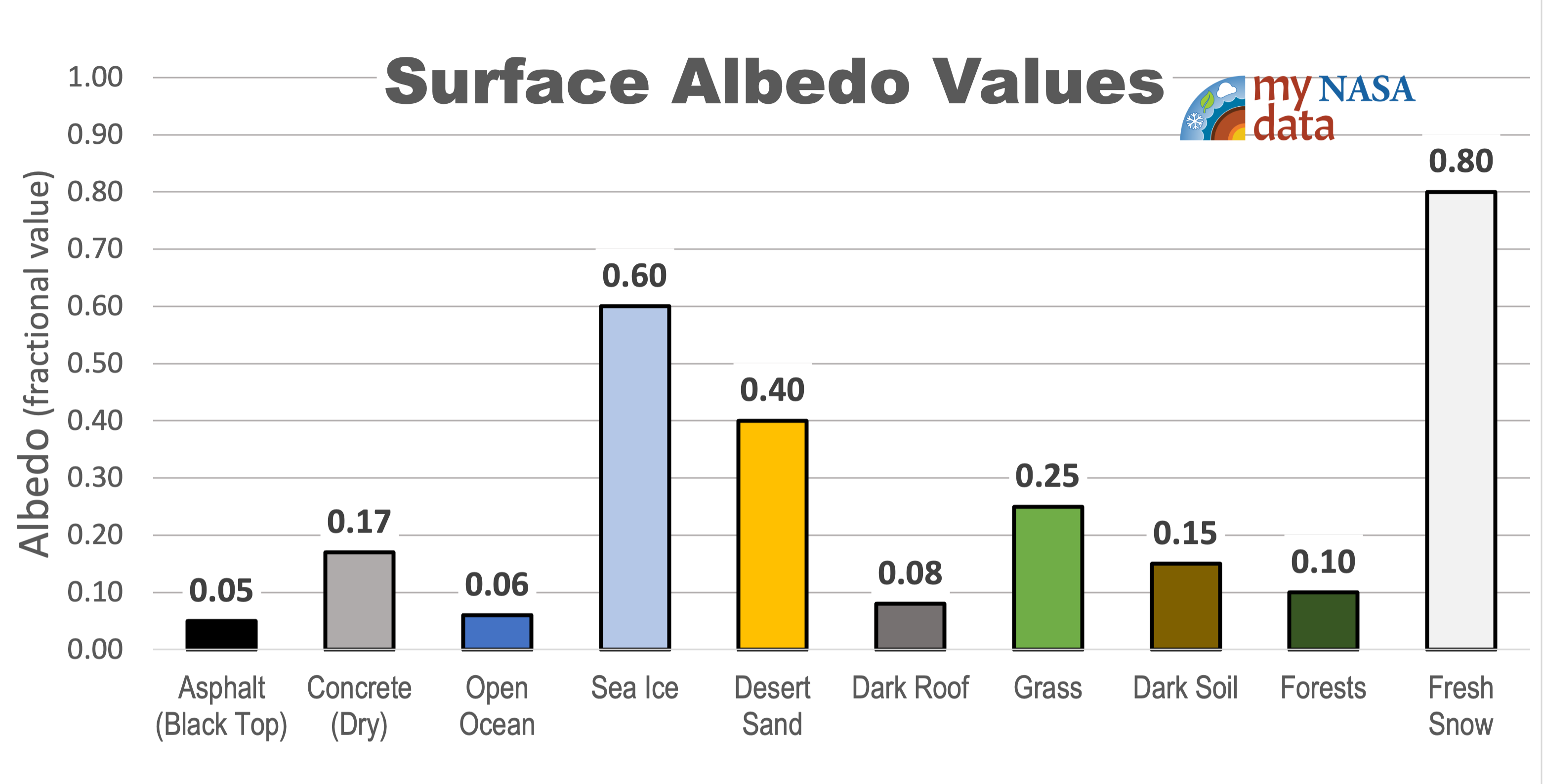
Surface Albedo Values Bar Chart. Source: My NASA Data | https://mynasadata.larc.nasa.gov/sites/default/files/inline-images/AlbedoSort_barchart_0.png - Analyzing a Volcanic Ash Model
-
Link to Analyzing a Volcanic Ash Model
- Watch the videos and answer the questions. Check with your instructor on how to submit your answers. Frist, watch the What's Ash Anyway? video to find out about volcanic ash and answer the questions below.
- First, watch the What's Ash Anyway? video to find out about volcanic ash and answer the questions below.
- How is volcanic ash different from fireplace ash? (Accept reasonable responses. Ash in the fireplace is the residue of burning wood and is organic. Volcanic ash is a mix of ground up rock and glass and is not organic.)
- Why is volcanic ash dangerous? (It can be a hazard to people on the ground and for aircraft. It can get into aircraft engines and damage them making flights unsafe.)
- Watch the video Tracking Volcanic Ash with Satellites. It describes tracking volcanic ash with satellites and shows the Calbuco volcano eruption. Then answer the questions below.
- What do you notice about how the ash from the Calbuco volcano traveled? (Accept reasonable responses including the following: It traveled far. It looked like it was traveling around the world. It was at different heights in the atmosphere.)
- Why does NASA study volcanic ash? (The information is used to help make forecasts to keep aircraft from being damaged by the volcanic ash and improving air traffic management.)
- Analyzing Cloud Effects on Earth's Energy Budget
-
Link to Analyzing Cloud Effects on Earth's Energy Budget resource
Link to Analyzing Cloud Effects on Earth's Energy Budget pdf
- Analyzing Earth's Energy Imbalance by Latitude and Month
-
Analyzing Earth’s Energy Imbalance by Latitude and Month
Steps:
- Check with your instructor on how to submit your answers.
- Describe the latitude zone/s where you see the biggest range in values? Why do you think this is? The largest spatial variability in EEI is found between 10° to 30° North throughout the year. Variability is the largest in this area because of the presence of large areas of bright desert areas with few clouds in this latitude zone.
- What months do you observe the greatest change by latitude? Summer months, compared to all other months, show the greatest change and range of values. High values are also seen at both lower and higher latitudes in both hemispheres during respective summer seasons. The high values a result of high insolation and surface properties of the polar regions (cold ice-free ocean versus ice/snow-covered ocean and land).
- What zones change the least? Why do you think this is? Areas around the -50 zone (50 degrees South) show the least amount of change. This may be due to ice-free ocean regions with the lack of large areas of land.
- Analyzing Historic Ocean Chlorophyll Concentration Data with Maps
-
Link to Analyzing Historic Ocean Chlorophyll Concentration Data with Maps
Steps:
- Check with your instructor on how to submit your answers.
- Identify what living organisms may be observed using chlorophyll data. Phytoplankton, plants, etc.
- Recall that phytoplankton are microscopic, floating, plant-like organisms that live in oceans, lakes, and rivers. They use photosynthetic pigments (like chlorophyll) to convert energy from the Sun into organic matter. For this reason, NASA satellites can observe the amount of phytoplankton present in the ocean by measuring chlorophyll concentrations.
- Review the color bar scale below. What do the different colors mean with respect to phytoplankton? When phytoplankton populations are large, the color of the water appears greener because of high concentrations of chlorophyll.
- Identify each region using the numbers listed on the map. 1. Alaskan Coast, 2. Canadian West Coast, 3. West Coast (U.S), 4. East Coast (U.S.), 5. Canadian East Coast, 6. Pacific (Hawaii)
- Analyze the Chlorophyll Concentrations in Surface Ocean Waters image at each region you listed.
- Compare the Chlorophyll Concentrations in the coastal areas to the open ocean in the Pacific. What do you observe? Coastal areas tend to have higher concentrations of chlorophyll than the open ocean.
- How do the lower latitudes like those in Florida or Hawaii compare to the higher latitudes like those in Alaska? There are high concentrations in the higher latitudes than the lower ones.
- Compare the West Coast and East Coast concentrations. The higher concentrations are more evident along the west coast of North America.
- Analyzing Seasonal Ice and Snow Extent
-
Link to Analyzing Ice and Snow Extent
Steps:
- Check with your instructor on how to submit your answers.
- What is the range of values shown on the scale bar? 0-100
- Where in the world do you find the highest and lowest extreme values of the data in your images? The highest extreme values are in the Arctic regions, beginning as far South as the middle of Asia. The lowest extreme values are those surrounding the equator through the oceans.
- Identify the patterns that you see. Regions that are closer to the North and South poles have higher extreme values of ice, while those closer to the equator have lower extreme values. The data varies over water. The levels of ice tend to remain lower over the water than over the land.
- Predict what month this plot to represents and give evidence for your prediction. This plot represents January. There is more ice in the Northern Hemisphere, indicating that this is the winter in the Northern Hemisphere.
- What changes do you observe? There is now more ice in the South Pole region.
- Choose a location or region to compare both maps. If there was a change, explain why it happened. Students will choose a location and compare. What explanations can you suggest for the timing of those extremes? Winter occurs during different months for the North and South Hemispheres.
- Identify and explain why some regions experience both extreme highs and lows and some do not. Northern regions of North America and Asia experience both the highs and the lows. Regions surrounding the border between the extreme highs and lows do not experience such extreme values because they allow the transition between the extremes.
- Explain why some regions remain relatively unchanged over the year. Regions that remain relatively unchanged are those surrounding the equator and those at the extreme poles in the Arctic and Antarctic regions. This occurs because these regions are constantly hot and cold, respectively, regardless of the season.
- Predict what month this plot to represents and give evidence for your prediction. This month represents July. It is summer in the Northern Hemisphere, as there are not as many extreme lows there, while it is winter in the Southern Hemisphere where there are more extreme lows.
- Analyzing Seasonal Phytoplankton & Energy Flow
-
Link to Analyzing Seasonal Phytoplankton & Energy Flow
Steps:
- Check with your instructor on how to submit your answers.
- Analyze the graph displaying Monthly Flow of Energy into Surface by Shortwave Radiation between the years of 2016 and 2018 in the North Atlantic Ocean. Answer the the following questions.
- What variable is represented on the x-axis? Time. What is the range of values? 2016-2018
- What variable is represented on the y-axis? Watts per square meter, which is the flow of energy spread out over an area. What is the range of values? 20-240 w/m2
- Describe the pattern that is revealed over the three years. The shortwave radiation values are sinuous in that the increase in the spring, peak in the summer, decline in the fall through winter and steadily repeat this pattern.
- Analyze the graph displaying Monthly Average Chlorophyll Concentration between the years of 2016 and 2018 in the North Atlantic Ocean and then answer the following questions. The units for chlorophyll concentration in this graph is milligrams of chlorophyll per cubic meter of seawater. This is a very small mass unit. To compare, the average mass of a feather from a chicken is about 8 milligrams.
- What variable is represented on the x-axis? Year What is the range of values? 2016-2018
- What variable is represented on the y-axis? Chlorophyll concentration
- Describe the pattern that is revealed over the three years. The chlorophyll values tend to decline around the middle of summer in both 2016 and 2017 but rebound in early fall, only to decline for the remainder of the calendar year.
- Compare the two line graphs. Describe what these graphs have in common? How are they different? They are both cyclical and highly variable. They both peak in the summer and decline in the winter. How are they different? The chlorophyll values tend to decline around the middle of summer in both 2016 and 2017 but rebound in early fall, only to decline for the remainder of the calendar year. On the other hand, the shortwave radiation values are sinuous in that the increase in the spring, peak in the summer, decline in the fall through winter and steadily repeat this pattern.
- Brainstorm the factors that may contribute to their differences. Answers will vary.
- Analyzing Seasonal Vegetation & Leaf Area
-
Link to Analyzing Vegetation & Leaf Area
Students observe seasonal images of Monthly Leaf Area, looking for any changes that are occurring throughout the year.
Steps:
- Check with your instructor on how to submit your answers.
- The Monthly Leaf Area Index maps (Plots A-D) are in chronological order, starting with the time periods: February 2016, June 2016, October 2016, and February 2017. Identify the seasonal cycles for leaf changes throughout the year by answering the following questions:
- What changes do you see through the year? What explanations can you suggest for these patterns? Answers will vary depending on location.
- Choose a location or region. During which months do the extreme highs and lows occur? What explanations can you suggest for the timing of those extremes? Answers will vary depending on location.
- Which regions experience both the extreme highs and lows? Which regions don’t experience the extremes? Why do you think this happens? Answers will vary depending on location.
- Analyzing Surface Air Temperatures by Latitude
-
Link to Analyzing Surface Air Temperatures by Latitude Mini Lesson
- Answer the questions below. Check with your instructor on how to submit your answers.
- At what latitudes and within which zone(s) do you see the most significant surface air temperature positive anomalies? What do these positive anomalies indicate? The most dramatic land surface temperature positive anomalies can be seen from 65°S to 85°S in the Antarctic Zone and from 65°N to 80°N in the Arctic Zone; these positive anomalies mean that the mean land surface temperatures across those latitudes were much higher than usual during the year of 2018 when compared to the mean land surface temperatures of the years 1951 through 1980.
- At what latitudes and within which zone(s) do you see the most significant surface air temperature negative anomalies? What does these negative anomalies indicate? The most dramatic land surface temperature negative anomalies can be seen from 85°N to 90°N; these negative anomalies indicate that the mean land surface temperatures across those latitudes were much lower than usual during the year of 2018 when compared to the mean land surface temperatures of the years 1951 through 1980.
- What trends in surface air temperature do you observe with respect to latitude? (Do you see places in the graph where a pattern can be recognized?) Both of the higher latitudes show a trend where mean land surface temperatures increase sharply above the baseline at about 65°S to 80°S and 65°N to 80°N; however, mean land surface temperatures then decrease sharply at both 60°S and 60°N. There is also much greater variability in the mean land surfaces temperature data from the areas of 60°S to 90°S and from 60°N to 90°N. A pattern of increase is seen once more at around 25°S to 50°S and 25°N to 50°N. While, the Tropics (from 23.5°N and 23.5°S) show the most stability of the data and areas on Earth where mean land surface temperatures were consistently much closer to the baseline temperatures.
- What inference(s) or conclusion(s) can you make about these data? Can you provide any scientific explanation(s) for these? Aside from the region from 85°N to 90°N, the higher latitudes were warming more than any other area of the globe during April of 2018. This could be linked to melting ice and decreases in albedo, which could, in turn, cause an increase in the absorption of shortwave energy and further warming (Accept other reasonable responses.).
- Analyzing Surface Temperature Differences
-
Link to Analyzing Surface Temperature Differences Mini Lesson
- Observe the image above and answer the following questions. Check with your instructor on how to submit answers.
- What time of year do you predict this to be? Explain your evidence. Autumn or Winter due to the lack of leaves on trees and the browning leaves of the one remaining tree with leaves. The grass is also browner than one would expect in the spring or summer.
- What is the temperature of the air? 54° Fahrenheit
- How do the temperatures of the grass measured in sunlight differ from grass measured in the shade? The temperatures collected from the grass in the shade are 9°C cooler than the grass in the sunlight.
- What is the temperature difference between sunlit concrete and shaded concrete? What does this difference in temperature tell you about how surfaces are heated? The temperatures collected from the sidewalk in the shade are 7°C cooler than the sidewalk in the sunlight. Surfaces heat up and cool down differently, as evidenced by the temperature differences between grass and concrete.
- Based on what you have seen in this image, which type of area do you think is warmer, urban areas (cities and towns) or rural areas (country sides)? Why. (Surfaces like concrete and asphalt heat up to higher temperatures than ones with grass and plants so cities and towns will likely be hotter than rural areas that have more agricultural and forested areas.)
- AQI Social Media Post
-
Link to AQI Social Media Post Lesson Plan
Accept reasonable responses.
- Arctic Sea Ice Changes and Earth's Energy Budget
-
Link to Arctic Sea Ice Changes and Earth's Energy Budget
- Question Set #1: Analyze the monthly changes in sea Ice extent using the graph above.
- Identify the range of sea ice extent measured during the monthly recorded sea ice minimum. 4,000,000 - 5,000,000 km2
- Calculate the percent change in sea ice extent between the sea ice maximum and minimum during 2020.Maximum = 15,000,000 km2 Minimum = 4,000.000 km2
Percent change = ((15,000,000 - 4,000.000)/4,000.000)x100 = -275% (decrease) - Identify the month of the year when Little Diomede will most likely have sea ice surrounding it? Sea ice maximum = March
- Question Set #2: Differentiate between shortwave and longwave radiation.
- Incoming “shortwave radiation” is the term typically used to describe solar radiation. Explain how this type of radiation can come from Earth’s surface. It is solar radiation that is reflected.
- Outgoing “longwave radiation” is the term typically used to describe terrestrial radiation. Explain how this type of radiation can come from Earth’s surface. Incoming solar radiation was absorbed by Earth’s surface. It is changed to longwave radiation and emitted from Earth’s surface.
- Identify which arrows in the model below represent the energy transfer for each of the four data sets above. A-Incoming Shortwave Radiation, B-Outgoing Shortwave Radiation, D-Incoming Longwave Radiation, C-Outgoing Longwave Radiation
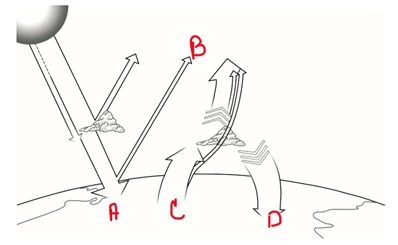
- Question Set #3: Connect energy transfer in the Earth System to changing sea ice extent.
- Describe the relationship between shortwave radiation flowing in the Earth system and changes in sea ice extent in the Arctic. The sea ice maximum is 2-3 months prior to the maximum amount of incoming shortwave radiation and the minimum is 2-3 months after the maximum amount of incoming shortwave radiation. The maximum outgoing shortwave radiation occurs the same month as the sea ice maximum, while the minimum outgoing shortwave radiation occurs the same as the sea ice minimum.
- Describe the relationship between longwave radiation flowing in the Earth system and changes in sea ice extent in the Arctic. The sea ice maximum is 1-2 months prior to the minimum amount of incoming/outgoing longwave radiation. While the sea ice minimum occurs 1-2 months prior to the maximum amount of incoming/outgoing longwave radiation.
- Discuss how both shortwave radiation and longwave radiation together drive the changes observed monthly in sea extent in the arctic region. Shortwave radiation start the seasonal cycle of sea ice ice expansion or decline, but the the continued melting or freezing of the ice occurs 1-2 months after the maximum amount of solar radiation energy flow. The source of the energy to continue melting for an additional 1-2 months is the sun’s energy that was originally absorbed by both the atmosphere and Earth’s surface. The energy is re-radiated as longwave energy.
- Question Set #4: Consider the impact humans have on sea ice extent.
- Identify one human activity that may ultimately affect the natural seasonal cycles of sea ice gain and loss. Answers vary. Example: Humans can increase the amount of greenhouse gases in the atmosphere by using fossil fuels as a energy source.
- Explain the connection(s) that link the human activity you stated above with its’ effect on annual sea ice. Answers vary. Example: Humans can increase the amount of greenhouse gases in the atmosphere therefore allowing a greater amount of energy be available for melting beyond the shortwave solar maximum. This will increase the time allowed for sea to melt and ultimately decrease sea ice extent in the long term.
- Propose one realistic solution to reduce the anthropogenic impact you described above. Answers vary. Example: If humans are using fossil fuels for energy production in their home, they may change to a renewable energy such as solar or wind energy.
- Question Set #1: Analyze the monthly changes in sea Ice extent using the graph above.
- Astronaut Pictures: Claim, Evidence & Reasoning
-
Link to Astronaut Pictures: Claim, Evidence & Reasoning
Accept reasonable responses which may include correctly attributing the surface or color with albedo values.
Student responses:
Claim: Students should make a statement that includes the independent variable (human impact) and dependent variable (albedo). The statement should not be general in nature.
Evidence: Students should include specific qualitative evidence from the astronaut photograph that describes a change in land surface and therefore it’s ability to reflect light. Qualitative evidence should be numerical values retrieved from the albedo bar chart that attributes an albedo value with a particular surface.
Reasoning: Students should provide a rationale to explain how the evidence supports their claim, then bridge a connection to how the change in albedo will impact Earth's energy budget.
- Atmospheric Methane
-
Steps:
- Check with your instructor on how to submit your answers.
- Identify the range of methane emissions displayed on the model. The model in the video shows a range of methane concentrations from 1800 ppb (parts per billion) to 2100 ppb.
- Identify and describe two anthropogenic sources of methane emissions. Answers Vary - the following are identified in the video: Rice cultivation and livestock, use of fossil fuels.
- Identify and describe two natural sources of methane emissions. Answers Vary - the following are identified in the video: Seasonal flooding of wetlands, thawing permafrost.
- Develop a scientific question that could lead to an investigation about a particular source of methane emissions. (QUESTION DEVELOPMENT GUIDELINES: The questions SHOULD NOT be rhetorical in nature, the questions SHOULD NOT be able to answered with Yes/No, the questions SHOULD be able to lead to a specific hypothesis, generally cause and effect questions are harder to answer (but not necessarily inappropriate for this exercise), guide your students to develop questions that help with identifying correlations.) Answers Vary - the following are examples: How will changes in precipitation in the Arctic region impact methane emissions? How will construction of a fossil fuel pipeline affect methane emissions? What type of agricultural activities result in the highest methane emissions? How can methane emissions from rice cultivation be reduced?
- Identify the range of methane emissions displayed on the model. How does this compare to the movie model? The model in the video shows a range of methane concentrations from 1.74 ppm (parts per million) to 1.98 ppm. Note that a part per billion is 1000 times smaller than a part per million. Therefore to compare the datasets, it may be useful to change the concentration to 1,740ppb and 1,980 ppb for the Alaskan Region emissions.
- Use specific data to describe a seasonal trend observed in methane emissions in the Alaska region. Answers Vary - but descriptions should always be supported to include specific data as evidence as opposed to simply noting general directional trends. The following is an example: Methane concentrations over in the north interior of Alaska (~58oN, 156oW) show a consistent seasonal increase from winter to late summer/early fall. Winter methane concentrations display a lower value around 1.90ppm while late summer/early fall show values at the highest range of 1.98ppm.
-
Explain how seasonal trends affect carbon cycling, including methane emissions in the Arctic region.
Answers Vary - the following are examples. The Arctic range is snow and ice covered in the winter months. These conditions limit the amount of carbon exchanged between the geosphere and the atmosphere. As seasonal temperatures rise, rates of decomposition increase and previously frozen soils that are saturated and have limited oxygen will emit methane.
Permafrost is extensive in the Arctic range. This is ground that remains completely frozen for at least two years. If the seasonal thaw period is extended, the greater the depths to which the soils will thaw. This increases the amount of thawing permafrost soils which result in a release of trapped carbon in the geosphere to the the atmosphere. When freezing occurs this condition in reversed and plant/organic material that has taken up atmospheric carbon becomes trapped in the frozen soils.
- Refer to the Earth’s energy budget diagram below to discuss how methane emissions in the Arctic are part of a positive feedback loop that is associated with an increasing rate of warming Arctic temperatures. Since methane is a potent greenhouse gas, when it is emitted from the geosphere into the atmosphere it will affect the how energy is transferred in the atmosphere since it traps longwave radiation (terrestrial radiation). The more longwave radiation is trapped in the atmosphere, the greater the amount of longwave radiation stays in the atmosphere and is not allowed to escape the Earth’s system. This causes and increase in Earth’s surface temperatures as more energy is now available to warm the Earth’s surface. As Earth’s surface warms, more methane is potentially emitted from the thawing of frozen Arctic soils (permafrost) which then leads to higher concentrations of greenhouse gases in the atmosphere.
- Aurora Bracelet
-
See the handout for a sample result.
- Aurora Chalk Art
-
See the handout for a sample result.
- Aurora vs. Airglow
-
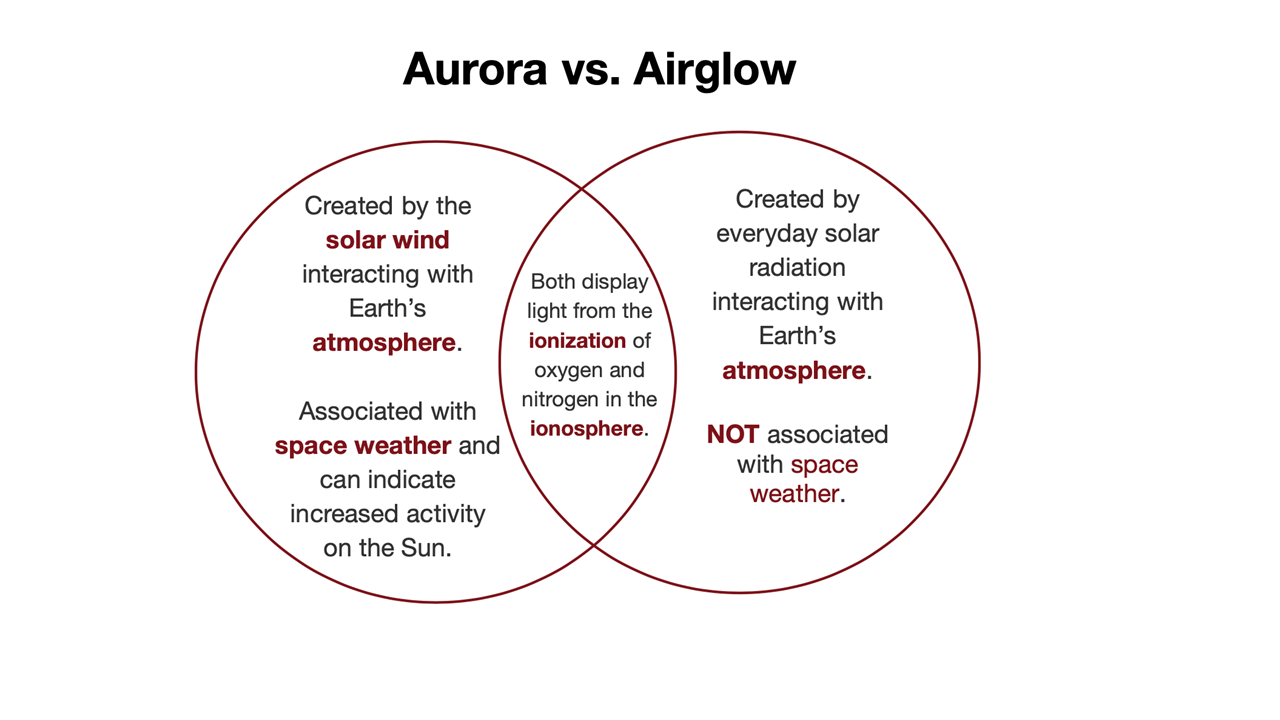
- Calculating Ratios of an Eclipse
-
Link to Calculating Ratios of an Eclipse
The Calculating Ratios of an Eclipse - Teacher Key
The spreadsheet has the answer formulas and numeric answers in the appropriate cells.
- Carbon Dioxide Production and Sequestration
-
Link to Carbon Dioxide Production and Sequestration
- Use the image of forested and deforested land to answer the questions. Check with your instructor on how to submit answers.
- The picture shows a plot of landscape measuring 1 kilometer on a side.
- Each box on the image covers 2.5 acres.
- The land and soil with green trees sequester carbon dioxide at a rate of 1 ton per acre per year. So, a box that is all trees will sequester 2.5 tons of carbon dioxide per year.
- The deforested land and soil have smaller amounts of vegetation and only sequesters carbon dioxide at a rate of 0.2 tons per acre per year. So, a box that is all deforested, or bare, land will sequester 0.5 tons of carbon dioxide per year.
- Estimate the size of the forested (dark green) area of the picture in acres. If one box has more than one type of cover, estimate how much is trees and how much is not. How many forested acres are in this picture?
- Approximately 2/3 of the picture is covered in green. 2.5 * 100 * .66 = 165 acres
- Accept reasonable estimates.
- Estimate the size of the deforested, bare area of the picture. How many deforested acres are in this picture?
- Approximately 1/3 of the picture is covered in green. 2.5 * 100 * .33 = 82.5 acres
- Accept reasonable estimates.
- How much carbon dioxide is sequestered by trees?
- (Number of boxes covered by trees X 2.5 tons of carbon dioxide per year)
- Approximately 66 * 2.5 tons/year = 165 tons/year
- Accept reasonable estimates
- How much carbon dioxide is sequestered by bare land?
- (Number of boxes covered by bare land x 0.5 tons of carbon dioxide per year)
- Approximately 33 * .5 tons/year = 16.5 tons/year
- What is the total rate of carbon dioxide sequestration in this particular area in terms of tons per year?
- Approximately 165 tons/year + 16.5 tons/year = 181.5 tons/year
- A typical American home produces about 10 tons of carbon dioxide per year. The image shows one house. What is the is the overall (or net) sequestration of carbon dioxide in the image including the house?
- 181.5 tons/year - 10 tons/year = 171.5 tons/year
- Assume someone built 50 more homes on the land in the image. What would the overall (or net) carbon dioxide sequestration be?
- There are 51 houses total.
- 181.5 tons/year - 51(10 tons/year) = 181.5 tons/year - 510 tons/year = -328.5 tons/year.
- This means that there is a production of 328.5 tons/year that is NOT sequestered.
- Use the image of forested and deforested land to answer the questions. Check with your instructor on how to submit answers.
- Changes in Criteria Pollutant Levels in the U.S.
-
Link to Changes in Criteria Pollutant Levels in the U.S. Lesson Plan
Criteria Pollutant Graphic Organizer Key
Accept reasonable responses in other activities.
- Changing Albedo and Sea Ice
-
Discuss Sea Ice
- Watch the video from NASA's Goddard Space Flight Center.
- As the video displays, Arctic sea ice reaches its minimum each September. Review the graph of Average Annual September Sea Ice Extent from NSIDC/NASA. This graph demonstrates the average monthly Arctic sea ice extent each September since 1979, derived from satellite observations.
- Answer the following questions about the graph. Check with your instructor on how to submit your answers.
- Which year has had the lowest recorded Arctic sea ice? 2012
- Which year had the highest recorded Arctic sea ice? 1980
- What is the overall trend in the annual Arctic sea ice minimum? It is declining.
- What factors might explain the trend in the annual Arctic sea ice minimum? More ice is melting and not as much is forming. Albedo can be one contributing factor.
The Link between Albedo and Sea Ice
- Answer the following questions about the short animation from NASA Scientific Visualization Studio. Check with your instructor on how to submit your answers.
- What do you notice about the areas of increased solar radiation? This visual shows that NASA satellite instruments have observed a marked increase in solar radiation absorbed in the Arctic since the year 2000 – a trend that aligns with the drastic decrease in Arctic sea ice during the same period.
- What do you notice about the areas of decreased sea ice? While sea ice is mostly white and reflects the sun's rays, ocean water is dark and absorbs the sun's energy at a higher rate.
- What is the connection between the two images? A decline in the region's albedo – its reflectivity, in effect – has been a key concern among scientists since the summer Arctic sea ice cover began shrinking in recent decades. As more of the sun's energy is absorbed by the climate system, it enhances ongoing warming in the region, which is more pronounced in the Arctic than anywhere else on the planet.
Exit Ticket
- Summarize the link between albedo and sea ice as an exit ticket. Check with your instructor on how to submit your answer. The influence of sea ice on the Earth is not just regional; it’s global. The white surface reflects far more sunlight back to space than ocean water does. (In scientific terms, ice has a high albedo.) Once sea ice begins to melt, a self-reinforcing cycle often begins. As more ice melts and exposes more dark water, the water absorbs more sunlight. The sun-warmed water then melts more ice. Over several years, this positive feedback cycle (the ice-albedo feedback) can influence global climate.
- Chlorophyll Concentration and Incoming Shortwave Radiation
-
Link to Chlorophyll Concentration and Incoming Shortwave Radiation
Link to Chlorophyll Concentration and Incoming Shortwave Radiation Teacher Key
- Clouds & Earth's Climate with Dr. Patrick Taylor Video
-
Link to Clouds & Earth's Climate with Dr. Patrick Taylor Video
Steps:
- Check with your instructor on how to submit your answers.
- How much has Earth’s mean surface temperature warmed over the last 130 years? More than 1֯ Celsius or more than 1.8֯ Fahrenheit.
- How does the CERES (Clouds and the Earth’s Radiant Energy System) project produce global climate data records of Earth’s energy budget and clouds over many decades? Over decades, from space, with six different instruments on four different satellites. The instruments are the CERES and MODIS instruments.
- Why is Earth’s energy budget important for climate? The difference between the amount of sunlight absorbed by Earth and the amount of infrared energy emitted to space controls Earth’s temperature.
- If less sunlight is absorbed than infrared energy is emitted to space, what will the effect be on Earth’s temperature? It will cool Earth’s temperature.
- If more sunlight is absorbed than infrared energy is emitted to space, what will the effect be on Earth’s temperature? It will warm Earth’s temperature.
- According to the animation of CERES data showing where Earth cools by losing infrared energy to space, which regions lose the most energy to space? In the warmest places, especially desert regions of Earth.
- Where is the least infrared energy lost to space? Cold regions such as the Arctic and Antarctic and places with a lot of clouds like the Amazon, Central Africa, and the tropical western Pacific regions.
- According to the animation showing CERES observations of reflected sunlight from Earth, where are the areas with the least reflected sunlight? Oceans.
- According to the animation showing CERES observations of reflected sunlight from Earth, where are the areas with the most reflected sunlight? Polar regions covered by ice and snow as well as some places in the Tropics with lots of clouds
- What are two possible effects that clouds have on the energy budget? Cooling and warming. Teacher Note: Some reflect more sunlight for a cooling effect. Others reduce the amount of infrared radiation lost to space resulting in warming. It depends on the height of the clouds and the amount of water vapor they contain. High-level clouds tend to have a warming effect. Low-level clouds tend to have a cooling effect. The effects are also different across Earth with more cooling over the oceans and warming over the land and the poles. The total overall effect is a cooling effect.
- Why does NASA study clouds and their role in Earth’s energy budget? How clouds change and the impact on the Earth’s energy budget will influence how climate changes including how hot and dry summers will be, the frequency of extreme weather events, where it rains, when it rains, and how hard it rains.
- Clouds & Their Impact on Global Warming
-
Link to Clouds & Their Impact on Global Warming
- To get students thinking about clouds and their role in Earth’s Energy Budget, start the lesson off by having students watch the NOVA PBS video entitled The Climate Wild Card.
- After the video, check for student understanding by asking some of the questions below:
- According to the video, what percentage of the sky do clouds cover? 70%
- What do clouds have a large influence on? Clouds have a large influence on global weather patterns to Earth’s climate and overall temperature.
- What happens to the Sun’s solar radiation after it enters Earth’s atmosphere? The radiation is either reflected away or taken in and then radiated back into space as heat.
- How do clouds influence the energy exchange between Earth and space? Clouds influence this energy exchange by reflecting away some incoming solar radiation and insulating the planet by absorbing some of the outgoing heat.
- True or False: Clouds reflect more energy than they absorb. True
- What would happen to Earth if it were completely cloudless? Since clouds reflect more energy than they absorb, removing clouds completely would warm the Earth.
- Identify the following types of clouds as absorbers or reflectors and state whether they have a cooling or warming effect on the planet:
- Cirrus Clouds Absorbers; warming effect
- Stratus Clouds Reflectors; cooling effect
- With the level of greenhouse gases in the atmosphere rising and the Earth’s temperature increasing, how will this affect clouds? It could affect cloud types, numbers, and location of clouds that form.
- What is the burning question for climate scientists? How will clouds respond as the planet warms?
- What do scientists theorize could happen to clouds as the planet warms? There could be an increase in reflecting clouds, which could slow the global warming trend. There could be an increase in absorbing clouds, which could dramatically speed up global warming.
- Stress to students the importance of clouds and their important (yet complicated) role in Earth’s Energy Budget and Earth’s temperature. Repeat the statement from the video that clouds can have both a cooling and warming effect on Earth’s temperature.
- Have students explore this idea further by looking at the diagram Cloud Effects On Earth's Radiation.
- Inform students that the yellow arrows on the diagram represent incoming shortwave radiation from the sun. The red arrows represent longwave radiation emitted (released) by Earth.
- Have students examine the diagram and answer the following questions:
- Check out the yellow arrows showing incoming shortwave radiation. What is the difference between the amount of incoming shortwave radiation transmitted through high-level clouds and low-level clouds? High-level clouds absorb shortwave radiation. Low-level clouds reflect shortwave radiation.
- Investigate the red arrows showing outgoing longwave radiation. What is the difference between the amount of outgoing longwave radiation transmitted through high-level clouds and low-level clouds? High-level clouds absorb more longwave radiation.
- Compare the yellow arrow reflected by the high cloud to the red arrow leaving the base of the high cloud and pointing toward the surface. Overall, what effect do high-level clouds have on the atmosphere? High-level clouds are absorbers of radiation.
- Differentiate between the yellow arrow reflected by the low cloud to the red arrow leaving the base of the low cloud and pointing toward the surface. Overall, what effect do low-level clouds have on the atmosphere? Low-level clouds are reflectors of radiation.
- Next, break the class up into groups of 3 or 4 students.
- Pass out the student handout Clouds & Their Impact on Global Warming. This is a C-E-R Response sheet in which students will be making a claim, examining evidence, and providing a detailed response.
- Explain to students that they will be examining the following pieces of evidence to answer the probing question “What effect will clouds have on global warming”?
- Once the groups have examined all evidence pertaining to clouds and global warming, they will copy their C-E-R response on a poster board or mini white board.
- Lastly, have groups present their findings to the class and explain the role clouds will play in global warming.
- Clouds and Climate Impacts
-
Link to Clouds and Climate Impacts
After watching the NOVA Video: The Climate Wild Card, reflect on the questions below that NASA scientists are working hard to answer. Answer the questions on another sheet of paper.
- How will clouds respond as the planet warms? Scientists are not sure if there will be an increase in low cooling clouds or higher absorbing clouds.
- Could we see an increase in reflecting clouds, which would help to slow the global warming trend? It is possible. This is why scientists are studying clouds and climate.
- Or will there be an increase in absorbing clouds, which could dramatically speed up the warming? It is possible. This is why scientists are studying clouds and climate.
- How would this warming affect the polar regions and in turn affect coastal areas? If there were an increase in absorbing clouds, the polar regions could warm by over 20 degrees Fahrenheit. This would lead to ice melting which could cause a rise in sea level of up to six feet.
As a class, brainstorm how the polar regions and coastal areas might be affected if there is an increase in absorbing clouds. Fill in the chain of events below that might occur if the percentage of absorbing clouds increases. Accept reasonable responses including those in question 4.
- Cloud Sort
-
The Cloud Sort Activity Key is available in a slide deck.
- Cloudy vs. Clear - Maps
-
Link to Cloudy vs. Clear - Maps
- Comparing Earth and Space Weather StoryMap
- Comparing Global Land Use Over Time
-
- Examine the images to see the projected differences between 1900 and 2100 and answer the questions. Check with your instructor on how to submit answers.
- What differences do you see? Accept reasonable responses
- Which color shows the highest primary land cover percentage? Lowest? highest - red, lowest white
- Describe where you would expect to find the highest percentage of primary land cover in 2100. Lowest? Accept reasonable responses.
- Examine the images of Africa and answer use the I² writing technique to write a caption for the images of Africa.
- What do you observe in Africa for 1900? In 1900 the primary land cover is highly variable in Northern Africa. Central Africa has a high degree of 0 primary land cover, with some minor amounts in primary land cover in the very center. Southern Africa appears to have about 70% primary land cover.
- What do you observe in Africa for 2100? By 2100, Africa is predicted to mostly loose all of its primary land cover, with the exception of a few spots around the country.
- What are the differences? There are several countries that have retained their primary land cover to a partial degree.
- What do these differences signify? Accept all reasonable answers. Answers could include the following. The differences could be due to population growth, access to resources and technology, industry development, health and public safety, etc.
- Write the caption. Accept all reasonable answers. "Africa loses most of primary land cover in two centuries."
- Examine the images to see the projected differences between 1900 and 2100 and answer the questions. Check with your instructor on how to submit answers.
- Comparing Winds & Surface Ocean Currents
-
Link to Comparing Winds & Surface Ocean Currents Mini Lesson
Reading the Images
-
Orient yourself to the ocean basins, the vectors, the vector legend, and the date/time information. Vector Legend:
-
Observe primarily the data displayed for the Equator and the North Atlantic Ocean.
- Run the animation My NASA Data: Global Wind Vectors 2017 2018. (May need to replay when needed.)
-
Answer the following questions. Check with your instructor on how to submit your answers.
- Observe the winds blowing across Earth’s surface. Which direction do the winds primarily blow around the Equator? West to East
- Focus your attention on the North Atlantic Ocean. What direction are the winds primarily blowing to? East in the North Atlantic (called the Prevailing Westerlies)
- Describe the months where the intensity of the Westerlies are the strongest? (Recall, the wind speed is displayed by the length of the arrow or the vector.) Winter months
- Describe the directions of winds off of the Eastern part of North America. There appear to be two circular patterns: 1.) Subpolar Gyre off of Greenland and 2.) Subtropical Gyre separating North America and Africa with Europe
- Winds blow from high to low pressure, and blow clockwise around areas of high pressure and counterclockwise around areas of low pressure in the Northern Hemisphere. (These directions the wind blows around high and low pressure is opposite in the Southern Hemisphere (clockwise around lows and counterclockwise around highs).)
- Observe the gyre in N. Atlantic - is it a high pressure or low-pressure area? The N. Atlantic Gyre consistently flows in a clockwise path around the North Atlantic Ocean. This would be a low pressure area.
Connecting the Data
- Observe the map of ocean surface currents.
- What similarities do you notice? Students should recognize the gyres.
- What role do winds play in the creation of surface currents? Large global wind systems are created by the uneven heating of the Earth’s surface. These global wind systems, in turn, drive the oceans’ surface currents.
-
- Computing Carbon Dioxide Amounts
- Computing Vegetation Cover
-
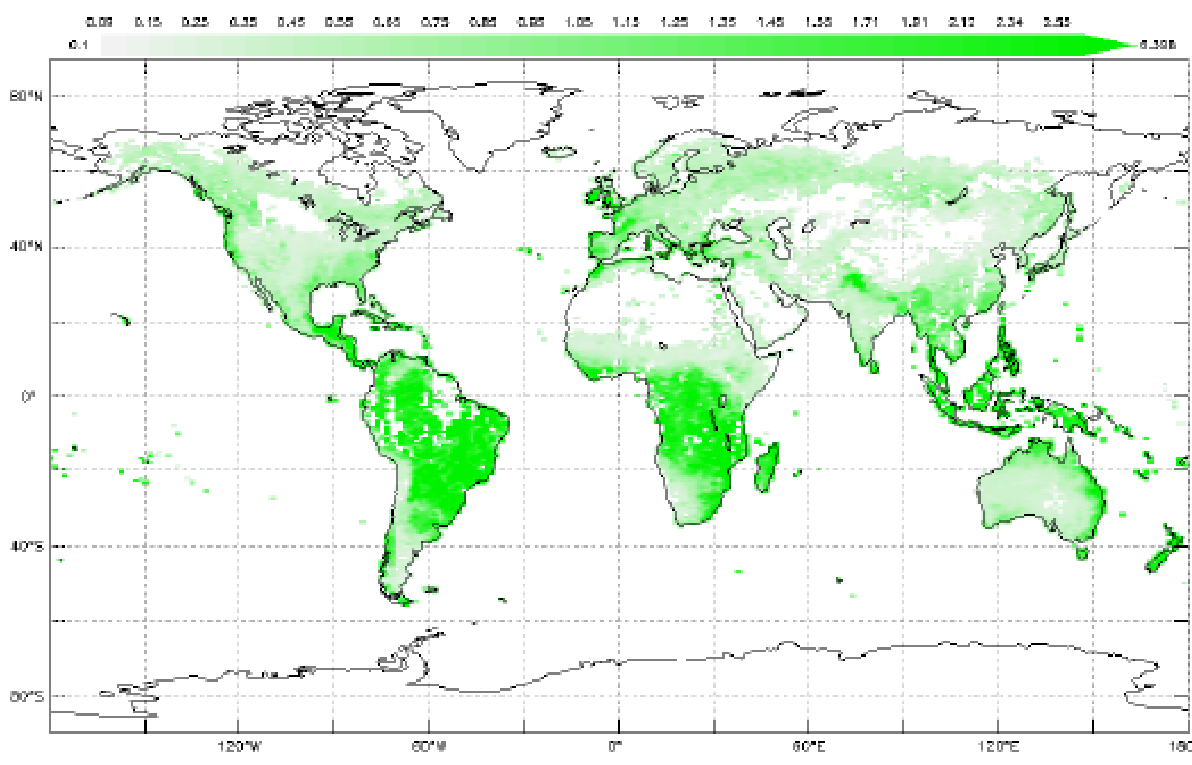
Leaf Area Index March 2018
Credit: My NASA Data
https://mynasadata.larc.nasa.gov/sites/default/files/inline-images/LAI%20Using%20Units%20in%20Calculations%20Image%202_0.png- Use the information and image provided to answer the questions. Check with your instructor on how to submit answers.
- Calculate leaf area index for the following examples. Use the units in the calculations.
- 1 m2 of leaves for 1 m2 of available land surface (answer: 1)
- 3.2 m2 of leaves for 2 m2 of available land surface (answer: 1.6)
- 100 m2 of leaves for 250 m2 of available land surface(answer: 0.4)
- Look at the monthly leaf index image for March 2018 and identify some areas where the LAI is at least 2. Where are they located? (answer: south of the equator)
- Identify some areas where the LAI is less than 1. Where are they located? (answer: Northern Africa and polar regions)
- What do you predict would happen to LAI in an area if there were deforestation? (Answer: It would decrease.)
- Computing Vegetation Health
-
Steps
- Watch the Let’s Focus on Preservation not Deforestation video. Two minutes into the video, the formula for calculating NDVI is given. Answer the following questions. Check with your instructor on how to submit answers.
- Answer the following questions. Check with your instructor on how to submit answers.
- Why is NDVI dimensionless? NDVI is a ratio where the units cancel out.
- How is NDVI used to help determine changes in the forest? NDVI helps us monitor vegetation to: monitor the health of vegetation, monitor ecosystems for disturbances, determine where vegetation is thriving, and identify where plants are under stress
- Calculate the following NDVI ratios.
- Reflected near infrared light 0.5, Reflectance of red-light 0.06 = 0.79
- Reflected near infrared light 0.4, Reflectance of red-light 0.25 = 0.23
- Which ratio above shows green, leafier vegetation? Sparser vegetation? 0.79 shows leafier green vegetation, 0.23 shows sparser vegetation
- Correlating Shortwave Radiation to Cloud Coverage
-
Link to Correlating Shortwave Radiation to Cloud Coverage
- Check with your instructor on how to submit your answers.
- Describe one thing about the datasets that catches your attention? Answers may vary but can include: Monthly Flow of Energy into Surface by Shortwave Radiation - Much of the southern hemisphere (mainly Antarctica) is a darker shade of orange during June 2021, however, during December 2021, the darker shade switches to the northern hemisphere in the Arctic. Monthly Total Cloud Coverage, there is more cloud coverage in the northern hemisphere during the month of December 2021 than there is in June.
- Looking at the datasets entitled Monthly Flow of Energy into Surface by Shortwave Radiation, identify the areas on the datasets that have absorbed the least amount of the Sun’s shortwave radiation.
- June 2021: Least amount of energy is depicted in the southern hemisphere from about 40ºS to 90ºS.
- December 2021: Least amount of energy is depicted in the northern hemisphere in areas of the Arctic from around 40ºN to 90ºN.
- Keeping with the same datasets, identify the areas on the datasets that have absorbed the most shortwave radiation.
- June 2021: Higher energy is depicted in the northern hemisphere between 20ºS and 90ºN
- December 2021: Higher energy is depicted in the southern hemisphere between 20ºN and 90ºS
- Switching over to the datasets Monthly Cloud Coverage, identify the areas on the datasets that have the highest percentages of cloud coverage.
- June 2021: Alaska, Greenland, Canada, Russia, India,
- December 2021: United States, South America, South Africa, Greenland
- Identify the areas on the Monthly Cloud Coverage datasets that have the lowest percentages of cloud coverage.
- June 2021: United States, Northern Africa, Saudi Arabia, Australia
- December 2021: Northern Africa, Australia, China, India
- List the evidence that you found to explain the relationship between shortwave radiation and clouds. Areas that show a high percentage of cloud coverage tend to show lower shortwave radiation.
- Can you pinpoint any other factor(s) that affect the amount of shortwave radiation reaching Earth’s surface besides clouds? Explain. As a result of the tilt of the Earth, incoming shortwave radiation varies by latitude to reflect the seasonal change of angle of incidence. In the northern hemisphere, energy flow increases in June while it decreases in December. The opposite monthly trends are observed in the southern hemisphere.
- Creating an El Niño Model
-
Link to Creating an El Niño Model
Questions:
- How many centimeters below normal sea height does the purple range represent? (6 - 30 cm below sea level)
- What does the green range represent? (0 - 5 cm above sea level)
- How many centimeters above normal sea height does the yellow range represent? (5 - 8 cm above sea level)
- How many centimeters above normal sea height does the red range represent? (10 - 15 cm above sea level)
- How many centimeters above normal sea height does white represent? (18 - 30 cm)
- What is the difference between the green and purple ranges? (approximately 20 cm)
- What is the difference between the yellow and green ranges? (approximately 7 cm)
- What is the difference between the red and yellow ranges? (approximately 6 cm)
- What is the difference between the red range and the white? (approximately 5 cm)
- How many millimeters are in one centimeter? (10)
- If you change the unit from centimeters without converting, how many times smaller will the numbers be? (10)
Wrap Up Questions:
- What do the different colors of gelatin represent? Different sea level heights.
- Where was the sea height the highest? Answers may vary.
- Why is the sea level higher in these locations? Answers may vary.
- Creating and Interpreting Images as Models
-
Link to Creating and Interpreting Images as Models
Array tables to be created:
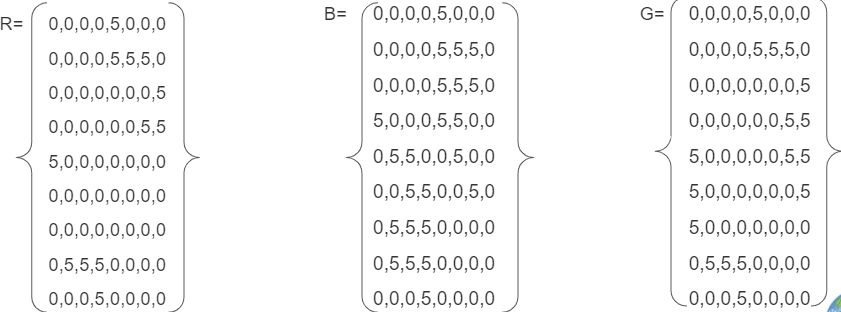
Combined Array Table:
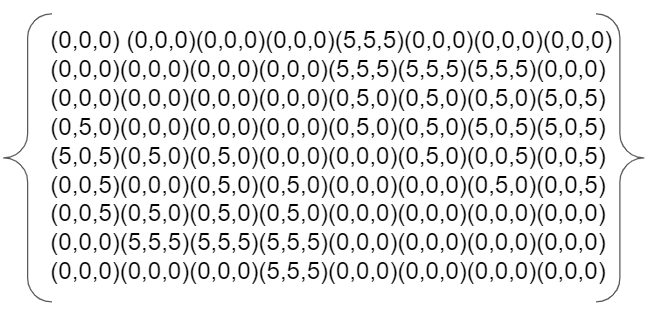
Pixel Grid:
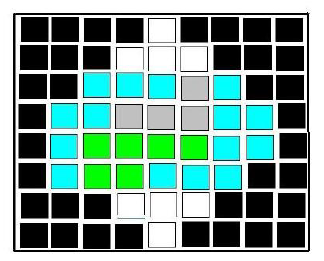
Where is the ice represented in the image? In the center of top and bottom. This could be representative of poles on a planet.
- Creating Images from Numbers
-
Link to Creating Images from Numbers
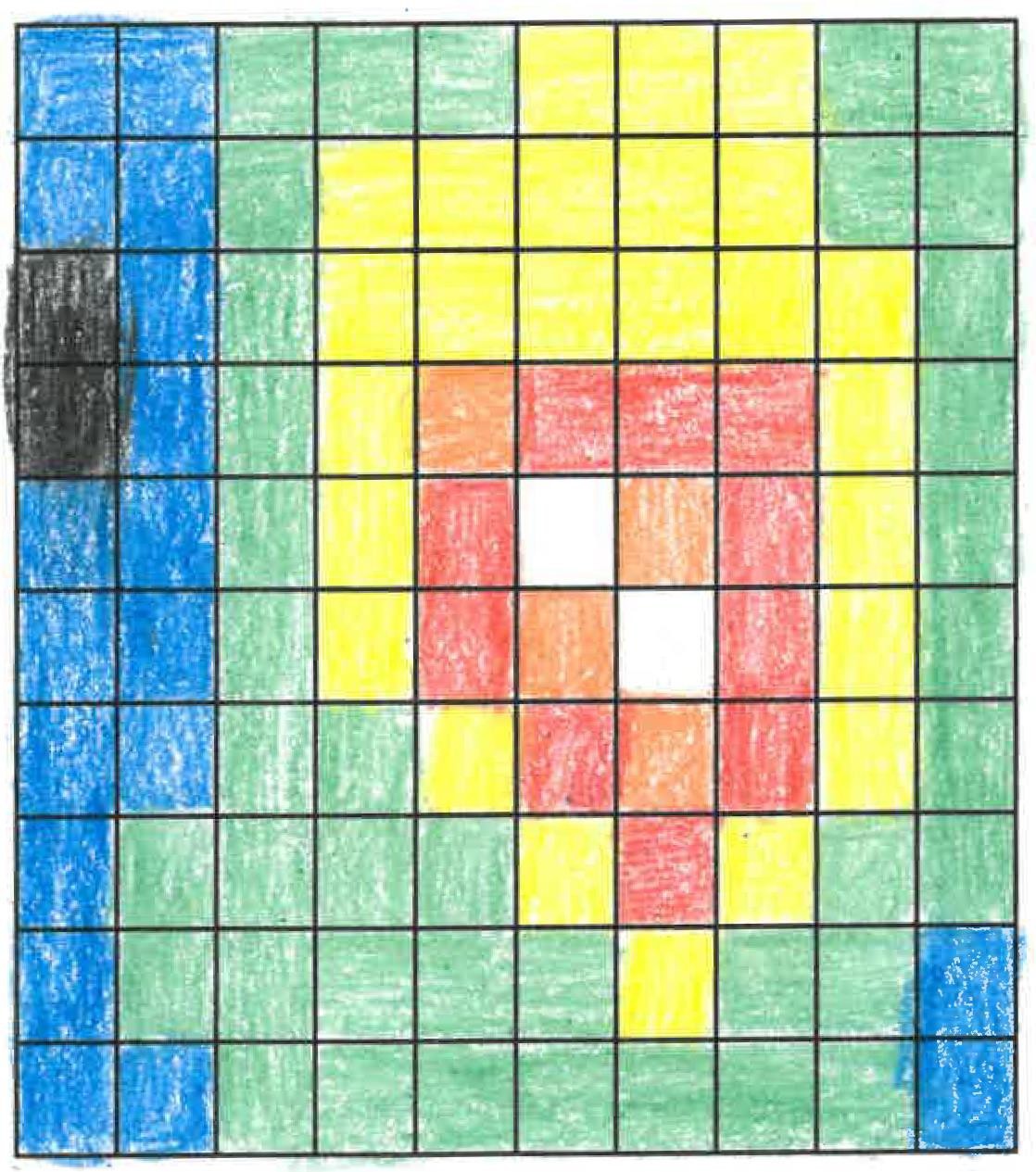
Creating Images from Numbers sample answer using assigned colors. The answers will vary if students select other colors.
https://mynasadata.larc.nasa.gov/sites/default/files/inline-images/creating%20images%20from%20numbers.jpg- Answer the following questions if the data are wind speed in km per hour.
- What color is the fastest? white Slowest? black
- Where is the wind between 21-25 km per hour? red squares or the color chosen
- Answer the following questions if the numbers are elevation in meters above sea level.
- What color is the lowest? black Highest? white
- Where is the elevation between 31 and 35 meters above sea level? white squares
- Do you notice any pattern in the image? Accept reasonable responses. The highest values are in the center. Numbers decrease the farther they are from the center. Learners are likely not to think the red color would be the highest, which is not the case.
- How does the size of the grids in the grid paper affect the image that you created? Accept reasonable responses. Smaller grids can have different values which can provide more detail. Larger grids will provide less detail.
- Which do you think would be more realistic, larger grid sizes or smaller? Why? Accept reasonable responses. Smaller grids will provide more detail, which can be more realistic.
- Answer the following questions if the data are wind speed in km per hour.
- Creation of Urban Heat Islands StoryMap
- Coronagraph Flipbook
-
- How is a coronagraph like a total solar eclipse? The Sun is blocked by the instrument so the corona is visible.
- Allow time for learners to share their answers.
- Criteria Pollutants
- Data Jigsaw: Exploring Sea Level Rise with Others
-
Link to Data Jigsaw: Exploring Sea Level Rise with Others
- Students work in groups of four. Each member within the group will become an expert on one of the resources below. (All resources are found in the Google Slide provided.) Students spend five minutes observing and analyzing the data with the expectation that they need to be able to explain the data's pattern and trends to their groups.
- After time to analyze data has passed, students fill out their square on the chart (on the PDF or Google Slide). Students with the same resource come together to discuss what they learned. Students address the following questions in the space for each resource.
- Summarize your resource clearly.
- What do you still need clarification on from within your resource?
- What was the significance of the information you learned
- Now the original group of four from Step 1 return together. Each member has two minutes to summarize what their resource group has discussed. Students need to fill in the other three parts as group members shares. They can use the questions above as a guide for what they should share out.
- After each member had a chance to share their summary, together the groups need to answer:
- What do the data tell you?
- What was similar within resources?
- What was different?
For all questions, accept reasonable responses.
After analyzing the various data visualizations, students should claim that the average global sea level has increased over the last 20 years and will likely connect the effects of land ice melt to this phenomenon. Students should also observe that sea level change does not happen evenly over the globe; some sea levels in the global ocean are increasing while others decreasing, and still other regions are staying relatively the same over time. They should cite evidence from the data table that land ice in Greenland and Antarctica has melted since 2002. Students will likely deduce that this land ice melt is contributing to global sea level change.
- Describing Radiation in Earth’s Energy Budget
-
Link to Describing Radiation in Earth’s Energy Budget
Steps:
- Check with your instructor on how to submit your answers.
- Identify the three distinct classifications of radiation (forms of electromagnetic energy) shown in the infographic. Ultraviolet, Visible and Infrared Radiation.
- Identify the measured value for each type of radiation. What units are used? Unit of length (nanometer, nm or micrometer, µm) used to measure the wavelength.
- Explain why it is important to not simply compare the numerical values when comparing the measurements of each classification. The unit scales for wavelength are different. 1 micrometer = 1,000 nanometers.
- Describe the range of radiation characterized as “shortwave radiation.”
- Longer ultraviolet (UV-A, UVB and only a the longest wavelengths of UV-C) range
- Entire visible range - the peak amounts are 500nm which is the Blue part of visible range
- Shortest infrared range 700nm - 5000nm
- Describe the range of radiation characterized as “longwave radiation.” Mid and upper infrared range 5000nm - 1 million nm (5um - 1000um).
- Discuss how the energy associated with shortwave radiation compares to the energy associated with longwave radiation. The shorter the wavelength the greater the energy associated with that electromagnetic radiation. Therefore, “shortwaves” transfer a greater amount of energy than do “longwaves”. This is described in using the mathematical equations c = 𝝺𝝼 that describes all electromagnetic traveles at the same speed (c = speed of light). Therefore the wavelength and frequency are inversersly related. E=h𝝼 is then applied to reveal that energy of a particle of light (E), called a photon, is proportional to its frequency (), by a constant factor (h).
- Identify the source of “shortwave radiation.” The Sun is the source of shortwave radiation.
- Identify the source of “longwave radiation.” The Earth’s geosphere and the Earth’s atmosphere is the source of longwave radiation. This longwave radiation was a result of shortwave radiation being absorbed and not reflected.
- Describe how the Earth’s energy budget model distinguishes between shortwave and longwave radiation. The model uses a yellow color and straight arrows to reveal the interactions of shortwave radiation.
- Look closely at the model and describe the different interactions clouds have with shortwave radiation and longwave radiation. The model uses a red color and curved arrows to reveal the interactions of longwave radiation.
-
Identify the heat illustrated in the model that is NOT characterized by either shortwave or longwave radiation.
The purple arrows are neither longwave, nor shortwave radiation.
Note: These purple arrows are used to describe sensible and latent heat. Sensible heat (the curved purple arrow) is described as the “thermals” which is both includes both conduction and convection. These types of heat create weather systems. Latent heat (The broken purple arrow) is the energy that accounts for phase change. In this case evapotranspiration in the driving phase change the feeds Earth’s weather systems.
- Does Albedo Affect Arctic Populations?
-
Link to Does Albedo Affect Arctic Populations?
Steps:
- Check with your instructor on how to submit your answers.
- Explain why the Arctic is more sensitive to warming then other regions on Earth. Albedo changes when snow and ice melt. This leads to increased energy absorption and more warming.
- Review the circle diagram. Explain what you think is the relationship between melting sea ice, lowered albedo, and increasing solar radiation. When sea ice melts, albedo is lowered. That leads to more energy being absorbed. That leads to more ice melting and lowering the albedo even more.
- Identify what role sea ice plays in polar bears' lives. Accept reasonable responses.
- Think of another animal that may be affected by changes in sea ice. How would this animal be affected? Accept reasonable responses.
- Explain how changes in sea ice extent could benefit some animals. Accept reasonable responses including that some animals such as the bowhead whale may gain habitat.
-
Can you think of another animal that may benefit from changes in sea ice extent? How would this animal benefit from the changes? Accept reasonable responses.
Exit Ticket
- Explain how albedo can be linked to changes in habitats for polar bears and bowhead whales. Accept reasonable responses. Example: The albedo changes have led to a loss of sea ice which has decreased the polar bear habitat area and increased bowhead whale habitat area.
- Earth System Energy Travels
-
Link to Earth System Energy Travels
- What can happen to the energy as it travels through the Earth system? It can be reflected or absorbed.
- Where does the largest percentage of energy go in the Earth system? It is absorbed by land and oceans.
- What kinds of ways is the energy used once it enters the Earth system (i.e., Hydrosphere, Atmosphere, Biosphere, etc.)? Accept reasonable responses. Energy that is absorbed can heat the surface and land (geosphere), atmosphere, and oceans (hydrosphere). Energy can also be used by plants for photosynthesis (biosphere).
- What is the role of the atmosphere (including clouds) as it relates to Earth’s energy? The energy can be both reflected and absorbed by the atmosphere and by clouds.
- Earth's Energy Budget StoryMap
-
Link to Earth's Energy Budget StoryMap
- Earth's Heating Imbalances
-
Link to Earth's Heating Imbalances
Steps:
- Check with your instructor on how to submit your answers.
- Analyze the graph.
- Describe the energy received at the Equator. At the equator (gray line), the peak energy changes very little throughout the year and it is where the energy is concentrated the most.
- How does it change over the year? The peak energy at the equator lowers slightly during the summer months of June and July, then raises during the fall and spring seasons.
- What do the blue lines (23.5 degrees N, 45 degrees N, 60 degrees N) represent? Latitudes in the northern Hemisphere.
- What do the green lines (23.5 degrees S, 45 degrees S, 60 degrees S) represent? Latitudes in the Southern Hemisphere
- Describe the relationship among the blue and green lines and the cause of these values/patterns. The northern latitudes that are furthest away from the equator have the highest peak energy during the summer months while the southern latitudes that are furthest away have the lowest, depicting the cooler periods the southern hemisphere experiences during that time of year. This pattern is reversed as the months go from fall to winter.
- El Niño & Spread of Human Disease
-
Link to El Nino & Spread of Human Disease
- Check with your instructor on how to submit your answers.
- Reflect on what you learned in the article and video.
- Analyze the 2 maps below of El Niño and Rainfall and Elevated disease risk. Answer the following questions.
- Identify the environmental changes that are associated with El Niño events. High temperatures and drought in some locations, as well as excess rain in other locations.
- Identify which diseases were elevated in Colorado and New Mexico. Plague and hantavirus. What do these states have in common? These diseases are both vector-born diseases, spread to humans by mosquitos, rodents, ticks, and other animals.
- Identify which disease were elevated in Tanzania? Cholera.
- Identify which disease were elevated in Brazil and Southeast Asia. Dengue fever. What do these countries have in common and what was the impact? In both locations, drought changed the habitat and behavior of mosquitos that carry dengue fever. This change resulted in more cases of dengue fever in humans
- How do the environmental changes caused by El Niño relate to the spreading of certain diseases (plague, hantavirus, cholera, and dengue fever)? Accept all reasonable responses. See examples:
- Plague and hantavirus in the southwestern U.S. are due to above-normal rainfall; the additional rainfall is associated with an increase in vegetation that rodents feed upon, leading to an increase in the rodent population. The rodents contribute to the spread of the diseases.
- Rainfall is associated with cholera in Tanzania. Outbreaks of cholera, E coli, and other diarrheal diseases can be caused by a lack of water supply and sanitation, as well as damaged infrastructure.
- Dengue in Brazil and SE Asia are associated with above-average surface temperatures and drought. Mosquito populations also increase in drought events because mosquitoes’ predators and competition are reduced, additionally, the high temperatures changed the metabolism of mosquitos and allowed them to reproduce more quickly. Also, during drought events, it is common to find water storage containers and rainwater collecting devices that provide additional habitat.
General Background: ENSO-associated events include extreme rainfall and high temperatures. These extremes are known to be drivers of a range of diseases, including vector-borne and water-borne diseases. Where there is limited access to clean water, sanitation, and food, there is a risk of communicable disease.
El Nino causes above-average rainfall events such as storms and cyclones that trigger floods. Floods and other large precipitation events create environmental changes that affect disease-bearing insects and their interaction with their animal hosts. Examples of diseases from these causes include malaria, dengue, hantavirus, chikungunya, West Nile virus, Rift Valley Fever, Zika, and more. Mosquitos are important vectors that transmit pathogens during times of increased rainfall. This is due to the availability of increased habitat made possible through the additional rainfall.
These diseases are also associated with other ENSO conditions such as low rainfall and higher temperatures. Mosquito populations may also increase in drought events. During these extreme conditions, mosquitoes’ predators and competition are reduced, allowing the mosquitos to populate. Additionally, during drought events, it is common to find water storage containers and rainwater collecting devices that provide additional habitat. Dengue in Brazil and SE Asia are associated with above-average surface temperatures and drought.
When water quality is impacted by contamination from drought, wildfires, flooding and/or storm events, water-borne diseases increase. This can be due to a lack of water supply and sanitation, as well as damaged infrastructure. Outbreaks of cholera, E coli, and other diarrheal diseases are examples. Plague and hantavirus in the SW U.S. are due to above-normal rainfall. Rainfall is also associated with cholera in Tanzania.
- Energy and Matter: Dust Transport
-
Link to Energy and Matter: Dust Transport
Steps:
- Check with your instructor on how to submit your answers.
- Where does the dust originate or come from? Explain what is important about the location of where the dust originates. The dust originates from the Sahara Desert in northern Africa. The Sahara is the world's largest desert, and it contains phosphorus, an essential nutrient that acts like a fertilizer.
- What location does the dust travel to? Explain what is important about this location. The dust travels 3000 miles to South America, over to the Amazon Basin. This location is important because the Amazon Rainforest is replenished by the phosphorus-rich dust from the Sahara, which is an important nutrient for plants to flourish. This essentially "feeds" the rainforest.
- How does the dust travel from one place to the other? The dust travels by wind.
- What NASA satellite collects the data? Cloud-Aerosol Lidar and Infrared Pathfinder Satellite Observation (CALIPSO).
- Explain how the biosphere and geosphere are connected in this example. Answers may vary. The geosphere includes rocks, sediments, and surface soils. The sediments from the Sahara which contain the phosphorous can be associated with the Geosphere. The Amazon Rainforest is part of the biosphere. Without the generation of sediments that have been formed through Earth's processes in the Sahara, the Amazon would not flourish, therefore this example of the biosphere is dependent on the geosphere for replenishment.
- Energy and Matter: Exploring Ocean Salinity
-
Link to Energy and Matter: Exploring Ocean Salinity Mini Lesson
- Review the NASA Video of sea surface salinity observations (September 2011-September 2014) from the Aquarius/SAC-D mission, a collaboration between NASA and the Space Agency of Argentina. The data is shown on a spinning globe.
- Answer the following questions. Check with your instructor on how to submit your answers.
- What is salinity? concentration of dissolved salt
- Why is salinity important in the water cycle and in ocean circulation? Salinity is key to studying the water cycle and ocean circulation, both of which are related to climate. Over decades, the amount of salt in ocean basins has been fairly stable. The water cycle operates on much faster time scales, however, causing changes in salinity patterns.
- In the video, what color represents high salinity values? Red Low? Blue
- Where do you see the greatest concentrations of low salinity values? Polar regions, equatorial region, some coast lines. High salinity values? The saltiest areas in the global ocean are the locations where evaporation is high or in large bodies of water where there is no outlet into the ocean.
- Based on what you know about the water cycle, what causes changes in the salinity values? Changes in sea surface salinity, provide a fingerprint of Earth's freshwater cycle. Salinity decreases when freshwater enters the ocean from rivers, melting ice, rain and snow. Processes that cause freshwater to exit the ocean such as evaporation and formation of sea ice raise salinity. Differences in dissolved salt content also play a major role in moving seawater, and the heat it carries, around the globe.
- Create a narration script that describes your observations over the course of this 30 second video. Answers will vary. Higher salinity areas are shown in red. These regions of high evaporation are sometimes called "ocean deserts." Blue colors represent lower salinities, resulting from freshwater inputs into the ocean. These include Amazon River outflow that appears as a ribbon-like feature in the tropical Atlantic, a zone of persistent rainfall that spans the tropical Pacific, and melting ice near Earth's poles.
- Energy and Matter: Longwave Radiation
-
Review the video and text below and answer the questions that follow.
- Watch the visualization and answer the questions. (Check with your instructor on how to submit your answers.)
- What time period does this video show longwave radiation on Earth? 01/26/2012 - 01/27/2012
- What colors represent areas where the most energy is being emitted out to space? brightest yellow
- What are the units of these measurements? Watts per square meter
- Where do you expect to find the warmest temperatures? where the atmosphere is transparent Coldest? where you find clouds, aerosols, or bright surfaces
- What drives Earth's climate engine? Sun
- What parts of the Earth system absorb the most energy? Oceans and land. What evidence do you have to support this claim? The oceans consistently show the highest values in the 300-380 range. Some parts of the Earth's geosphere also show these large values, too.
- Watch the visualization and answer the questions. (Check with your instructor on how to submit your answers.)
- Energy and Matter: Sea Surface Temperature
-
Review the NASA Video below. This visualization shows long-term average sea surface temperature observations shown on a spinning globe. The long-term average (or "climatology") of sea surface temperature used in this animation came from the World Ocean Atlas 2005.
Answer the following questions:
1. In the video, what color represents high temperature values? Red Low? Dark blue
2. Where do you see the greatest concentrations of low temperature values? High temperature values? The most obvious feature of this temperature map is the variation of the temperature by latitude, from the warm region along the equator to the cold regions near the poles. Another visible feature is the cooler regions just off the western coasts of North America, South America, and Africa. In these regions, the combination of Earth's rotation and alongshore winds push water away from the coast, allowing cooler water to rise from deeper in the ocean.
Analyze the line plot showing Sea Surface Temperature in January 2018 in the Atlantic Ocean (15.5 W, 0).
3. Describe what you see in the data visualization. Sea Surface Temperatures are variable along 25.5W in the Atlantic Ocean at different latitudes spanning from pole to pole. The 80-60 degrees S latitudes have waters that stay around 0 degrees Celsius, whereas the waters in the north latitudes are warmer during January 2018. Temperatures increase as waters get closer to the Equator and peak at 28 degrees Celsius around 5 degrees N.
4. How are the ideas and information presented connected to what you already knew? Answers will vary. The polar regions receive less solar radiation than the equator so the higher latitudes' sea surface temperatures will be cooler and the areas around the equator will be warmer.
5. Make a prediction about what you think these data will show in June and September. Answers will vary.
Analyze the line plot showing Sea Surface Temperature in June 2018 (Left) and September 2018 (Right) in the Atlantic Ocean (15.5 W, 0).
6. Describe the evidence that supports or refutes your predictions? Answers will vary.
- Energy and Matter: Shortwave Radiation
-
Link to Energy and Matter: Shortwave Radiation Mini Lesson
- What time period does this video show shortwave radiation on Earth? from January 26 and 27, 2012
- What colors represent areas where the most energy is being reflected back out to space? brighter, whiter regions show where more sunlight is reflected Least energy? blue
- What are the units of these measurements? Watts per square meter
- What drives Earth's climate engine? The Sun's radiant energy
- What part of the Earth system is always adjusting to maintain a balance between Earth's incoming and outgoing energy? Atmosphere
- What parts of this system reflect energy back to space? clouds, aerosols, bright surfaces
- Energy and Matter: Water Cycle & The Ocean's Temperature
-
Link to Energy and Matter: Water Cycle & The Ocean's Temperature
- Review the NASA Scientific Visualization Studio video, The Water Cycle: Heating the Ocean on Youtube.
- Answer the following questions. Check with your instructor on how to submit your answers.
- What is the water cycle? The water cycle is a never-ending global process of water circulation from clouds to land, to the ocean, and back to the clouds.
- What drives the movement of air and water in the Earth System? The Earth acts as a giant engine that uses solar power to move air in the atmosphere and water in the ocean.
- Where does this visualization begin in the water cycle? In this visualization series, the cycle begins when the top of the ocean absorbs sunlight.
- Describe what happens to the Sun's heat as you progress through the video. The Sun's heat is dispersed in the upper ocean by waves and currents.
- How does the Sun and the Hydrosphere's oceans interact in this video? Water has a high heat capacity and the ocean can absorb a lot of heat without much change in temperature.
- Describe what happens in the night to the ocean with respect to energy. The ocean cools off very little at night.
- Describe what happens to the land's temperature over the course of the day and night. Materials forming the land surface such as rocks and soil, however, have lower heat capacity. Thus land temperature changes rapidly, even from night to day.
- Energy Transfer in Earth's Atmosphere
-
Link to Energy Transfer in Earth's Atmosphere
Video Real World: Monitoring Earth's Energy Budget with CERES
- NASA uses CERES, a data collecting sensor on satellites, to measure what? Ceres measures the amount of energy that the Earth receives and also the amount of energy it returns back to space.
- How much of the Sun’s solar radiation is reflected back to space or absorbed by Earth’s atmosphere and clouds? 50%
- What absorbs the remaining radiation? The remaining radiation is absorbed by land and oceans.
- True or false: Darker surfaces tend to absorb more energy, whereas lighter surfaces tend to reflect more energy. True
Google Slides Energy Transfer in Earth's Atmosphere
- Explain in your own words what is meant by the term “heat transfer”. Heat transfer is a form of energy transfer and can occur by conduction, convection, and/or radiation. Heat transfer occurs any time there is a temperature difference between two objects and occurs in the direction of decreasing temperature, meaning from a hot object to a cold object.
- Describe how radiation, conduction, and convection work together to heat Earth’s atmosphere. Radiation occurs when the Sun heats up Earth’s surface. Conduction occurs when the Earth’s surface heats up the air. Convection occurs when warm air rises in Earth’s atmosphere.
- What is meant by a “balanced” Earth’s Energy Budget? Earth’s Energy Budget is considered to be “balanced” when the incoming energy plus the outgoing energy equal zero.
- Differentiate between shortwave and longwave radiation. Shortwave radiation is direct radiation from the Sun whereas longwave radiation is secondary radiation, being reflected from the Earth.
Extension
Diagram Earth’s Energy Budget
- Define the following terms found on Earth’s Energy Budget diagram:
- Absorb: To take in the Sun’s energy
- Reflect: To throw back without absorbing
- Identify the objects in Earth’s atmosphere that are absorbing and reflecting the Sun’s energy. The atmosphere and Earth’s surface are absorbing some of the Sun’s energy. The clouds, atmosphere, and surface are also reflecting some of the Sun’s energy.
- Latent heat in water vapor carries a percentage of what back into the atmosphere? Heat
- List the amount or radiation in Wm² that the following objects emit:
- Atmosphere: 169.9 Wm²
- Clouds: 29.9 Wm²
- Surface: 398.2 Wm²
- By looking at Earth’s Energy Budget and reviewing today’s class notes, explain how the energy budget can become imbalanced. An imbalance of Earth’s Energy Budget can occur when the amount of incoming energy is NOT equal to the amount of outgoing energy. If more energy is coming in than what is given off, the Earth will heat up. If more energy is going out than what is coming in, the Earth will cool down.
- Predict what will happen to Earth’s Energy Budget if the amount of greenhouse gas emissions continue to rise in the Earth’s atmosphere. Students should make the connection that an increase in the amount of greenhouse gases would most likely cause Earth’s Energy Budget to become imbalanced.
- Estimating Biomass Loss from a Large Fire
-
Link to Estimating Biomass from a Large Fire
- Use a paper copy of the image to complete this activity. Check with your instructor on how to submit answers.
- Using a metric ruler, and the conversion 1 mile = 1.61 kilometers, what is the scale of the image in meters per millimeter? The legend on the lower right indicates that 12 miles = 12 millimeters, so in kilometers, this becomes 19.4 km/12 mm = 1.6 km/mm.
- About what is the total area, in square kilometers, of this photo of Greece and its surroundings? The field on the right measures 78 mm x 98 mm= 125 km x 127 km = 19,700 km2.
- About what was the land area, in square kilometers, that was burned? (Burned areas show up in red in the image on the right.) To estimate the area of irregular regions, divide the image into a suitable number of smaller squares, for example, 5mm on a side (= 8 km on a side or an area of 64 km2) as shown in the figure below. The full area has 13 squares across and 19 squares vertically, for a total of 247 cells and a total area of 16,000 km2. Because the drawn cells are slightly irregular, we can recalculate their average area as 19,700 km2/247 cells = 80 km2. The land area is covered by 173 cells for a total area of 173 x 80 km2 = 13,800 km2. The red areas that were burned total about 30 cells or 2,400 km2. Student answers will vary depending on how they counted the cells. Students may combine their counts and average the to get a more accurate estimate.
- What percentage of the total area was lost to the fires? 100% x 2400km2/13,800km2 = 17%.
- Suppose that a typical forest in this region contains about 5.0 kilograms of biomass per square meter. How many metric tons of biomass were lost during the fires? 5.0 kg/m2 x (1,000,000 m2/km2) x 2,400 km2 = 12,000,000,000 kg or 12,000,000 metric tons.

Sample Grid
Source: NASA Earth Math Educator Guide
https://mynasadata.larc.nasa.gov/sites/default/files/inline-images/Estimating%20Biomass%20from%20a%20Large%20Fire.PNG - Evaluating Natural and Human Activities Effects on Earth's Climate
-
Link to Evaluating Natural and Human Activities Effects on Earth's Climate
- Review the chart above and answer the following questions. Check with your instructor on how to submit answers.
- What is the net total value of radiative forcing (in watts per square meter) of natural activities? Anthropogenic (human) activities? Natural approximately 0.05 - 0.1 watts per square meter. Anthropogenic approximately 2.5 watts per square meter
- Of the anthropogenic activities, which factor has the greatest value? What category does this belong to? Carbon dioxide belongs to long-lived greenhouse gases.
- Which of the factors have both a cooling and warming effect on climate? Halogenated gases, some short-lived gases that create ozone or destroy other green house gases, and aerosols.
- Why is the year 1750 selected as a baseline? It is prior to the industrial revolution.
- What are three questions that you can ask of this chart? Accept reasonable responses.
- Review the chart above and answer the following questions. Check with your instructor on how to submit answers.
- Evaluating Plants as Energy Stores
-
Steps:
In which month do you predict the most energy will be taken in by plants? Why? Accept all reasonable answers.
- Check with your instructor on how to submit your answers.
- In which month did the plants take in the most energy? July Least energy? December Explain how the variables of Energy Flow and Monthly Leaf Area Index impacted these data values. July had the largest amount of incoming solar energy (during the summer) with the largest leaf area, as compared to the other months. Conversely, December, had the lowest amount of solar energy (winter) and the least amount of leaf area.
- How might the type of plants surveyed affect the efficiency rate? For example, how would a deciduous forest compare to a coniferous forest at the same latitude? Conifers have less leaf area as compared with deciduous leafy trees, thus having a smaller LAI value. Deciduous forests sharing nearly the same latitude, longitude, climate and other conditions would be expected to be more efficient in harnessing energy from photosynthesis.
DATE Monthly Average Shortwave Energy Flow (Watts/m^2) Monthly Leaf Area Index Photosynthesis Efficiency =
0.046 (value estimated by scientists for a typical plant)Energy Taken in By Plants (W for every square meter of ground) Apr-2019 160.027 0.697028 0.046 1. 5.130991789 Jul-2019 276.433 2.49856 0.046 2. 31.77148408 Sep-2019 178.14 1.72661 0.046 3. 14.14860205 Dec-2019 53.6093 0.622693 0.046 4. 1.535578249 - Examining a Simplified Model of Clouds Effects on Earth's Energy Budget
-
Link to Examining a Simplified Model of Clouds Effects on Earth's Energy Budget
Steps:
- Check with your instructor on how to submit your answers.
- Examine the yellow arrows showing incoming shortwave radiation. What is the difference between the amount of incoming shortwave radiation transmitted through high-level clouds and low-level clouds? High-level clouds transmit more shortwave radiation to Earth’s surface than low-level clouds.
- Examine the red arrows showing outgoing longwave radiation. What is the difference between the amount of outgoing longwave radiation transmitted through high-level clouds and low-level clouds? High-level clouds allow less longwave radiation to escape to space.
- Compare the yellow arrow reflected by the high cloud to the red arrow leaving the base of the high cloud and pointing toward the surface. Overall, what effect do high-level clouds have on the atmosphere? Overall, high-level clouds reflect less shortwave radiation than redirect longwave radiation back toward the surface. High clouds have a warming effect. This is shown in the diagram as the yellow arrow directed toward space from the low cloud is smaller than the red arrow directed from the low cloud to the surface.
- Compare the yellow arrow reflected by the low cloud to the red arrow leaving the base of the low cloud and pointing toward the surface. Overall, what effect do low-level clouds have on the atmosphere? Overall, low-level clouds reflect more sunlight than redirect longwave radiation back toward the surface. Low clouds have a cooling effect. This is shown in the diagram as the yellow arrow directed toward space from the high cloud is smaller than the red arrow directed from the high cloud to the surface.
- As global temperatures rise, how do you think this will effect clouds? Accept reasonable responses. Rising temperatures may cause the cloud base to rise, causing a reduction in cloud layer thickness due to the drier air on the surface of the Earth. Higher-level clouds tend to warm the Earth.
- Explore Albedo
-
- Review the NASA Climate Bits: Albedo video and answer the following questions. (Check with your instructor on how to submit your answers.)
- What is albedo? The fraction of the incoming Sun's energy that is reflected.
- What do the colors represent in the weekly maps of reflected solar radiation for the past 10 years? Lighter colors show more reflection, or higher albedo, and darker colors show less reflection, or lower albedo.
- Why is albedo important for Earth's climate? Incoming solar energy must equal outgoing energy. The amount of energy absorbed and reflected can impact this balance.
- What pattern did you notice? More reflected energy where there are persistent clouds, dust, smoke and pollution and snow and ice. Also, albedo increases at the poles during their respective fall and winter seasons and decrease in their respected summer months. Missing data peaks at the poles in their respective summers. Deserts have a higher albedo than areas with a lot of vegetation.
- Why do you think there are missing data at the poles during their winter seasons? There is little to no sunlight arriving at the poles during tese times. Therefore, there is no sunlight to reflect.
- How can humans impact albedo? Contrail and ship trails can temporarily raise albedo. Land use change and burning can also change albedo.
- Review the NASA Climate Bits: Albedo video and answer the following questions. (Check with your instructor on how to submit your answers.)
- Explore Earth's Energy Budget Diagram
-
Link to Explore Earth's Energy Budget Diagram Interactive Model
- Explore Solar Eclipses
- Explore Solar Orbiter
- Exploring Cryosphere's Seasonal Thaw
-
Link to Exploring Cryosphere's Seasonal Thaw
Observing Changes in Land’s Surfaces
1. Check with your instructor on how to submit your answers.
2. Watch this animation and answer the questions below:
- Which latitudes in the Northern Hemisphere (i.e., Arctic, Northern Mid Latitudes, or Tropics) experience the most change in snow and ice extent over the course of a year? Northern Mid Latitudes
- During what months do you predict to have the largest amount of frozen soil conditions in the Northern Mid Latitudes? Nov-Jan Thawing soil conditions in the Northern Mid Latitudes? March - August
Describing the Arctic’s Land Surfaces
3. Analyze the maps below to orient yourself to the geographic region being analyzed in the blue and red maps that follow. Answer the following questions.
- What is the location that the map is focused on? We are looking at the Arctic in the northern hemisphere
- What variable is being analyzed? The state of H2O in the soil changing from solid to liquid during spring thawing, based on the temperature of the soil.
- Describe what the shades of red indicate about soil conditions mean? Water within the soil is in the thaw (liquid) state. White? The ratio of the frozen soil to thawed soil equals 0.5. Blue? Water within the soil is in the frozen (solid) state.
- What two dates are being compared? April 1st, 2015 and April 13, 2015
- The two maps are 12 days apart. What do you predict would happen in 12 more days? Why? There would be more thawing even closer to the North Pole. The hours of daylight increases as we move from winter to spring and the illumination of solar energy increases at the poles, the bright white snow and sea ice reflect a significant portion of the incoming light, reducing the potential for solar heating.
- When the surface changes from blue to red, what happens to the environment of that area? Rapid warming releases liquid water. As liquid water becomes more readily available, plant and animal activity are energized. The land greens up, and animals return to graze.
- Exploring Energy and Matter with Chlorophyll Data
-
Link to Exploring Energy and Matter with Chlorophyll Data Mini Lesson
The following video, NASA SeaWiFS Biosphere Data over the North Atlantic, shows satellite data as an animation, displaying 10 years of phytoplankton growth. This animation begins with Earth's rotation until it reaches the North Atlantic.
Review the video and then answer the following questions.
Steps:
- Check with your instructor on how to submit your answers.
- Describe how can you tell what season is showing in the video. Identify the indicators of seasonal change? By observing the land cover, changing vegetation becomes evident as seasons change. For example, land vegetation appears in the northern hemisphere during summer.
- Describe what the dark blue areas of the ocean represent? These are areas where phytoplankton are scarce, often due to the lack of nutrients.
- Describe what the greens and reds in the ocean indicate? They indicate an abundance of phytoplankton, which often correlates with nutrient-rich areas. These can include coastal regions where cold water rises from the seafloor and near the mouths of rivers.
- Compare the Chlorophyll Concentrations in the coastal areas to the open ocean in the Pacific. What do you observe? Coastal areas tend to have higher concentrations of chlorophyll than the open ocean.
- Compare the Chlorophyll Concentrations of the North Atlantic. What differences do you in the summertime versus the wintertime? Chlorophyll concentrations surge during the wintertime months and fall back during the summertime months.
- Exploring Historic Ocean Chlorophyll Concentrations for Different Regions with Graphs
-
- Review the Chlorophyll Concentration map below.
- Students analyze locations 1-6 to determine how the chlorophyll values for these locations have changed over the last 20 years. Do not spend time analyzing the mapped image here; only focus on the location of these sites.
- Select one location site to analyze to maximize time. Students may use the Graph Cube to help with data analysis.
- 1 Cube per group/student
- Consider using Virtual Dice in place of dice/cubes
- 1 matching Question Sheet per group/student
4. Students work together to:
- Identify changes, trends, or differences of the chlorophyll concentrations on their graph and draw an arrow to each observation with a "What I See" comment.
- Next, students interpret their observations by drafting a "What It Means" comment for each.
- Next they write a caption under the graph to help remind them of their interpretation of the graph as a whole.
- If you have copies of the graphs for the students, direct them to draw arrows and draft comments on and around the graph in order to create connections to the graph they are analyzing.
5. Present the graphs individually or collectively as the graph below shows. Individual graphs are available in the Document Resources.
6. Share your findings and I2 .
7. Answer the following questions:
- What similarities do you observe among the different locations? What differences? [Some of the highest average chlorophyll concentrations are located near continental coasts of the Pacific and Atlantic Oceans. Students should also observe that phytoplankton are generally more abundant in colder waters and less abundant in warmer waters. ]
- What inferences can you make about the causes of these differences? [Primary production by phytoplankton can be affected indirectly by climatic factors, such as changes in water temperatures and surface winds, which affect mixing within the water column and the availability of nutrients. Changes in cloud cover, which can reduce or increase solar energy available for photosynthesis, can also affect primary production. ]
- Why are these data important? [Changes in phytoplankton populations may impact fish and other marine life, which can affect economic productivity and food availability. Decision makers can use this indicator to understand the health and productivity of marine ecosystems that depend on phytoplankton.]
- Exploring Patterns of of Human Geography and COVID-19
-
Link to Exploring Patterns of Human Geography and COVID-19 Interactive Model
Link to Exploring Patterns of Human Geography and COVID-19 Interactive Model Teacher Key
- Exploring Sea Ice Changes over Time
-
Link to Exploring Sea Ice Changes over Time
Steps:
- Check with your instructor on how to submit your answers.
- Describe the long-term trend that is depicted by the analysis of the polar sea ice covers for the past 40 years. The trend show a decreasing in sea ice over 40 years.
- Describe what ICE-SAT2 measures? Sea ice thickness.
- Explain why this measurement is important? It will help scientists understand the changes in the Arctic. Seasonal ice is thinner, more saline and weaker while older ice is fresher, stronger and more resilient.
- How does sea ice thickness relate to the annual Arctic sea ice minimum extent? If the minimum extent is decreasing, it means that not only seasonal ice is melting. Older sea ice is also melting. If the overall thickness of the ice is decreasing, it suggests the minimum extent is also likely decreasing.
- Exploring Seasonal Chlorophyll Concentrations
-
Link to Exploring Seasonal Chlorophyll Concentrations
Observe the monthly seasonal chlorophyll concentration images in our global oceans for the four different months of 2017. Answer the following questions.
- Check with your instructor on how to submit your answers.
- The chlorophyll maps (Plots A-D) are in chronological order, starting with the time periods: February 2017, June 2017, October 2017, and December 2017. Identify the seasonal cycles for chlorophyll concentrations throughout the year by answering the following questions:
- What changes do you see through the year? What explanations can you suggest for these patterns? Spring brings increased sunlight and warming temperatures, which traps nutrients at the ocean surface. This allows phytoplankton to absorb energy and take in the nutrients they need to photosynthesize and multiply. The warming of the surface layer keeps this water less dense, so it stays afloat. Phytoplankton respond very quickly when the right conditions occur, growing and reproducing as soon as a slight stratification of the water column occurs.
- Choose a location or region. During which months do the extreme highs and lows occur? What explanations can you suggest for the timing of those extremes? Answers will vary depending upon location selected. These regions vary due to upwelling, runoff, or shortwave radiation.
- Which regions experience both the extreme highs and lows? Which regions don’t experience the extremes? Why do you think this happens? Answers will vary.
- What differences, if any, do you find between the year’s variations over the coastal versus the year’s variations over the open oceans? Answers will vary. The coastal regions may experience seasonal rains which bring nutrients from the watershed.
- Are there regions that remained relatively unchanged over the year? Why do you think this happens?
- Waters where there are few nutrients keep phytoplankton from growing all year. Conversely, areas that have continuous nutrients such as estuaries, may provide the right environments for phytoplankton to thrive.
- Nitrogen and phosphorous are the most critical nutrients to phytoplankton blooms because they require large amounts of them to stay alive and reproduce. Most of these nutrients exist in deep ocean waters and are brought closer to the surface where phytoplankton live in areas of ocean upwelling. This is where ocean currents drive deep waters to the ocean surface.
- Exploring the Tradeoffs of Surface Temperature Models
-
Link to Exploring the Tradeoffs of Surface Temperature Models
Link to Exploring the Tradeoffs of Surface Temperature Models Teacher Key
- Extreme July 2022 Temperatures
-
Link to Extreme July 2022 Temperatures
Steps:
- Check with your instructor on how to submit your answers.
- Describe the daily maximum air temperature in the continental United States during the month of July in 2022. During July 2022, most of the United States daily air temperatures above 30oC with some locations in the mid-west and south displaying temperatures higher than 40oC.
- Identify evidence provided in the animation that supports the claim that the July 2022 air temperatures in the United States were extreme and out of normal expected temperature ranges. Temperature ranges in the United States show values similar to Saharan Desert in northern Africa. (Note the temperature scale has an upper limit of >40oC therefore it is unknown how much higher the air temperatures were modeled to be.)
- Describe one impact excessive heat has on your local community. Answers vary. Example answers may include impact on human life, opening cooling centers, limits time outdoors, increase electric costs for air conditioning, etc.
- Describe one action you should take during times of excessive heat other than to simply moving indoors into climate-controlled conditions. Answers vary. Example answers may be found at https://www.heat.gov/pages/planning-and-preparing
- Describe how the daily maximum air temperatures on the West Coast of the continental United States differs from the air temperatures immediately offshore over the Pacific Ocean. Air temperatures on the continental West Coast were generally over 30oC while immediately offshore, the air temperatures were dramatically different ranging between 10oC and 20oC.
- Use your knowledge of heat transfer to explain why the air temperatures over land are different than the air temperatures over nearby large bodies of waters. Heat is transferred to the air both by directly absorbing shortwave solar radiation as well as absorbing longwave radiation that is emitted from Earth’s surface. The dramatic difference in temperature is a result of a large difference in surface temperatures. Since ocean waters in that region are much cooler as a result of the California current, the air immediately above the ocean surface is cooler since the ocean serves as an energy sink in that region.
- Identify a localized area/region in the continental United States where the air temperatures remained relatively cooler in July. Answers vary. Example response may include that a cooler region of air was experienced over the Rocky Mountain range in Colorado.
- Global Air Temperatures Graph
-
Link to Global Air Temperatures Graph Mini Lesson
- Answer the Questions below. Check with your instructor on how to submit your answers.
- What time frame does the graph cover? 1880 - 2020.
- What do the white dots represent? The white dots represent the variability of annual mean temperatures over time.
- What does the black line represent? The black line represents a trendline or Lowess smoothing over time.
- What is an anomaly? An anomaly is a departure from average conditions.
- What do the changes in the anomaly data mean? As time increases, the variability of temperature also increases. This is depicting a warming trend with the past eight years being the warmest.
- Do you notice a trend? If so, what direction does the trend go? Yes, the trend increases from around 1940 - 2020.
(Additional Information) This graph illustrates the change in global surface temperature relative to 1951-1980 average temperatures. Nineteen of the hottest years have occurred since 2000, with the exception of 1998, which was helped by a very strong El Niño. The year 2020 tied with 2016 for the hottest year on record since record-keeping began in 1880 (source: NASA/GISS). This research is broadly consistent with similar constructions prepared by the Climatic Research Unit and the National Oceanic and Atmospheric Administration.
- Global Phytoplankton Distribution
-
Link to Global Phytoplankton Distribution Interactive Model
Link to Global Phytoplankton Distribution Interactive Model Teacher Key
- Global Phytoplankton Distribution StoryMap
-
Link to Global Phytoplankton Distribution StoryMap
Link to Global Phytoplankton Distribution StoryMap Teacher Key
- Greenhouse Gases: Importance & Human Impact
- How are Phytoplankton and Sea Surface Temperatures Related?
-
How are Phytoplankton and Sea Surface Temperatures Related?
Steps:
- Check with your instructor on how to submit your answers.
- Analyze the Chlorophyll Concentrations color bar provided with the map.
- Describe what you think the color bar legend represents. When phytoplankton populations are large, the color of the water appears greener because of high concentrations of chlorophyll.
- Describe where do you observe the highest concentrations? Lowest? Highest concentrations are located at he higher latitudes and coastal waters Lowest? Lowest concentrations are located at the lower latitudes.
- What factors do you think control where phytoplankton are distributed? Access to sunlight and nutrients
- Now, analyze the Sea Surface Temperature mapped image, paying specific attention to the color bar provided and answer the following questions.
- Where do you observe the highest concentrations? Lowest? The highest concentrations are located at the higher latitudes and coastal waters, while the lowest concentrations are located at the lower latitudes.
- Review following video visualizing Chlorophyll & Sea Surface Temperature from 2002 to 2019. Answer the following questions:
- Where are the highest concentrations of chlorophyll generally located? Do the trends that you observed in the Northern Atlantic also occur in the Southern Hemisphere? Cold, polar waters in both hemispheres (and places where ocean currents bring cold water to the surface, such as around the equator and along the continents) experience high levels of chlorophyll.
- How do the values of chlorophyll change over the seasons? In the hemisphere experiencing summer, we can see the biggest differences between the equatorial regions and polar regions.
- Why do you think that the polar regions experience these changes during the spring/summer seasons? Day length increases so phytoplankton flourish with more sunlight.
- How Do We Receive Energy From the Sun?
-
Link to How Do We Receive Energy From the Sun? Interactive Model
- How does a Solar Eclipse Affect Air Temperature?
-
Link to How does a Solar Eclipse Affect Air Temperature?
Analyze:
- Examine: (no questions in this section)
- Watch: (no questions in this section)
- Analyze:
- Approximately how many degrees does air temperature drop during the eclipse? Hint: look at the legend for the temperatures for the colors.
- In the penumbra? Approximately 2-4 degrees in many locations. Not all locations are the same, and with careful examination, you may find some locations with temperature increases.
- In the umbra? Approximately 1-3 degrees in many locations. Not all locations are the same, and with careful examination, you may find some locations with temperature increases.
- Do locations experiencing the total solar eclipse have greater temperature variations than locations experiencing the partial solar eclipse? Most locations in the umbra have a greater temperature variation.
- Aside from the Moon’s shadow, what other variables would affect the air temperature during this four-hour period? Other factors can include time of day, elevation, topography, and weather.
- Approximately how many degrees does air temperature drop during the eclipse? Hint: look at the legend for the temperatures for the colors.
- Make a prediction:
- How do you think plants and animals would behave during a total solar eclipse? Accept reasonable responses including that they may behave like it is night.
- How does the Cryosphere Change over the Seasons?
-
Link to How does the Cryosphere Change over the Seasons?
Steps:
- Check with your instructor on how to submit your answers.
- Describe the phenomenon you observe. This video shows snow and sea ice in the Northern and Southern Hemispheres pulse at exact times of the year from 2011 - 2012.
- Identify the patterns you see in this model. This model shows the extent in change at the poles. The northern hemisphere shows a growth of snow and sea ice during the months of November 2011 thru March 2012. The southern hemisphere shows the opposite, showing growth during the winter Months of April 2012 thru August 2012.
- What are the limits of this model? This model is depicting the pulse in growth and recession of snow and sea ice at the end of 2011 and all of 2012. It does not show other years to fully compare overall changes that may be occurring at the poles.
- What evidence of Earth System interaction (among Atmosphere, Hydrosphere, Biosphere, Cryosphere, Geosphere) do you see? The water cycle is an important aspect of snow and sea ice. This involves the interaction of all of the spheres. The hydrosphere and atmosphere interact with evaporation and condensation. The volume of water in the hydrosphere increases with the melting of ice in the cryosphere. The geosphere and biosphere are affected by changes in season, changing Earth surface conditions, vegetation, and water supply.
- How is My Air?
-
Accept reasonable responses. - How the 2020 Creek Fire Impacted Air Quality
-
Link to How the 2020 Creek Fire Impacted Air Quality
ENGAGE
Questions 1 and 2 sample expected responses.
- It is red and smoky
- Areas on the border of the fire can have pretty clear air.
- Some of the smoke can be white and look like clouds.
- Wind seems to blow the smoke.
- In different areas, the sky can appear red, gray and black.
Explore
Frayer Model Sample Answer Key (Please note that there are many possible answers to the Frayer Model prompts. The answer key offers possible student responses.)
Explain
Narrative to inform possible CER answers.
Between 9/4/2020-9/20/2020, as the area covered in smoke increases, AOD levels are also high in the same regions near Fresno, CA. On 9/4/2020 when the Creek Fire ignites, a relatively small area of opaque smoke is seen south of Fresno, CA. On the corresponding AOD map for 9/4/2020, the same region is red indicating 1.0 AOD levels. On the edges of the smoky area where the smoke is transparent, the corresponding AOD levels range from 0.6-1.0. As the fire burns more acreage, regions where smoke is transparent, have 1.0 AOD levels on September 6th, 8th, 14th, and 20th. As the fire burns for a longer period of time with less than fifty-percent containment, aerosols remain in the atmosphere causing the highest AOD levels to persist. Across all of the True Color maps, the geographic areas covered in smoke match up precisely with the regions with high AOD shown on GeoColor/ AOD maps from the same date.
- How to Safely Observe a Solar Eclipse
-
How to Observe a Solar Eclipse Lesson Plan Link
How to Observe a Solar Eclipse Lesson Plan Teacher Key
Math Extension Answer:
H / (1.5 * 1011 m) = (0.009 m)/1m
H ={(1.5 * 1011 m)(0.009m)}/1m
H=1.35*109m or 1.35 billion meters
- How will different locations in the US experience the 2024 solar eclipse?
-
Link to How will different locations in the US experience the 2024 solar eclipse
- Examine the map of the United States that shows how each location will experience the April 8, 2024 solar eclipse.
- Examine the data table that accompanies the data from the map. For example, if you live in Dallas, TX:
- The partial eclipse begins at 12:23 pm Central Daylight Time (CDT). The Moon’s shadow will start to cover the Sun.
- The Sun will become more and more obscured until totality begins at 1:40 pm CDT.
- As you experience totality, the sky gets darker and darker until 1:42 pm CDT, at the maximum totality, which is the moment that you would experience the most darkness.
- Totality ends at 1:44 pm CDT, when the Moon’s shadow moves away from you.
- You would then experience a partial solar eclipse until the partial ends at 3:02 pm CDT.
- Safety Reminder! Only viewers in the path of totality will be able to remove their solar eclipse glasses, and only during totality, which only lasts for about 4 minutes in most locations. The rest of the time observers will have to wear their solar eclipse glasses to view the partial eclipse.
- Answer the following questions on the Google Form.
- What location Which location(s) on the path of totality will experience the longest duration of totality? Cleveland, OH (5 minutes)
- What location Which location(s) on the path of totality will experience the shortest duration of totality? Little Rock, AR; Paducah, KY; Burlington, VT; Caribou, ME will only experience 1 minute of totality.
- Where is your location? What will you see at that location on April 8, 2024? For how long will you be able to see it? Answers will vary. Remind students that they can approximate their location and that the yellow crescents on the border of the map tell them the percentage of the Sun that will be blocked by the Moon at that location.
- Make a prediction: how does NASA predict the duration of totality in different locations for future solar eclipses? Answers will vary. Remind students that predictions are based on background knowledge. A common guess is that NASA uses past eclipse data to predict future eclipse data.
- Watch the video on Tracing the 2017 Solar Eclipse to learn more about how NASA uses data from past eclipses to predict the locations and times of future solar eclipses.
- Answer the following questions about the video.
- What features of this visualization are driven by data? All features are driven by data: the color of the ground, the path of totality, the lighting from the Sun, the Sun angle, etc.
- Data on Moon topography was collected from the NASA Lunar Reconnaissance Orbiter (LRO)
- NASA Shuttle Radar Topography Mission (SRTM) Data for Earth topography
- NASA Jet Propulsion Laboratory Orbits & Ephemerides data for a tabulation of the Sun, Earth, and Moon positions
- How does Moon topography (mountains and valleys) affect the duration of totality? Moon topography affects the shape of the edge of the shadow. This could mean that some observers may get a longer or shorter duration of totality depending on if they are located on the edge of the shadow.
- What other variables affect the way an observer views a total solar eclipse from different locations on Earth?
- Elevation of the observer (Earth topography)
- Local weather (clouds may block the view)
- What features of this visualization are driven by data? All features are driven by data: the color of the ground, the path of totality, the lighting from the Sun, the Sun angle, etc.
- Human Health & Air Quality
-
Link to Human Health & Air Quality
Explore:
Observe and Interpret
Identify students with descriptive observations and accurate interpretations.
Question 3 - Expected Student Responses:
- I see the red line that represents the Americas is the lowest. This means that the rate of deaths attributed to PM 2.5 remained around 25% from 2000 to 2019.
- I see that the lines for the Eastern Mediterranean, Africa, and the Americas remained below the global urban average. This means that the rate of deaths attributed to PM 2.5 was below the average in cities across the globe from 2000 to 2019.
- Human Impact and the Creation of Urban Heat Islands
-
Link to Human Impact and the Creation of Urban Heat Islands Interactive Model
Link to Human Impact and the Creation of Urban Heat Islands Interactive Model Teacher Key
- Hurricanes as Heat Engines StoryMap
- Hurricane Harvey's Effect on Soil Moisture
-
Link to Hurricane Harvey's Effect on Soil Moisture Mini Lesson
- Answer the questions below. Check with your instructor on how to submit your answers.
- Explain what the size of the dot represents. The rate of change in the amount of moisture in the soil
- Describe what the color represents. The volume of water in the soil (units: cm cubed) per volume of soil (units: cm cubed)
- Identify the area that was the most impacted by Hurricane Harvey. How do you know? North West of Houston because it has the largest and darkest hexagons.
- Compare the urban area of Houston and the soil moisture changes resulting from Hurricane Harvey. How does this urban area compare to areas to the east and west? The surface of a city is mainly impermeable so the water isn’t able to soak into the soil but rather runs off into its watershed
- Brainstorm the factors that may have contributed to this difference. Answers will vary.
- Answer the questions below. Check with your instructor on how to submit your answers.
- Hurricane Sandy to Scale
- Identifying Changes in Land Use
-
Link to Identifying Changes in Land Use
- Check with your instructor on how to submit your answers.
- Clear Cut:
- Identify the trend in the Pacific Northwest before the clear cut. The trend was stable at around 825 on the vegetation index before around 1999.
- When did the clear cut in the Pacific Northwest occur? Before 1999
- Explain the impact of the forest after the clear cut. The soil gets covered with grasses and then continues to recovering vegetation.
- Bark Beetle
- Identify the trend in the forest before the Bark Beetle epidemic. The trend was stable at around 250 on the vegetation index.
- When was the Bark Beetle epidemic? It began around 2004.
- Explain the impact of the forest after the Bark Beetle epidemic. The events after the epidemic include a large decrease in the forest's needles and the satellite's instruments collected a much different lower of NDVI as compared to before the beetle infestation.
- Western Spruce Budworm
- Identify the trend in the forest before the Western Spruce Budworm infestation. Stable forest, around 700 NDVI
- When was the Western Spruce Budworm infestation? Around 2000
- Explain the impact of the forest after the Western Spruce Budworm infestation. Changed the type of vegetation to a shrub instead of a forest.
- How might these problems influence human activity? Answers may vary.
- Explain the differences between what the visualization shows and what the graph shows. The graphs and visualizations use the same data. The graphs can show how a particular area changes over time. These are useful for making quick assessments. Visualizations show large volumes of data and help provide scientists tools. They help to reveal trends and patterns over a large area. Both are useful for analyzing, interpreting, and communicating a scientific story.
- Identifying Patterns in PM 2.5
- Impact of a Volcanic Eruption
-
Link to Impact of a Volcanic Eruption
- In early 2022, there was a series of volcanic eruptions that resulted in changes to the island of Hunga Tonga-Hunga Ha'apai. The images show the land formation before and after the eruptions. Examine the images from 2021 and 2022 and answer the questions below. Check with your instructor on how to submit answers.
- What sort of changes do you notice in the island? A large portion of the island is gone. It appears to have gone back to close to the landform in 2015 before the eruption that joined the two small islands. There are now two small islands again.
- Do you think the timescale involved in this change is faster or slower than many other areas on Earth? Faster
- Can volcanic eruptions cause more than one type of change to land formations? Yes. First eruptions joined the two small islands with new land. Then, eruptions removed the new land.
- What evidence is there that volcanic eruptions can impact land formations? The images show the land formation before eruptions in 2015 and after. This shows the formation of new land. Then, in 2022, eruptions removed land reducing the land form and causing major changes. The images show the changes.
- In early 2022, there was a series of volcanic eruptions that resulted in changes to the island of Hunga Tonga-Hunga Ha'apai. The images show the land formation before and after the eruptions. Examine the images from 2021 and 2022 and answer the questions below. Check with your instructor on how to submit answers.
- Ins and Outs of Shortwave Radiation
-
Link to Ins and Outs of Shortwave Radiation
Question Set #1: Relating Shortwave Energy Flow Data to a Phenomena. A student standing at the North Pole would observe the phenomena of complete darkness during the winter months. Measured average temperatures of -40oC have been recorded when there is 0 W/m2 recorded.
- Use the model to explain the absence of incoming solar radiation during the winter months. As a result of the tilt of the Earth, incoming shortwave radiation varies by latitide to reflect the seasonal change of angle of incidence. During winter solstice months, in the Arctic latitude, the sun’s energy do not directly encounter the Earth’s surface.
- Use the model to explain what attributes of the Earth system results in relatively warm surface temperatures in the absence of direct incoming solar radiation. (Nighttime temperatures on the moon’s equator average -140oC). The Earth system has an atmosphere that is able to hold onto the energy (greenhouse gases). These gase prevent the radiation from escaping outside the Earth system and into space.
Questions Set #2: Monthly Shortwave Energy Flow Into Earth’s Surface
- Identify the months with the greatest amount of energy flow into the Earth’s surface in the northern hemisphere? (southern hemisphere?) Northern hemisphere has the greatest amount of flow into the Earth’s surface between May and June. Southern hemisphere is between December and January.
- Describe and explain the pattern of general monthly trends in the data for the amount of incoming radiation at different latitudes. As a result of the tilt of the Earth, incoming shortwave radiation varies by latitide to reflect the seasonal change of angle of incidence. In the northern hemisphere energy flow increases after spring solstice in March until June. July shows an abatement of incoming energy flow as the angle of incidence decreases during these months. The opposite monthly trends are observed in the southern hemisphere.
- Analyze the data and identify a specific region using latitude and longitude that does not follow the general monthly trends you identified above. Answers vary. Example: A line of decreased solar energy along equator.
- Use the model to explain why locations may not follow general monthly changes in energy flow out from the Earth’s surface that follow latitudinal lines. Some of the incoming solar energy is intercepted and reflected back by cloud cover.
- If you needed additional evidence other than radiation data to support your argument, explain what type of data you would request. Cloud coverage data or precipitation data.
Questions Set #3: Monthly Shortwave Energy Flow Out From Earth’s Surface
- Identify the months with the greatest amount of energy flowing out from the Earth’s surface in the northern hemisphere? (southern hemisphere?) Northern hemisphere has the greatest amount of flow out from the Earth’s surface during June. Southern hemisphere is during December. These are the winter and summer solstice months.
- Describe and explain the pattern observed between the monthly trends of energy flow out from the Earth’s surface and the monthly trends of changes in the amount of incoming radiation at different latitudes. The patterns for outgoing shortwave energy generally follow the trends of incoming solar radiation as explained above.
- Analyze the data and identify a specific region using latitude and longitude that does not follow the general monthly trends you identified above. Answers vary: Example, students may identify location in Greenland or northern Africa.
- Use the model to explain why locations may not follow general monthly changes in energy flow out from the Earth’s surface that follow latitudinal lines. These regions have conditions that allow for an increase amount of reflected solar energy because of the color of the land surface (ice and deserts) - albedo
- If you needed additional evidence other than radiation data to support your argument, explain what type of data you would request. Answers vary: Land surface data such as albedo.
Questions Set #4: Evaluating Earth’s Energy Budget Mode. The Earth’s Energy Budget model is used to communicate information about the complex movement of energy in the Earth system. As all models, it has strengths and limitations. After investigating some CERES data, let’s evaluate the model’s ability to communicate interactions of shortwave radiation within the Earth system.
- Identify one strength of the model that allows you to effectively communicate the evidence gathered by the CERES data. The models show incoming (solar) shortwave radiation and outgoing shortwave radiation using yellow arrows. When solar radiation is absorbed by either atmosphere/clouds or the earth’s surface the arrow fades to show this. When the energy is reflected off of either atmosphere/clouds or the earth’s surface and sharp angle is present. The relative amount of energy is shown by the width of the arrows.
- Identify one limitation of the model that is revealed by the evidence presented by the CERES data. Answers vary. Address students concerns about using the model. Example response: The model doesn’t show differences that occur geographically and instead uses averaged global data.
- Interactive Weather Observations
-
Link to Interactive Weather Observations
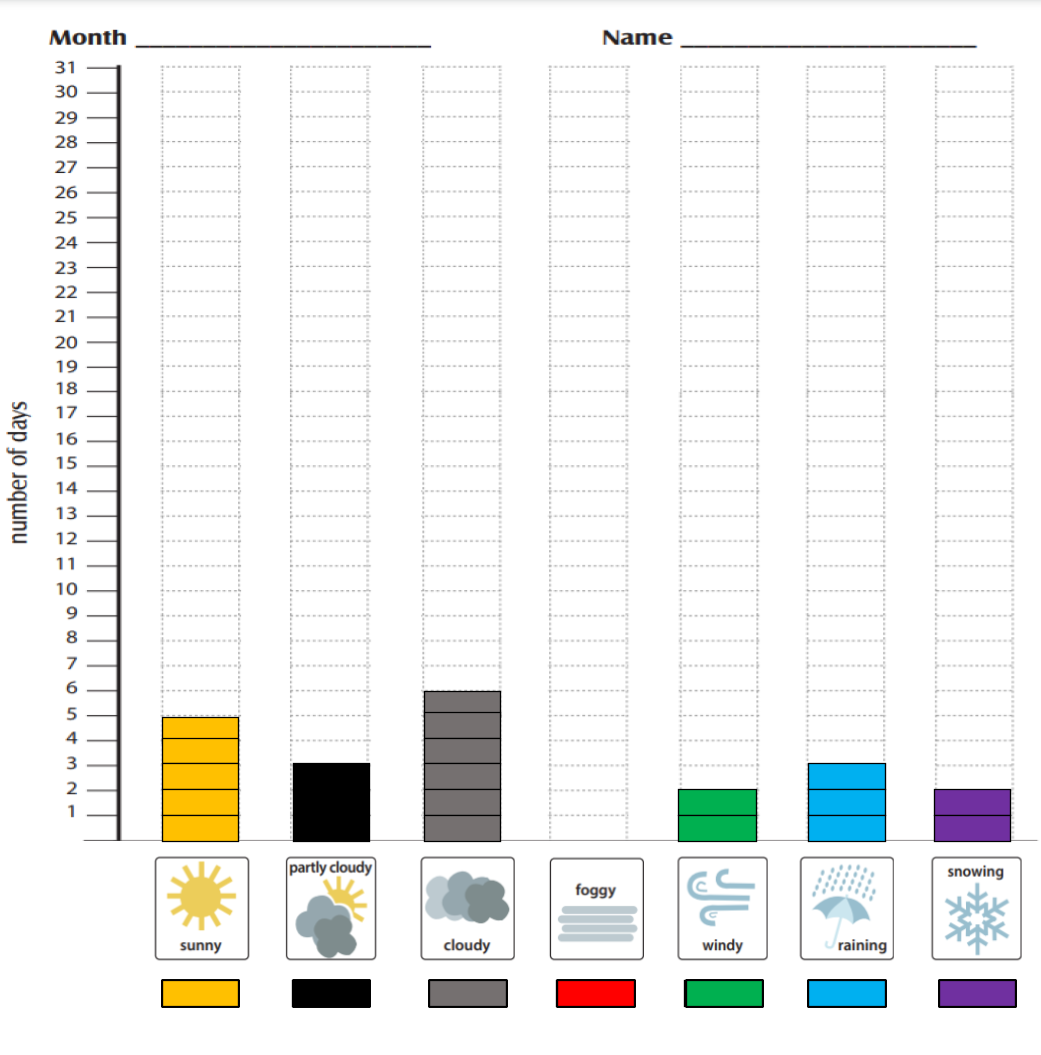
This is a sample of how the bar chart would be filled out. Your chart will look different depending upon the number of days you make observations and the weather you observe.
https://mynasadata.larc.nasa.gov/sites/default/files/inline-images/Weather%20Observation%20Bar%20Chart%20image.png - Interpreting a Graph of Surface Temperature of Urban Areas
-
Link to Interpreting a Graph of Surface Temperature of Urban Areas Mini Lesson
Review the Urban Heat Island Profile graph below showing surface temperatures taken from different types of communities.
- Answer the questions. Check with your instructor on how to submit answers.
- What is the highest temperature in Celsius on the graph? 38 degrees Celsius
- What is the highest temperature in Fahrenheit on the graph? 100 degrees Fahrenheit
- Identify which community (rural, suburban, urban) has the highest surface temperatures and explain why. Urban environments will have the highest surface temperatures because cities are full of these rocky surfaces — asphalt, brick, and concrete — that absorb heat by day and release it at night. These materials are used to make the sidewalks, parking lots, roads, and basketball courts of urban areas.
- Identify which community (rural, suburban, urban) has the lowest surface temperatures and explain why. Rural environments will have the lowest surface temperatures because they have more vegetation. Plants take up water from the ground through their roots. Then, they store the water in their stems and leaves. The water eventually travels to small holes on the underside of leaves. There, the liquid water turns into water vapor and is released into the air. This process is called transpiration. By releasing water, plants cool themselves and the surrounding environment. Like how sweat cools the human body, energy is absorbed and transported away from a warm object by the evaporation of water.
- What kind of community do you live in? Describe the surface temperature of your neighborhood by comparing it with other parts of your community. Answers will vary.
- Answer the questions. Check with your instructor on how to submit answers.
- Introduction to Volcanic Ash
-
Link to Introduction to Volcanic Ash Mini Lesson
- Watch the videos and answer the questions. Check with your instructor on how to submit answers.
- Watch the NASA's Earth Minute: All About Aerosols video.
- Identify different sources of aerosols. Some sources of aerosols are dust, salt, volcanic ash, fire, smoke stacks, and engine emissions.
- What are the effects of aerosols? Aerosols can cool or heat the air, damage the ozone through chemical reactions, and cause health issues.
- How does NASA study aerosols? NASA studies aerosols using equipment on satellites, aircraft, and ground-based devices.
- Watch the NASA video: Fire, Ice, and Safer Skies: NASA Satellites Track Volcanic Clouds which describes hazards of volcanic emissions.
- How does volcanic ash demonstrate an interaction between the geosphere and the atmosphere?
- Why are volcanic emissions a problem? Volcanic emissions are a big problem for aviation, which can cause economic downturn. The volcanic ash can be hard to distinguish from clouds when flying, making it an even bigger challenge. The ash can damage or destroy the exterior and interior of aircraft, including the engine, posing a real danger.
- What is NASA tracking to try to help predict emissions? NASA is tracking SO2 columns via satellite to determine the location of atmospheric sulfur dioxide, characteristic of volcanic emissions.
- Investigating Sea Ice Extent in the Arctic and Antarctic
-
Link to Investigating Sea Ice Extent in the Arctic and Antarctic
Accept reasonable responses and use the framework in the following document to evaluate responses.
Teacher 5E Guide- Analyzing Sea Ice Extent in the Arctic and Antarctic
- An Island Transforms through Erosion and Deposition
-
Link to An Island Transforms through Erosion and Deposition Mini Lesson
- Watch the The Birth of a New Island video about the formation of the island Hunga Tonga-Hunga Ha'apai and why NASA is interested in studying the island. Check with your instructor on how to submit answers.
- After the video, answer the following questions.
- How did the island form? (From a volcanic eruption.)
- Why is NASA interested in studying this island? (It can help NASA learn about how features seen on other planets formed.)
- What sort of changes did you notice in the island? (Answers will vary.)
- How did the geosphere and hydrosphere interact in the changes of the island? (The geosphere had a newly formed land feature that experienced erosion and deposition. The water in the hydrosphere eroded portions of the island, transported and deposited the sediments.)
- Do you think about the timescale involved in these videos is faster or slower than many other areas on Earth? (Much faster than many areas on Earth.)
- Kuril Islands Volcanoes
-
- Examine the images to complete a graphic organizer and answer questions. Check with your instructor on how to submit answers.
- Examine the image snapped from the International Space Station of the Sarychev Volcano in the Kuril Islands which are northeast of Japan. It is a photo of an early stage of eruption on June 12, 2009.
- Describe the impact you think the eruption could have on the Earth spheres: Atmosphere, Biosphere, Cryosphere, Geosphere, and Hydrosphere. Use the graphic organizer provided. NOTE: You will be filling it in for another image as well. Plan to use a different color or font to tell them apart. Answers will vary but may include:
- Atmosphere - clouds are forming among the smoke and ash over the volcano; there is also an area around the central cloud that doesn't have any clouds
- Biosphere - plant and animal life are affected by the eruption
- Cryosphere - any ice located at the top of the mountain melted and evaporated.
- Geosphere - sediment, rock, and ash have been dispersed in the atmosphere and the land surrounding the volcano
- Hydrosphere - sediment, rock, and ash also enter into the watershed where this volcano is located. This combination is a volcanic hazard.
- Now, examine the image (also taken from the International Space Station) of the Raikoke Volcano, also in the Kuril Islands. This eruption occurred on June 22, 2019.
- Describe the impact you think the eruption could have on the Earth spheres: Atmosphere, Biosphere, Cryosphere, Geosphere, and Hydrosphere. Use the same graphic organizer provided. Record your observations for the new volcano in a different font or a different color. Answers will vary and may include the following:
- Atmosphere - the volcanic plume interacts with storm clouds. There are different kinds of clouds formed along the plume and they have different colors.
- Biosphere - plant and animal life are affected by the eruption
- Cryosphere - any ice located at the top of the mountain melted and evaporated.
- Geosphere - sediment, rock, and ash have been dispersed in the atmosphere and the land surrounding the volcano
- Hydrosphere - sediment, rock, and ash also enter into the watershed where this volcano is located. This combination is a volcanic hazard.
- Compare the two images and use your graphic organizer to answer the following questions.
- Compare the two images. What are the similarities and differences in the images?
- Similarities: Sarychev Volcano & Raikoke Volcano: Plumes both reach the atmosphere and impact cloud formation
- Differences:
- Sarychev Volcano - the plume does not seem to spread to other regions.
- Raikoke Volcano ash plume seems to have risen higher in the atmosphere and the ash is mixing with the clouds and spreading out.
- The volcanoes happened approximately 30 km apart. What does this tell you about the area? Answers will vary. Example, this is a very tectonically active region.
- Make a claim about the volcanoes in the area. Use the evidence from the images and give your reasoning. Answers will vary. Example, volcanoes in this region erupt material high into the atmosphere which may be observed in regions beyond the North Pacific Ocean.
- Compare the two images. What are the similarities and differences in the images?
- Land Cover Changes
-
- Check with your instructor on how to submit your answers.
- What is different about the two images (Slide 2)? There are noticeable changes along the road.
- What do you think could have happened here between 2017 and 2020 (Slide 3)? A new building facility has been built in the green area.
- What information can satellite images provide us with (Slide 4)? Answers may vary but could include: information such as changing vegetation or the expansion of urban buildings.
- What information do we need to observe from the ground because it is not shown in satellite images (Slide 4)? Answer may vary but can include: information on the change urban construction could have on ground soils or to specify what is causing the change.
- How could this operations and maintenance facility impact the environment (Slide 7 & 8)? When vegetation is removed, it is more likely that soils can be loosened during a storm water runoff and cause landslides.
- How much do you think the construction of the operations and maintenance facility will impact the environment (Slide 9)? Answer may vary but can include: The impact is very high if construction takes place in areas where flooding is more frequent due to impervious surfaces like sidewalks and buildings. More water is collected than would otherwise run off to nearby streams or be absorbed in the soils and vegetation.
- Provide evidence from the previous slides to support your claims (Slide 9). Images such as sidewalks, do not allow runoff to be absorbed in the soils.
- Make a claim about what should be considered when making decisions about urbanizing a land cover (Slide 11)? (i.e. cutting down a forest or building over a grassland). Answers may vary.
- Learning From Stars and Solar Eclipses StoryMap
-
Link to Learning From Stars and Solar Eclipses StoryMap
Link to Learning From Stars and Solar Eclipses StoryMap Teacher Key
- Magnetospheric Multiscale (MMS) Spacecraft Model
-
Link to Magnetospheric Multiscale (MMS) Spacecraft Model
Have learners consider the following questions:
- Why is Mars’ atmosphere so thin? Mars' atmosphere is so thin because the solar wind stripped away most of its atmosphere (there is no significant magnetosphere to deflect the solar wind).
- What does it mean that Earth’s magnetosphere is permeable? Earth's magnetosphere is permeable because sometimes the magnetic rifts occur in the magnetosphere and allows energy to reach Earth.
- How would you describe magnetic reconnection? Magnetic field lines converge and reconfigure creating energy. (criss-crossing of magnetic field lines)
Have learners consider:
- Why are there four spacecraft and what shape is their formation in?
- The Spin-plane Double Probe (SDP) instrument and the Axel Double Probe (ADP) instrument work together to measure the 3D electric field, and the Magnetometer instruments measure the magnetic field. Magnetic fields and electric fields are perpendicular to one another. The fields affect one another.
- Mini Urban Heat Island
-
Link to A Mini Urban Heat Island
Steps:
- Using the infrared thermometer, measure the temperature of each material during the day when it is in direct sunlight. Record the temperature for each object in the first row of the data table. Values will vary depending upon student measurements.
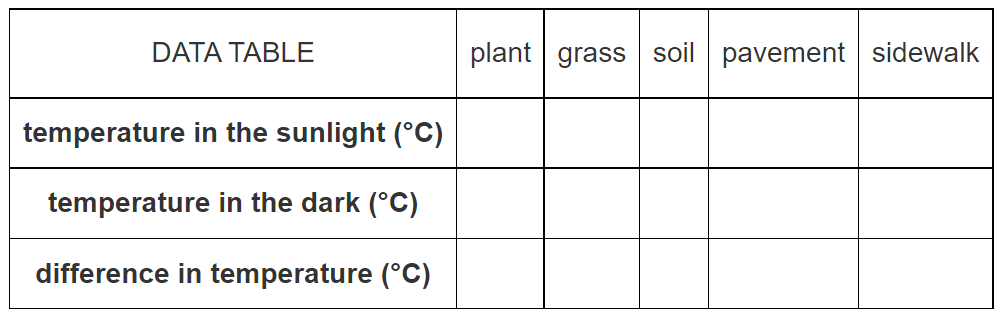
- Wait for the Sun to set.
- Measure the temperature of each surface an hour after sunset. Record the temperature for each object in the second row of the data table.
- Subtract the temperature of each material after dark from the temperature observed during daylight. Record this temperature difference in the bottom row of the data table. Values will vary depending upon student measurements.
- Answer the following questions.
- Which three materials retained the most heat (changed the least)? Answers will vary and should agree with recorded data.
- Which two materials radiated the most heat (were warmest) at night? Answers will vary and should agree with recorded data.
- Which two materials absorbed heat the most readily (warmest daytime temperatures)? Answers will vary and should agree with recorded data.
- Using the infrared thermometer, measure the temperature of each material during the day when it is in direct sunlight. Record the temperature for each object in the first row of the data table. Values will vary depending upon student measurements.
- Modeling Cloud Cover
-
Link to Modeling Cloud Cover
A slide deck with answers in the speaker notes is available.
- Modeling Magnetic Fields
-
Students are asked to share throughout. Accept reasonable responses.
- Modeling Solar Eclipse Geometry
-
Link to Modeling Solar Eclipse Geometry
Link to Teacher Key for Modeling Solar Eclipse Geometry
- Modeling Sun-Moon Positions for Solar Eclipses
-
Link to Modeling Sun-Moon Positions for Solar Eclipses
Link to Teacher Key for Modeling Sun-Moon Positions for Solar Eclipses
- Modeling the Heliosphere
-
Link to Modeling the Heliosphere
Examine:
The Heliosphere Graphic image was created from a 3D model of the heliosphere using actual data collected by the IBEX mission. Colors are meant to enhance features and show structure. The solar wind is represented by the greenish, wavy lines coming out from the Sun. The heliopause is the outermost boundary of the heliosphere. Beyond the heliopause is interstellar space. The termination shock is the innermost boundary of the heliosphere, where the solar wind begins to interact with interstellar space. The termination shock is still inside the heliosphere. The heliosphere creates a bow wave because the Sun is moving through interstellar space, as it orbits the center of the Milky Way galaxy. Just like how a bow wave is created as a boat moves through the water.
- What do you notice about the boundary? Accept reasonable responses.
- What shape is it? Accept reasonable responses.
Share Results
Record your results. Include drawings and diagrams and note any modifications you made in order to perfect the model, perhaps adjusting the water pressure or the position of the image, for example.
Answer the following questions:
- How does this model help us learn about the properties (characteristics) of the solar wind and the heliosphere boundary? The model really helped me understand that the boundary of the heliosphere is not a defined, static line, but a fluid boundary that changes with the output of the solar wind. Just like the puddle of water on the handout changed its shape depending on the outflow of water from the faucet.
- Why would a soap bubble not be an appropriate model for the heliosphere? It is not a perfect sphere.
- Monitoring Community Air Quality
-
Link to Monitoring Community Air Quality Interactive Model
Link to Monitoring Community Air Quality Interactive Model Teacher Key
- Mosquito Habitats
-
a. Which month do you think the Culex pipiens emerged in Memphis, TN in 2020? Answer: March
b. Which month do you think the Culex pipiens emerged in Moline, IL in 2020? Answer: May
c. What might explain the differences? Answer: Moline is at a higher latitude and has lower average temperatures.
d. What do you think will happen if the temperatures increase by two degrees in each location? Answer: The mosquitos will likely emerge days sooner, and the season can last days longer. In both locations, the starting month may not change, but the ending month will likely be one month later.
e. How could the temperature increase impact human health? Since Culex pipiens can transmit disease, this could impact human health due to more possible disease transmission days.
Extensions:
1. Visit the Climate Central site to see the change in mosquito days from the 1980s to the 2010s for Memphis, TN (minus 11 days) and Moline, IL (plus three days). Find the city closest to you and see if it has changed.
2. Use this image of mosquito emergence from 1981 - 2010 to compare the typical emergence time with the graphs. Note that the Memphis (latitude 35 N, longitude 90 W) climograph temperatures suggest a likely emergence in March of 2020. The emergence map show Memphis in late March. Likewise, the Moline (latitude 40 N, longitude 90 W) climograph temperatures suggest a likely emergence between April and May. The emergence map predicts late April.
3. Alternatively, students can use the Earth System Data Explorer to pull data for their location and create a climograph.
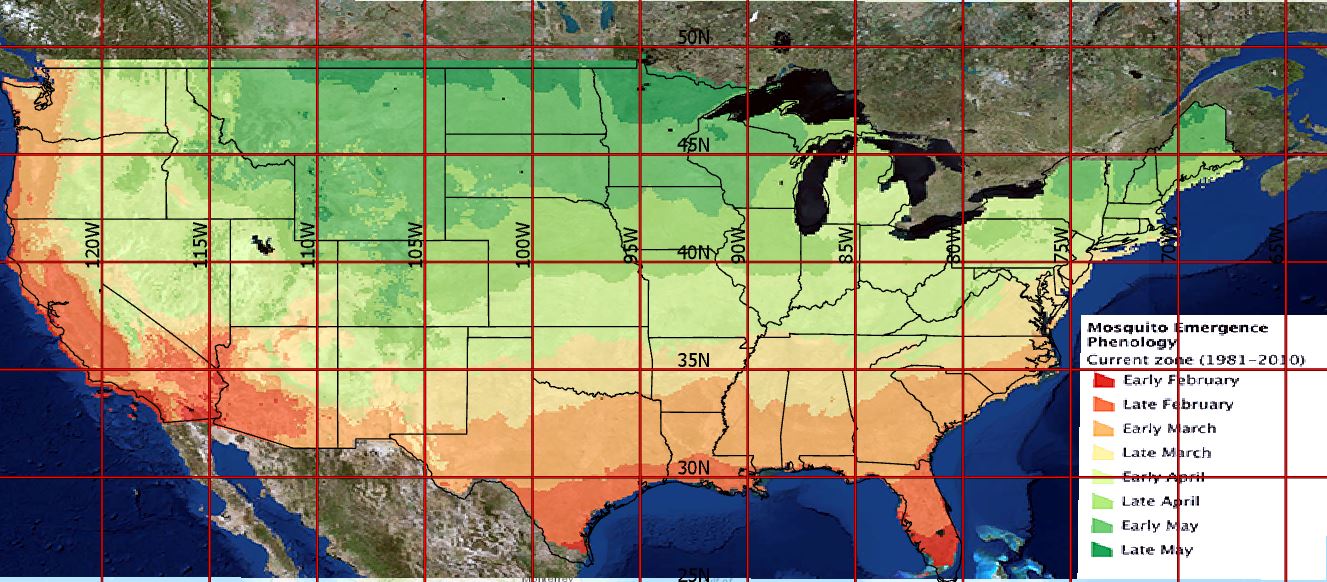
Map of projected first appearance of mosquitoes, based on monthly minimum temperature data. Map data from Anthony Arguez, lmke Durre, Scott Applequist, Mike Squires, Russell Vose, Xungang Yin, and Rocky Bilotta (2010). NOAA’s U.S. Climate Normals (1981-2010). NOAA National Centers for Environmental Information. Courtesy Andrew Clark, IGES. Latitude and longitude grid added by Desiray Wilson, NASA Langley Research Center. - Multiyear Time Plots for Air Quality Data
-
Link to Multiyear Time Plots for Air Quality Data
Steps:
- Check with your instructor on how to submit your answers.
- Study the tile plot for Oregon and identify:
- The month and year with hazardous air quality. September 2020
- Months that regularly have good air quality. March-June or April-June
- Months that have more potential for poor air quality. October-February (may want to include July or August)
- Make a claim based on the data from Umatilla Country, Oregon.
- What is your evidence?
- What makes this good evidence?
- Fill in the Claims-Evidence-Reasoning table.
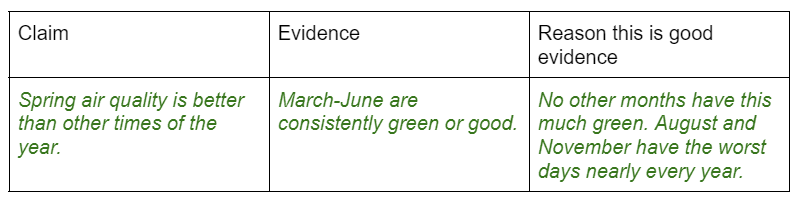
- Study the tile plot for Buffalo and make a claim based on the data from Buffalo, New York.
- What is your evidence?
- What makes this good evidence?
- Fill in the Claims-Evidence-Reasoning table.
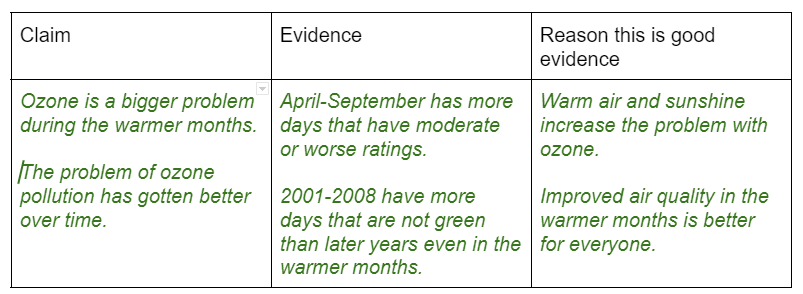
- NASA's Earth Minute: Greenland Ice
-
Link to NASA's Earth Minute: Greenland Ice
- Check with your instructor on how to submit your answers.
- Explain why coal miners brought canaries into coal mines. To warn of trouble.
- Explain how the Greenland ice sheet is like a canary in a coal mine. It can alert us to what is in store for the rest of the planet from warming.
- What is the only place on Earth with more land ice than Greenland? Antarctica.
- If ALL the ice from the Greenland ice sheet melted, what would happen to sea level? It rises 23 feet
- How long might it take for ALL the ice from the Greenland ice sheet to melt? It could several hundred years.
- How much water is the melting Greenland ice adding to the ocean each year? 250 gigatons.
- What is a gigaton? 1 billion tons
- Describe what other environmental changes could be a result of the melting ice. Changing circulation patterns in the oceans and atmosphere.
- Nitrogen Cycle Game
-
Link to the The Nitrogen Cycle Game- Interactive Model
Link to The Nitrogen Cycle Game- Teacher Key
- Nonattainment Areas: Zoom In Inquiry
- Observing Annual Vegetation Changes
-
- Review the changes in vegetation over the course of 2017. The six images show change in vegetation across the world as time progresses throughout the year.
- What do the colors represent? Dark green areas show where there was a lot of green leaf growth; light greens show where there was some green leaf growth, and tan areas show little or no growth. Black means "no data."
- What changes do you see through the year? What explanations can you suggest for these patterns? There is a greening that appears to follow the spring/summer seasons in each hemisphere. What explanations can you suggest for these patterns? Axial tilt explains why the Northern Hemisphere experiences spring/summer during March- August; Southern Hemisphere - September - February.
- Choose a location or region. During which months do the extreme highs and lows occur? What explanations can you suggest for the timing of those extremes? Answers will vary.
- Which regions experience both the extreme highs and lows? Polar regions experience extremes. Which regions don’t experience the extremes? Why do you think this happens? The higher latitudes have more extreme highs and lows due to the tilt of the Earth's axis affecting the amount of incoming solar radiation received on Earth.
- Are there regions that remained relatively unchanged over the year? Why do you think this happens? The low latitudes do not have such extremes due to lack of fluctuation of solar radiation.
- Observing Change in Air Temperatures
-
Link to Observing Change in Air Temperatures Mini Lesson
- Answer the questions below. Check with your instructor on how to submit your answers.
- Review the video "Global Surface Air Temperature Anomalies from 1880 to 2017".
- Write a commentary of the events as they happen in the NASA video on global temperatures. A commentary is a descriptive, spoken account about an event or situation. As if you were a NASA broadcaster, you will explain what is happening in this video.
Background:
Earth’s global surface temperatures in 2017 were the second warmest since modern record keeping began in 1880, according to an analysis by NASA. Despite year-to-year changes, average temperatures around the globe remain on a steady, long-term upward trend. In fact, 17 of the 18 warmest years on record have occurred since 2001.Continuing the planet’s long-term warming trend, globally averaged temperatures in 2017 were 1.62 degrees Fahrenheit (0.90 degrees Celsius) warmer than the 1951 to 1980 mean, according to scientists at NASA’s Goddard Institute for Space Studies (GISS) in New York. That is second only to global temperatures in 2016. Last year was the third consecutive year in which temperatures were more than 1.8 degrees Fahrenheit (1 degree Celsius) above late nineteenth-century levels. NASA’s temperature analyses incorporate surface temperature measurements from 6,300 weather stations, ship- and buoy-based observations of sea surface temperatures, and temperature measurements from Antarctic research stations. These raw measurements are analyzed using an algorithm that considers the varied spacing of temperature stations around the globe and urban heating effects that could skew the conclusions. These calculations produce the global average temperature deviations from the baseline period of 1951 to 1980.
See this video for background information.
- Observing Earth's Cryosphere
-
Link to Observing Earth's Cryosphere
Steps:
- Check with your instructor on how to submit your answers.
- Review the various images of the Earth's Cryosphere.
- Identify at least three different forms of ice that are shown in the video. Any of these three: Alpine glaciers, tidewater glaciers, ice sheets, sea ice, snow.
- Describe how ice can moderate temperatures on Earth? Ice's white surface reflects sunlight back into space, while ocean water and land absorbs the sun's energy.
- What NASA satellite missions are studying ice? GRACE, Terra's MODIS, and ASTER.
- Describe what is happening to the annual sea ice minimum? The Annual Sea Ice minimum is shrinking in the Arctic Ocean.
- Why does NASA study ice from space? Studying ice from space helps scientists understand the global effects of climate change.
- Observing the Sun During a Total Solar Eclipse
-
Link to Observing the Sun During a Total Solar Eclipse Interactive
Observing the Sun During a Total Solar Eclipse Teacher Key Slides
- Ocean Circulation Patterns: Garbage Patches StoryMap
-
Ocean Circulation Patterns: Garbage Patches StoryMap
Link to Ocean Circulation Patterns: Garbage Patches StoryMap Teacher Key
- Ocean Salinity Data Analysis
-
1. Open this link to show the interactive map of surface salinity used to create in-water profiles of how the salinity changes with depth (NOTE: Profiles of temperature and density may also be created using this tool).
- How do we know that map shows only surface conditions? [The title reads Mean Salinity (psu) at 0m Depth.]
2. Observe the color bar. What colors represent the high salinity values? The high salinity values are in red (37 psu). The lowest value is 32 psu in blue.
3. Locate the blue, green, and red dots in the image above showing key locations for maps and in-water salinity profiles. What colors are represented by the coordinates below?
- 5N, 24W? (Blue)
- 18S, 20W (Green)
- 62S, 34W (Red)
4. Click the "Plot" button, located below the "Selected Location List" box. In-water profiles from these locations will appear at right.
5. Review the features of the graph with the students.
6. How does salinity vary with depth? Describe by using evidence for the three sites.
Possible answers could include:- The blue profile - from the equatorial Atlantic Ocean (5N 24W) - shows relatively low salinity at the surface, an increase in the top 50 meters , and then a decrease below 50 meters.
- The green profile is located in in the central South Atlantic Ocean (18S, 20W), a region with very high surface salinity. It shows an unusual gradient with depth: salinity decreases from 37 Practical Salinity Units (psu) to 35 psu in the upper 300 meters (984 feet).
- The red profile is from the Southern Ocean (62S, 34W), a region with low surface salinity. It's the only profile that shows a steady increase of salinity in the top 300 meters and constant salinity values below that. Of these selections, the red profile shows the least variability in salinity in the upper 300 meters. For the other locations, much of the salinity change occurs within the top 200 meters (656 feet), a salinity minimum is reached at about 1000 meters depth (3281 feet), while salinity is fairly constant below 1500 meters (4921 feet) depth.
- You can select other locations (i.e., by clicking on the map and hitting "Plot") to see how salinity varies with depth at various locations.
- Ocean Surface Salinity Data Analysis
-
Ocean Surface Salinity Data Analysis Mini Lesson
- Explore the sea surface salinity mapped plot for April 2019.
- Answer the following questions. Check with your instructor on how to submit your answers.
- Is salinity uniform throughout the ocean? No. Although the amount of salt in the ocean is relatively constant on time scales of years to decades, sea surface salinity (SSS) varies because freshwater input & output - part of the global hydrologic or water cycle - varies from place-to-place. The large scale pattern of evaporation and precipitation is established by earth's atmospheric convection cells. In the simplest case - for example, if earth were covered by oceans and not spinning - the atmosphere would move heat between the hot tropics and cold poles in a very simple way. Hot air would rise along the equator, creating a band of low atmospheric pressure. Cold air would sink at the poles, creating regions of high atmospheric pressure.The presence of continents and earth's rotation complicates the idealized "two cell" system. A fairly realistic model of earth's atmospheric circulation consists of six cells: three on each side of the equator. This pattern has atmospheric pressure highs at the poles, 30°N and 30°S. It also has atmospheric lows along the equator, 60°N and 60°S. Away from the poles, cloudiness and precipitation (P) dominate bands of low pressure: these latitudes host the world's rainforests. Dryness and evaporation (E) dominate bands of high pressure: these latitudes are home to deserts.In terms of SSS [sea surface salinity], lower salinity generally occurs where precipitation is greater than evaporation (P>E). Higher SSS generally occurs where evaporation is greater than precipitation (E>P). Compare the "six cell" model with the map of global average SSS (image upper right). How well do SSS patterns mirror bands of high and low atmospheric pressure? In places where they do not match, what other types of freshwater inputs & outputs might be occurring?
- What is the range of ocean surface salinity in Earth's ocean? Ocean surface salinity generally ranges from 32 practical salinity units (psu, which are roughly equivalent to parts per thousand) to 37 psu, but may be as high as 42 psu in the Red Sea or as low as 8 psu in the Baltic Sea.
- Which latitudes have saltiest waters in in the Atlantic, Indian, and Pacific? In all of these ocean basins, the saltiest regions are located at subtropical latitudes, around 20°N and around 20°S.
- Where, in general, are the freshest surface waters? The freshest waters are found in the Antarctic Ocean, also known as the Southern Ocean, and in the high latitudes of the Northern Hemisphere, above 40°N.
- Particulates & Population: Zoom In Inquiry
- Patterns in Earth's Surface Temperatures
-
Link to Patterns in Earth's Surface Temperatures Interactive Model
Link to Patterns in Earth's Surface Temperatures Interactive Model Teacher Key
- Phytoplankton Distribution and Watersheds
-
Link to Phytoplankton Distribution and Watersheds Interactive Model
Link to Phytoplankton Distribution and Watersheds Interactive Model Teacher Key
- Pollutant Source and Transport
-
Link to Pollutant Source and Transport Interactive Model
Link to Pollutant Source and Transport Interactive Model Teacher Key
- Predicting Aurora
-
- What colors do you observe in the light displays? Primarily green, but some purple, pink, and white.
- What shapes do you observe in the light displays? "curtains" or "bands" for example
- At what time of day are the images taken? Images of aurora are taken at night.
- Instruct learners to watch the forecast and answer these guiding questions in their analysis of the data:
- What is the probability of seeing an aurora at high latitudes (near the pole) right now? Accept reasonable responses.
- Is there any chance of seeing an aurora near where you live? Accept reasonable responses.
- What does this data tell you about the current activity on the Sun? Accept reasonable responses.
- Predicting Space Weather
-
Link to Predicting Space Weather
Analyzing Data 1: Solar Cycle Progression Graph
Examine the sunspot data from both the table and the graph and answer the following questions:
- What do you notice about the differences between the solar cycles? The solar cycles vary in length and intensity. Some solar cycles have lots of sunspots while others have much less.
- Do you see patterns in the data? The consistent pattern of high and low solar activity in approximate 11 year intervals can be observed since the data began being collected in the 1700's.
- What do scientists think Solar Cycle 25 will look like? The data shows that solar cycle 25 has already maxxed in 2024, with a higher number of sunspots than previous cycles (cycle 24 peaked at 116, cycle 23 at 180, and cycle 22 at 212). With higher activity than expected, I would predict that solar cycle 25 may be very active.
Analyzing Data 2: Kp-index
- When did the greatest “observed Kp” occur over the last three days? Accept reasonable responses.
- Was there a lot of geomagnetic activity over the last three days? Accept reasonable responses.
- What does this activity tell you about what is happening on the Sun? Accept reasonable responses.
- What would you predict the activity would be over the next three days? Accept reasonable responses.
- Even though the Sun could be experiencing a high number of sunspots, the Kp-index may still be low at any given point in the solar cycle. What needs to occur on the Sun for the Kp-index to show a geomagnetic disturbance? Explain. If a solar flare or a CME occurs on the Sun and is in the direction of Earth, there could be a geomagnetic disturbance. But during normal solar wind output, the Kp-index would show low numbers.
- Relationship between Surface Temperature and Vegetation
-
Link to Relationship Between Surface Temperature and Vegetation
- Answer the questions below. Check with your instructor on how to submit your answers.
- Review the Landsat mapped image showing Vegetation of the Atlanta, Georgia region May 1, 2018. It shows Vegetation Index; it is a measure of how much near-infrared radiation is reflected at the surface and can be used to identify the locations of plants.
- Review the color bar below. On the legend below, areas with a vegetation index closer to 1 contain plant life, while areas less than 0 represent areas that do not contain plant life.
- Select a quadrant to analyze in the image below and answer the questions.
- Where do you find the largest and the smallest values in your quadrant. (Answers will vary. Overall, there is mostly green representing up to 0.6 on the vegetation index. There are concentrations of purple up to -0.4 on the vegetation index mostly in the center of image where the four quadrants meet, as well as near the river.)
- What kinds of environments may exist in an urban environment like Atlanta that would include areas of more/less vegetation? (Parks and suburbs are likely found where the green locations are located; developments where roads, sidewalks, businesses, and homes, etc. are found.)
- Using the vegetation map, make predictions about where you would likely find the hottest and coolest temperatures in the Atlanta metro area. (Answers will vary. The most forested areas will have the coolest temperatures because plants take up water from the ground through their roots and store the water in their stems and leaves. The water eventually travels to small holes on the underside of leaves. There, the liquid water turns into water vapor and is released into the air. This process is called transpiration. By releasing water, plants cool themselves and the surrounding environment.)
- Now observe the surface temperature image from Landsat below and review the color bar. This image shows Surface Temperature, of the Atlanta, Georgia region May 1, 2018; it represents the temperature of the Earth’s surface (expressed in degrees Fahrenheit).
- Now analyze the same quadrant as with the previous map.
- Students answer the the following questions.
- Are your predictions correct? Why or Why not? (Answers will vary.)
- What patterns do you observe? (Generally, the inverse patterns emerges as with the Vegetation map above. The most vegetated are the coolest, while the lease vegetated surfaces are the warmest.)
- What are the tradeoffs to urban development? (The benefit of urban development is that there are more shared communal resources such as transportation. People live within a smaller footprint. The costs are that the developed surfaces create warmer micro climates.)
- The Role of Earth's Features in Earth's Energy Budget
-
Link to The Role of Earth's Features in Earth's Energy Budget Interactive Model
Link to The Role of Earth's Features in Earth's Energy Budget Teacher Key
- Safely Observing the Sun
- Satellites at Work
-
- Check with your instructor on how to submit your answers.
- Click on the blue up arrow in the lower left corner, next to the label “Visible Earth”. Read the information box. If the larger title doesn’t say Visible Earth, click on the term Visible Earth just below the label next to the blue up arrow, to switch.
- What is Visible Earth? Satellite data used to create images of Earth’s land, air, water, and ice.
- Find and click on the Aura satellite. After the picture loads, click on the blue up arrow and read the information box.
- How long has Aura been in orbit? 18 years (as of writing this question)
- What does Aura observe and measure? Ozone, aerosols, and trace gases
- Close the Aura window, click the back button. and find the ISS. Click on the ISS. Open the information box.
- How long has the ISS been in orbit? Almost 24 years (as of writing this question)
- What does ISS stand for? International Space Station
- Close the ISS window and click the back button. On the menu tabs at the bottom of the screen, find and select ozone.
- What colors do you see? Green, blue, yellow
- What color indicates the highest value on the model that you can see (not the color scale itself)? Yellow (almost orange, at the time of writing this question).
- In the upper right, find the Events tab and click on it. Select any event. Use the blue arrow to learn more about the event.
- What is the date of the view? Will vary by selection
- What and where is the event? Will vary by selection
- What satellite collected this image or data? Will vary by selection
- Identify some differences between the satellite missions. Accept reasonable responses and evidence.
- Sea Ice and the Earth System StoryMap
- Sea Level Rise By Decade
-
For over 20 years, satellite instruments have measured the sea surface height of our ever-changing oceans. This video of images shows the complicated patterns of rising and falling ocean levels across the globe from 1993 to 2015.
Directions:
- Watch this video.
- Capture three things that you observed in the video related to how sea surface height is measured using NASA technology or how it changes over the course of time. Answers will vary. See below for ideas.
- Document two new things that you learned. Answers will vary. See below for ideas.
- Brainstorm one type of user that changing sea surface height may affect. Answers will vary. See below for ideas.
For over 20 years, satellite altimeters have measured the sea surface height of our ever-changing oceans. This series of images shows the complicated patterns of rising and falling ocean levels across the globe from 1993 to 2015.
Sea levels reflect changing currents (which tilt the sea surface), the redistribution of heat (which makes sea levels higher) and the long-term rise in global sea levels that is the result of human-caused warming. The globally averaged rise is traced out in the bottom right-hand corner. These maps are made using data from at least two satellites at all times, and colors represent highs and lows between 30 cm of normal levels. Toward the end, the expansion of last year's record-breaking El Niño can be seen in the tropical eastern Pacific.
- Seasonal Arctic Albedo
-
Link to Seasonal Arctic Albedo Mini Lesson
1. Watch The High Variability of Global Albedo video by NOAA, and think about how the changes in Arctic albedo might be impacted by the seasons.
2. Answer the following questions. Check with your instructor on how to submit your answers.
- In what seasons do you expect a change in albedo in the Arctic to have the greatest impact in the amount of sunlight absorbed and reflected at the surface? Answers will vary.
Think-Pair-Share:
- How does the amount of solar energy received by the Arctic change with the seasons? In the winter months, the polar regions receive less solar energy; during the summer months, the polar regions receive more solar energy.
- Why does albedo change seasonally in the Arctic? The albedo of the Arctic changes over the seasons; the albedo decreases and the rate of absorbed solar radiation increases in the Arctic in June, July and August; during the winter months, albedo increases and the rate of absorbed solar radiation decreases.
- What is albedo? It is the measure of the percentage of the incoming solar radiation (sunlight) is reflected by a surface.
- How does the albedo of ice compare to the albedo of the ocean? The ocean has a lower albedo so more energy is absorbed, where as ice has a higher albedo so more energy is reflected by its surface.
- Seasonal Science: Building Claims from Evidence
- Seasonal Sea and Land Ice Melt
-
Link to Seasonal Sea and Land Ice Melt
Steps:
- Check with your instructor on how to submit your answers.
- What do these graphs show? Both graphs show the seasonal cycles of snow and ice percent coverage in a given area, which depict warming and cooling trends each year from 2000 to 2018.
- What variable is on the horizontal axis? The variable on the X-axis shows the time scale from 2000 - 2018.
- What variable is on the vertical axis? The variable on the Y-axis shows the percentage of ice/snow coverage.
- What is the maximum value for the vertical axis? 100.0 percent.
- What pattern do you see for the sea ice? The graph shows significant decreases in the seasonal cycles of snow/ice percent coverage for a certain time for each year (around 82 - 86 percent) which may be depicting the summer months. The warmest periods are recorded in 2000 - 2002 and 2010 - 2011.
- What pattern do you see for the land ice? The graph shows that values on land show a much lower decrease in percent coverage during the summer months (around 70 percent). The warmest periods being around 2000 - 2003 and 2010 - 2012.
- What are the differences? Both graphs show similar warming trends during the seasonal cycles from 2000 - 2018, however sea ice tends to have higher percent coverage than on land in the arctic. Additionally, both graphs show that the cooling trends on land tend to be more short-lived than sea ice.
- Sky Color and Visibility StoryMap
- So, You Think You Can be a Data Scientist
- Soil Moisture Analysis
-
Steps
- Observe the map above, and complete the tasks. Check with your instructor on how to submit your answers.
- I see...
- Spend five minutes coming up with as many things you observe on this map.
- Start each item with, "I see..." Some general questions are:
- What is represented within this map?
- What is the range of the data?
- Where are the extreme values located?
- I think...
- Next, list as many thoughts as possible on what this map makes you think.
- Start each item with, "I think..."
- I wonder...
- The last step is to think of questions about this map.
- Create at least five statements that begin with, “I wonder…”
Accept reasonable responses for all questions.
Examples:
I think soil moisture changes as seasons change so this is the soil moisture for the end of spring. I think this information is vital for farmers. I think there was likely a weather system that moved across from South Dakota to Pennsylvania. I think another storm system went up the East Coast dropping precipitation.
- Space Weather Forecast with Bite-Sized Candies
- Space Weather Maps
- Space Weather StoryMap
- Stability and Change: Changes in Sea Ice
-
2. What color do you see the most of along the edges of the ice shelves? The red color fades to blue at the edges.
3. What do these data mean about the thickness of the ice sheets?
The visualization shows the interaction of modeled ocean currents and Antarctic ice shelves, where red areas represent ice thicker than about 1,800 feet (about 550 meters) and blue areas represent ice thinner than about 650 feet (about 200 meters). Notice how the ice shelves generally become thinner- a rainbow of colors indicates intermediate thicknesses- as they extend farther from land.
4. What factors may contribute to this phenomenon?
There are warm ocean currents moving around the coast of Antarctica. These currently are indirectly increasing global sea levels. These currents flow around the continent's frozen edges and beneath the floating ice shelves. They are slowly melting the ice from below.
- Stability and Change: Monitoring Sea Level
-
Steps:
- Check with your instructor on how to submit your answers.
- Create a mental model to estimate the height measurements used in this video. Twenty inches is roughly equal to what common object? Accept any credible answer. Answers may include the following: approximately the length of a necklace, a newborn baby, etc.)
- What locations have sea surface heights that are higher than average? the Pacific Ocean off the coast of S. America along equatorial region, Red Sea
- What locations have sea surface heights that are lower than average? Indonesia and parts of the equatorial region in the Pacific Ocean
- Identify oceans that have both ends of the extremes. What might cause this? Pacific Ocean, El Nino Southern Oscillation
- What processes cause changes in sea height? Currents, winds, and temperature fluctuations that cause seawater to expand or contract.
- As you review this video, what questions come to mind? Why does the Red Sea have such high values? What causes the variable heights in the Pacific Ocean? Why does the surface seem to ripple?
- Stability and Change: Observing and Measuring Plants
-
Link to Stability and Change: Observing and Measuring Plants
- What do the terms "stability" and "change" mean as they relate to the Biosphere?
NSTA states that "Stability denotes a condition in which some aspects of a system are unchanging, at least at the scale of observation. Stability means that a small disturbance will fade away—that is, the system will stay in, or return to, the stable condition...By contrast, a system with steady inflows and outflows (i.e., constant conditions) is said to be in dynamic equilibrium...A repeating pattern of cyclic change...can also be seen as a stable situation, even though it is clearly not static." - Provide examples of times when the Biosphere is stable and when it changes. Accept all reasonable answers.
- Watch the visualization to see how Earth's plant life changes over the course of a year.
- In this video, what do areas of dark green represent? The dense green areas on the globe represent thriving flora.
- What do areas that are colored light green or tan represent? The light green or tan areas represent sparse plant life or struggling vegetation.
- Observe the eastern United States in the beginning of the video. What pattern do you notice in the months of March and April? Why do you think that is? There is an increase in greening in the eastern United States. This is occurring during the spring season.

NSTA: https://ngss.nsta.org/CrosscuttingConcepts.aspx?id=7 - What do the terms "stability" and "change" mean as they relate to the Biosphere?
- Summer of Heat Waves
-
- Describe the daily maximum air temperature in the continental United States during the month of July in 2022. During July 2022, most of the United States daily air temperatures above 30oC with some locations in the mid-west and south displaying temperatures higher than 40oC.
- Identify evidence provided in the graphic that supports the claim that the July 2022 air temperatures were extreme and out of normal expected temperature ranges. Temperature ranges in the United States show values similar to Saharan Desert in northern Africa. (Note the temperature scale has an upper limit of >40oC therefore it is unknown how much higher the air temperatures were modeled to be.)
- Describe one impact excessive heat has on your local community. Answers vary. Example answers may include impact on human life, opening cooling centers, limits time outdoors, increase electric costs for air conditioning, etc.
- Explain the difference between darker versus lighter colors on the map in context of what it reveals about the weather at a particular location. Dark colors on the heat wave model show that during the summer months (June-August), at large number (>50) of days were categorized as being part of a heat wave at that particular location.
- Choose one state/region and identify a year that experienced the worst heat wave conditions over the previous three decades? - Compare this to another state/region. Answers vary: This is a question to ensure that students are correctly interpreting the modeled data.
- Using the data above, describe two ways that summer heat waves have changed over the past thirty years. Answers vary: (note a description should include specific data retrieved from the model)
- Using either one of the changes you described above, describe the following: a) an ecological impact, and b) a human impact. Answers vary. (Remind students that the model show air temperatures. Therefore the increased number of heat wave days over ocean waters may only indicate increased ocean temperatures)
- Explain why the statistic of heat wave frequency relies on average temperatures retrieved from a calendar-day. Heat wave day are conditions outside the normal range. Therefore you must compare the current temperature to the range of typical/expected temperatures on that day at a particular location.
- Explain the statistical significance of having a temperature being recorded above the 90th percentile. The temperatures is higher than 90% of the range of temperatures recorded at that location during that particular calendar day.
- Describe how the data above would change if the threshold definition of heat wave frequency was altered to only include days with temperatures above the 95th percentile. Less days would count and therefore the number of heat wave days would decrease overall. This is due to the fact that if the threshold is 95 percentile, then a day would only count if the temperature is higher than 95% of the range of temperatures recorded at that location during that particular calendar day.
- Explain the importance of establishing a shared definition/criteria when trying to identify patterns and correlations in datasets. Since the term “heat wave” is based on a statistical definition, in order for different regions to compare the frequency of heat waves, they must determine if a day counts as being part of a heat wave in the same manner.
- Surface and Air Temperatures Throughout the Day
-
Link to Surface and Air Temperatures Throughout the Day Mini Lesson
This line graph shows how the surface temperature and air temperature values change over the course of 24 hours. Surface temperatures vary more than air temperatures during the day, but they both are fairly similar at night.
- Review the line graph of surface temperature and air temperature throughout the day and answer the questions below. Check with your instructor on how to submit your answers.
- What do you observe in the line graph of surface temperature and air temperature throughout the day?
- What do you the two different colors represent? Day (orange) vs Night (blue)
- What is the difference between the dashed and the full lines? The dashed lines indicate the Air Temperature, while the solid lines indicate the Surface Temperature.
- How are the variables, surface temperature and air temperature, the same? Different?
- Surface Temperature: This quantity represents the temperature of the first few centimeters at the top of the surface.
- Air Temperature: This quantity refers to the temperature of the air about 2 meters above the surface.
- Describe the X Axis and what it represents.
- The X-axis - The x-axis shows land use areas. Ask students to think about what you will find in the different areas (e.g., When you visit a big city, you won’t see many plants. Instead, you’ll see sidewalks, streets, parking lots and tall buildings. These structures are usually made up of materials such as cement, asphalt, brick, glass, steel and dark roofs). As you head to rural areas, you will probably find that most of the region is covered with plants (grass, trees, and farmland covered with crops).
- Describe the Y Axis and what it represents.
- The Y-axis - The y-axis represents temperature. It should be the same for all four variables. There is no scale because this graphic is a generic representation and doesn't represent any particular geographic region, over a particular time. It shows the general pattern of these changes over a 24-hour cycle over a variety of land-use areas.
- Analyze the line graphs and answer the following questions.
- What do you see? [Answers may vary. Answers may include: Surface temperatures vary more than air temperatures during the day, but they both are fairly similar at night. The temperatures generally increase from the outskirts of the urban areas as you move towards the city center.]
- Describe differences between city and rural areas. The temperatures are generally higher in the cities than the rural areas.
- Explain why these differences might occur. [City-related materials such as black roofs, roads, etc. cause urban areas to absorb and retain heat. Also, the heat produced by automobiles, factories, and homes may also contribute to the higher temperatures.]
- Surveying Earth’s Energy Balance with the Earth System Data Explorer
-
Link to Surveying Earth's Energy Balance with the Earth System Data Explorer
Steps:
- Check with your instructor on how to submit your answers.
- Explain what is being compared between the two data sets. The data sets are comparing the flow of energy into Earth’s surface by shortwave radiation to the amount of energy leaving Earth’s surface by shortwave radiation.
- Describe the term shortwave radiation. Shortwave radiation is visible light coming from the Sun.
- Identify the two factors that can affect the flow of energy to Earth’s surface by shortwave radiation. Clouds and the seasons can affect the flow of shortwave radiation.
- Which factor determines the amount of flow of reflected shortwave radiation? Albedo determines the amount of flow of reflected shortwave radiation.
- The unit used to measure shortwave radiation is called Watts per square meter. What exactly is it measuring? Watts per square meter measures the flow of energy spread out over an area.
- By examining the two data sets, is the amount of shortwave radiation flowing into Earth’s surface equal to the amount of shortwave radiation leaving Earth’s surface? Explain how you know. No. The amount of energy flowing into Earth’s surface is greater than the amount of energy leaving Earth’s surface.
- How does this affect Earth’s Energy Budget? The difference between the amount of energy entering and leaving Earth’s surface causes Earth’s Energy Budget to become unbalanced, warming up the Earth.
- Systems and System Models: Megadroughts in our future?
-
Link to System and System Models: Megadroughts in our future?
Steps:
- Check with your instructor on how to submit your answers.
- Describe the phenomenon you observe. This video shows megadrought across the United States from 1950 through present and then shows projected drought in the US through 2095.
- What are the limits of this model? This model shows a projection. Since this may not be accurate, it could be clearer where the model transitions from past data to projection. Additionally, the model is focused on North America so the scale could be changed to make it easier to look at smaller or larger regions. Since this visualization is a video, it moves very quickly, making it difficult to really analyze the data presented. Having fewer frames per second in the visualization could give students more time to view and interpret the data.
- Identify the patterns you see in this model? Drier areas, such as deserts, are focal points of drought, though the dry conditions eventually spread across the US. Dry conditions tend to worsen over time in this projection.
- What evidence of Earth System interaction (among Atmosphere, Hydrosphere, Biosphere, Cryosphere, Geosphere) do you see? The water cycle is an important aspect of drought. This involves the interaction of all of the spheres. The hydrosphere and atmosphere interact with evaporation and condensation. The volume of water in the hydrosphere increases with the melting of ice in the cryosphere. The geosphere and biosphere are affected by drought, changing Earth surface conditions, vegetation, and water supply.
- Systems and System Models: Observing Carbon Dioxide in the Atmosphere
-
Link to Systems and System Models: Observing Carbon Dioxide in the Atmosphere
- Check with your instructor on how to submit your answers.
- Describe the phenomenon you observe in the video. Carbon dioxide and carbon monoxide cycle in production, concentration, and location across the globe across the seasons.
- Identify the patterns you see in this model. Answers will vary.
- What are the limits of this model? This model only shows one year of data. Since it shows the whole world, it can be hard to focus in on one place to determine the cyclical patterns of a certain continent or country. With a larger data set, we could analyze the changing patterns over a longer period of time to see the effect on climate change. With a different scale, we could focus on emission areas or other areas of interest.
- What evidence of Earth System interaction (among Atmosphere, Hydrosphere, Biosphere, Cryosphere, Geosphere) do you see? The atmosphere interacts with the biosphere directly as plants use up atmospheric carbon dioxide in spring and summer months. The hydrosphere interacts with the atmosphere as well, as ocean reservoirs absorb some of the carbon dioxide in the atmosphere. The geosphere also interacts with the atmosphere as fire plumes contribute to atmospheric carbon monoxide levels.
- Systems and System Models: Observing Our Planet on Fire
-
Link to Systems and System Models: Observing Our Planet on Fire Mini Lesson
Accept reasonable responses for all questions. Some possible answers are outlined below.
- Describe the phenomenon you observe. Global impact of smoke from fires
- What patterns do you see in this model?
- From South America smoke is carried far into the Atlantic.
- Smoke from Southern Africa is also carried into Atlantic.
- Fires in Northeast India produce thick smoke which is trapped by the Himalayas.
- Unusually large human set fires in Indonesia create haze and reduce air quality and visibility.
- Australian fires mostly ignited by lightning burn on eastern and southern coasts, and the smoke is sucked into the constant swirl of storms around Antarctica and mixed with sea salt.
- Africa is home to 70% of world’s fires and smoke merges with dust from Sahara and travels across the Atlantic.
- Fires are common in dry season in South America and Southern Mexico.
- Fires in North America are more rare and occur in the Southeast and Mississippi River Valley.
- Southeast Asia fires extend 1000s of miles and reach distant lands.
- What are some limits of this model? The entire Earth cannot be seen at once. Specific events may not be included.
- How is this model precise? It does capture some specific events such as the volcano. It shows the different types of aerosols in the atmosphere such as smoke, sea salt and dust. It shows wind patterns.
- What benefits are there in using this model? It may help predict the impact of large fires in different parts of the world.
- Predict the future of the phenomenon based on the model you've observed. Fires in different parts of the world are likely to follow similar patterns of smoke transport.
- What evidence of Earth System interaction (among Atmosphere, Hydrosphere, Biosphere, Cryosphere, Geosphere) do you see?
- Biosphere is burning and impacting atmosphere with smoke.
- Farmers ignite fires to clear fields for new crops (biosphere) which impacts atmosphere.
- Smoke from Australian fires is sucked into storms formed around Antarctica (cryosphere) and mixed with sea salt from the Hydrosphere.
- Volcanic eruptions (geosphere) can emit smoke into the atmosphere as well.
- The Role of Earth's Features in Earth's Energy Budget
-
Link to The Role of Earth's Features in Earth's Energy Budget Interactive Model
Link to The Role of Earth's Features in Earth's Energy Budget Teacher Key
- Tracking Monthly Salinity Changes in Our Ocean
-
Link to Tracking Monthly Salinity Changes in Our Ocean Mini Lesson
- The following data visualizations were pulled from NASA's Aquarius Mission's Historical Changes in Monthly Mean Data tool to show salinity time series for the two pre-selected profiles in the polar regions. Blue for the Arctic, Red for the Antarctic.
- Observe the salinity values for the polar regions.
- What changes do you observe and when do these changes occur? In the Arctic, ice melt begins in the northern spring (i.e., starting around April). In the Antarctic, ice melt begins about six months later.
- Analyze to see if a relationship exists between these variables and explain your findings. The relationship is inversely proportional [when one amount decreases, the other increases.]
- What may explain this pattern? The tilt of the Earth's axis causes the seasonality of the freeze/melt cycle in the Cryosphere. During summer, Antarctica (near the red dot) is on the side of Earth tilted toward the sun. For a few days at the coast and for a few months at the South Pole, the sun never sets and melting occurs, reducing the saltiness of the water. In winter, Antarctica is on the side of Earth tilted away from the sun. During this season, the sun never rises for a similar length of time, resulting in freezing water. As ice crystals form at the ocean surface, they expel salt, which increases the salinity of the underlying waters.
- Tropical Cyclone Count Bar/Column Chart
-
Link to Tropical Cyclone Counts Bar/Column Chart Mini Lesson
Steps
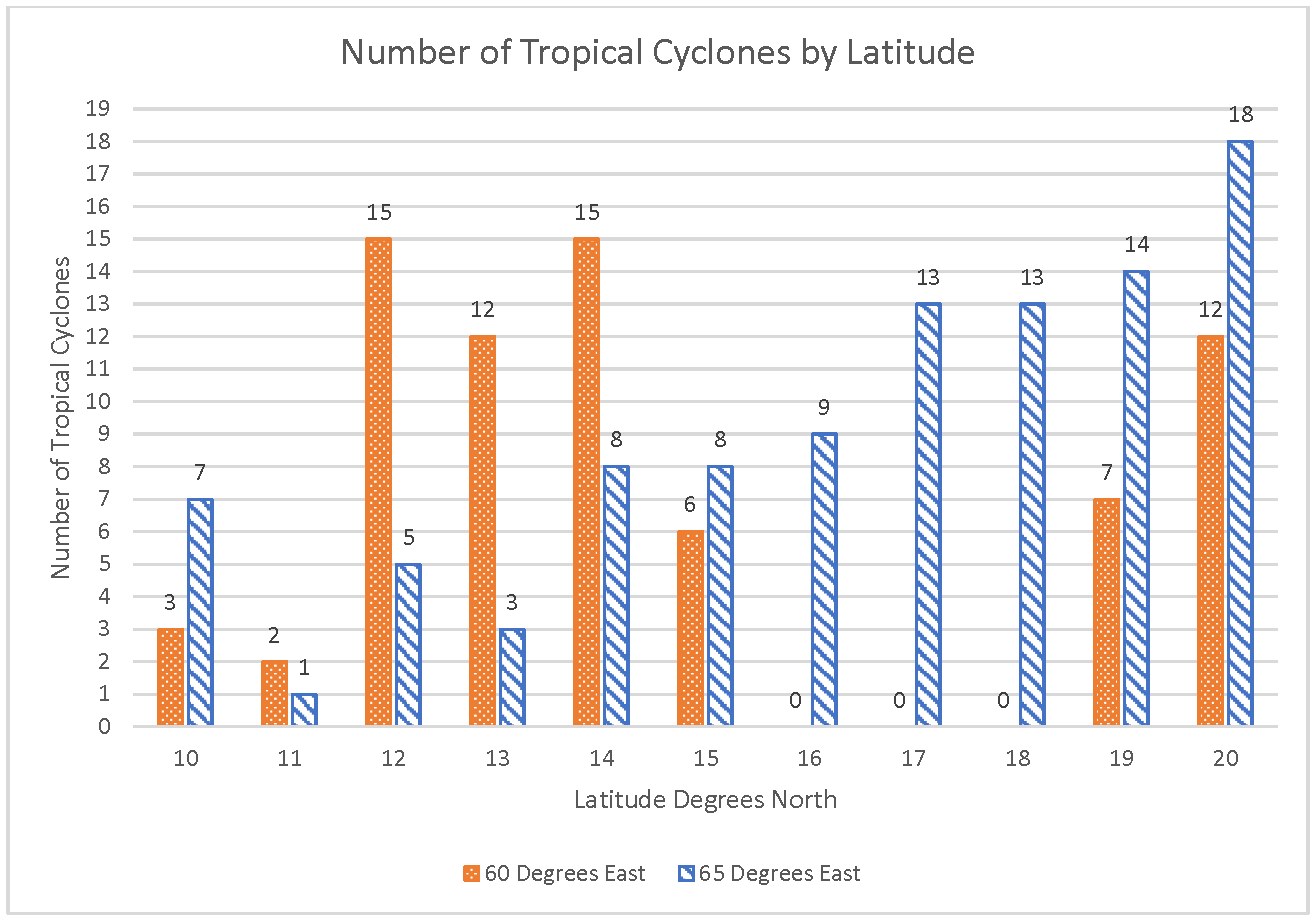
Number of Tropical Cyclones by Latitude
https://mynasadata.larc.nasa.gov/sites/default/files/2022-01/Bar_column%20chart%20cropped.png- Analyze the Tropical Cyclone Counts double bar graph and answer the questions.
- Check with your instructor on how to submit your answers.
- At 14° north, how many more tropical cyclones were at 60° east than at 65° east? 7 more
- At 60 degrees east, how many more tropical cyclones were at 14° north than at 15° north? 9 more
- What was the total number of tropical cyclones at each latitude between 60° and 65° east?
- 10° N – 10 tropical cyclones
- 11° N – 3 tropical cyclones
- 12° N – 20 tropical cyclones
- 13° N – 15 tropical cyclones
- 14° N – 23 tropical cyclones
- 15° N – 14 tropical cyclones
- 16° N – 9 tropical cyclones
- 17° N – 13 tropical cyclones
- 18° N – 13 tropical cyclones
- 19° N – 21 tropical cyclones
- 20° N – 30 tropical cyclones
- In table form:
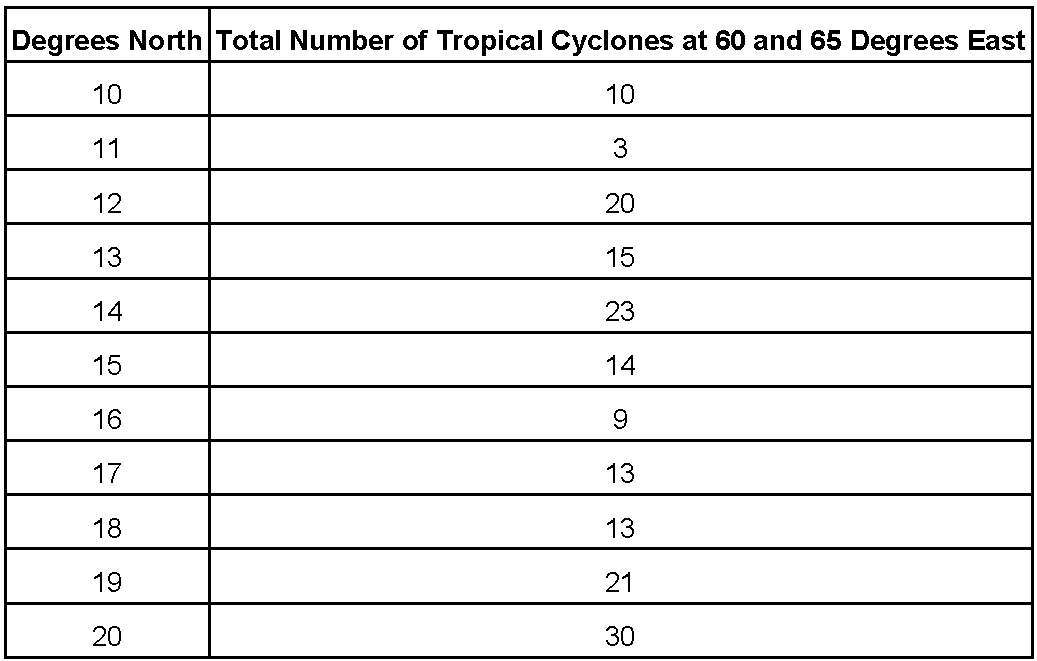
- Which latitude had the highest total number of tropical cyclones at these longitudes? 20 degrees north
- How many fewer total tropical cyclones were at 15° north than at 14° north at these longitudes? 9 fewer
- Tropical Cyclone Counts Box Plot
-
Link to Tropical Cyclone Counts Box Plot Mini Lesson
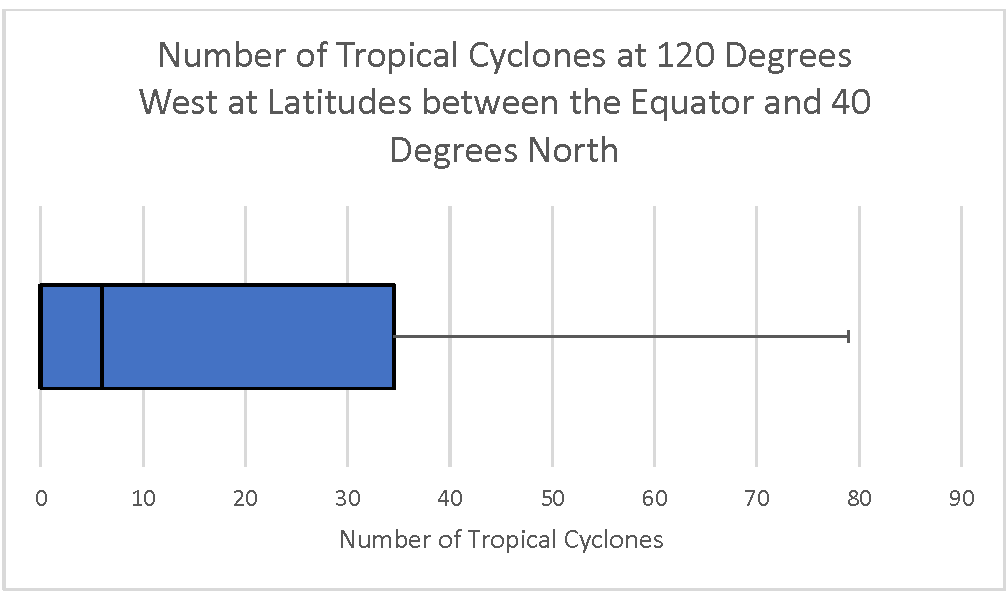
Number of Cyclones at 120 degrees west at latitudes between the equator and 40 degrees north
https://mynasadata.larc.nasa.gov/sites/default/files/inline-images/Box%20Plot%20120%20West%20horizontal_0.png- The box plot below shows the number of tropical cyclones at 120 degrees west for each degree of latitude from the equator to 40 degrees north; the same as represented along the red line in the mapped image below. Analyze the box plot and answer the questions that follow. Check with your instructor on how to submit answers.
- What does the box plot show? accept reasonable responses. What does it NOT show? Accept reasonable responses including that it does not show the number of tropical cyclones at particular latitudes. It also does not have a lower whisker. This is because the data are skewed. More than the bottom quartile are all zero. Therefore, there is no whisker. Fifty percent of the dat are from zero to the median at 6.
- What is the overall distribution of the box plot? Is it skewed right (with a longer whisker on the right)? Skewed left (with a longer whisker on the left)? The range is from 0 to 79. The bottom 25% of the data is all the same value (0). The median is much lower than the maximum. It is skewed right, meaning that it looks like it has a tail on the right. This is easier to see if it is horizontal.
- What does the shape of the distribution tell you? Accept reasonable responses including the following. Some latitudes have no tropical cyclones. The median is 6. The maximum is 79. Most latitudes didn’t have many tropical cyclones. A few had a high frequency. 50% of the latitudes had 6 or fewer tropical cyclones. 25% had between 6 and 34, 25% had more than 34.
- What are the maximum, minimum, range, median, first quartile, third quartile, and interquartile range? Maximum- 79; Minimum- 0; Range- 0-79; Median- 6; First quartile 0; Third quartile 34; Interquartile range 34.
- The map below shows is a thick line at 120 degrees west from the equator to 40 degrees north; the same locations represented in the box plot. (The Tropical Cyclone Counts map was generated in the My NASA Data Earth System Data Explorer. ) Now, compare the box plot to the map image and answer the following questions.
- Which visualization shows the number of tropical cyclones at each latitude? map
- What kind of questions about tropical cyclones can you ask that a box pot will help you answer? Accept reasonable responses.
- What do you wonder from the box plot? Can you answer it with the box plot, or do you need to see the data in a different way? Accept reasonable responses.
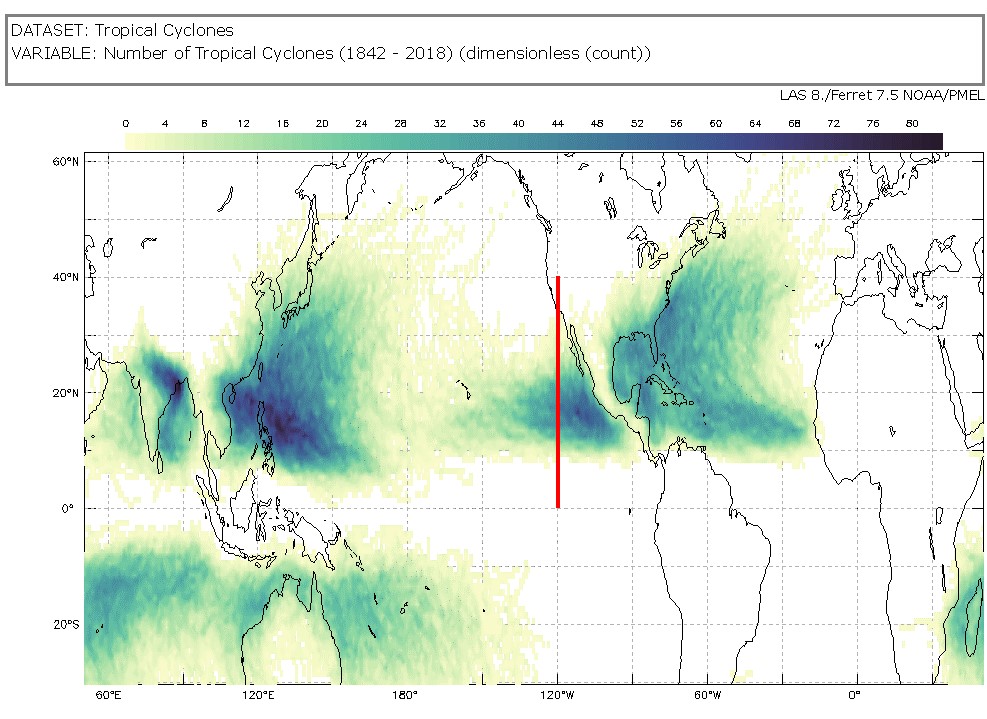
Tropical Cyclone Counts Map showing a line at 120 degrees west from the equator to 40 degrees north
https://mynasadata.larc.nasa.gov/sites/default/files/2022-02/Tropical%20Cyclone%20count%20120%20W.png - The box plot below shows the number of tropical cyclones at 120 degrees west for each degree of latitude from the equator to 40 degrees north; the same as represented along the red line in the mapped image below. Analyze the box plot and answer the questions that follow. Check with your instructor on how to submit answers.
- Tropical Cyclone Counts Histogram
-
Link to Tropical Cyclone Counts Histogram Mini Lesson
- The histogram provided shows the number of tropical cyclones at 120 degrees west for each degree of latitude from the equator to 40 degrees north; the same as represented along the red line in the mapped image below.
- Analyze the histogram and answer the questions that follow. Check with your instructor on how to submit answers.
- What does the histogram show? Accept reasonable responses, including: Most of the latitudes have had few hurricanes. Only a few latitudes had 70 or more tropical cyclones. The total number of latitudes can be calculated by adding the height of each column. It is 40.
- Describe the shape of the distribution of the histogram. Is it skewed left with a long "tail" of data on the left? Skewed right with a long "tail" of data on the right? Uniform (with the data spread equally across x-axis)? Bell shaped? U-shaped? skewed right
- What does the shape of the distribution tell you about the location and frequency of tropical cyclones? Most of the latitudes had few tropical cyclones, or hurricanes.
- What does it NOT show? Accept reasonable responses, including: It does not show the number of hurricanes at each latitude. It also does not show the total number of tropical cyclones at other lines of longitude.
- Compare the histogram to the map image?
- Which visualization, map or histogram, shows the number of tropical cyclones at each latitude? map
- Which visualization, map or histogram, displays the number of latitudes with 6-10 tropical cyclones? histogram
- What kind of questions about tropical cyclones can you ask that a histogram will help you answer? Accept reasonable responses.
- Tropical Cyclone Counts Model
-
Link to Tropical Cyclone Counts Model Mini Lesson
Use the Tropical Cyclone Counts Map Image to answer the questions. Check with your instructor on how to submit your answers.
- What does the information on the map show? It shows how many tropical cyclones there have been between 1842 and 2018 across the world.
- What do the dark colors on the map represent? Darker colors represent a higher number of tropical cyclones at a location between 1842 and 2018. The darkest color is the most.
- Point to a spot on the map that is not white. How many tropical cyclones, or hurricanes, have there been at that spot between 1842 and 2018? Answers will vary.
- Where do the most hurricanes form? The most hurricanes form in the bodies of water between 10 and 30 degrees north of the equator.
- What do you notice about the image? Answers will vary. there are more tropical cyclones in the Pacific Ocean than in the Atlantic Ocean. They tend to form north of the equator but not much above 40 degrees north. There are also tropical cyclones in the southern hemisphere.
- What questions do you have about the image? Answers will vary.
- Tropical Cyclone Counts Scatter Plot
-
Link to Tropical Cyclone Counts Scatter Plot Mini Lesson
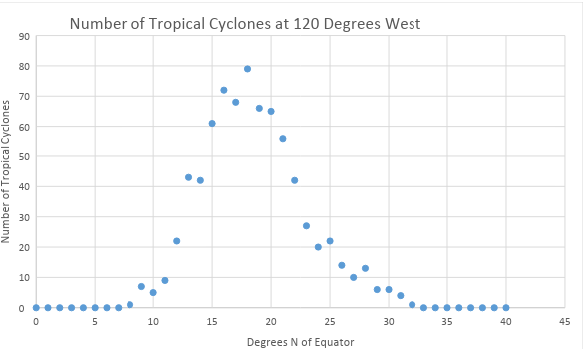
Scatter plot - number of tropical cyclones at 120 degrees west
https://mynasadata.larc.nasa.gov/sites/default/files/inline-images/thumbnail.png- The Number of Tropical Cyclones at 120 Degrees West Scatter Plot shows the number of tropical cyclones at 120° west for each degree of latitude from the equator (0°) to 40° north; the same as represented along the red line in the mapped image below.
- Analyze the scatter plot to answer the questions follow. Check with your instructor on how to submit your answers.
- What does the scatter plot show? What does it NOT show? Accept reasonable responses. It shows how many tropical cyclones, or hurricanes, were at each whole number latitude from 0 to 40 degrees north at the longitude of 120 degrees west. It does NOT show latitudes that are not whole numbers. It does NOT show latitudes outside the 0 to 40 degree north range. It does NOT show any other longitudes in the world.
- Is the plot linear (do the points appear to lie close together along a straight line) or nonlinear (do the points appear to form a curve)? Nonlinear
- The image shows the number of tropical cyclones around the world from 1842 – 2018. There is a thick line at 120 degrees west from the equator to 40 degrees north; the same as represented by the scatter plot. The Tropical Cyclone Counts map was generated in the My NASA Data Earth System Data Explorer. Now compare the scatter plot to the map image and answer the following questions.
- Which visualization, the scatter plot, map or both, shows the number of tropical cyclones at each latitude? both the graph and the map.
- Which data visualization, the scatter plot or map, best helps you answer questions about specific number of tropical cyclones at specific locations? The graph could be more precise if it shows the location you want.
- Which data visualization, the scatter plot or map, best helps you answer questions about tropical cyclones around the world? map
- What kind of questions can you ask about tropical cyclones that a scatter plot can help you answer? Accept reasonable responses asking about how the locations and number of cyclones are related.
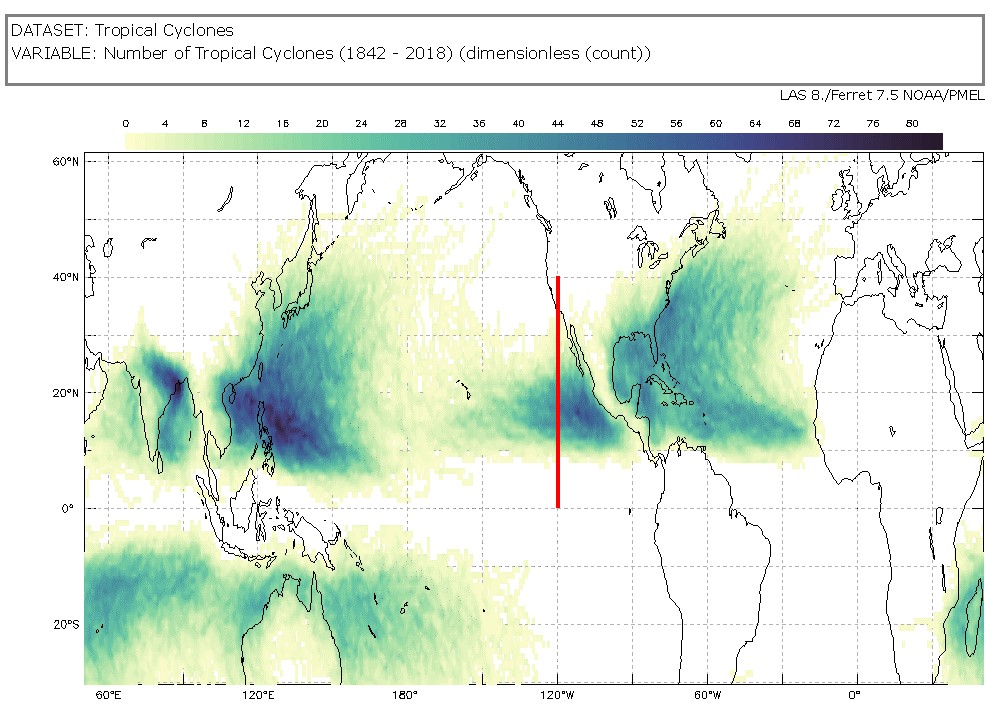
Tropical Cyclone Counts Map showing a line at 120 degrees west from the equator to 40 degrees north
https://mynasadata.larc.nasa.gov/sites/default/files/2022-02/Tropical%20Cyclone%20count%20120%20W.png - Using Models to Explore Chlorophyll and Radiation Data
-
Link to Using Models to Explore Chlorophyll and Radiation Data
Steps:
- Check with your instructor on how to submit your answers.
- Review the color bar scale for net radiation. What do the colors mean? The color bar shows changes in the balance of incoming and outgoing energy on Earth. Places where mor e energy was coming in than going out (energy surplus) are orange. Places where less energy was coming in than going out (energy deficit) are purple. Places where the amounts of incoming and outgoing energy were in balance are white.
- Review the color bar scale for chlorophyll concentration. What do the colors mean? The color bar shows changes in chlorophyll values. Places where chlorophyll amounts are very low, indicating very low numbers of phytoplankton, are blue. Places where chlorophyll concentrations were high, meaning many phytoplankton were growing, are dark green. The observations come from the MODIS sensor on NASA's Aqua satellite. Land is dark gray, and places where MODIS could not collect data (reasons include sea ice, polar darkness, or clouds) are light gray.

- Describe the values for net radiation during the spring and fall in the Northern Hemisphere. In the Northern Hemisphere, net radiation during the spring and fall is closest to zero. There are areas that are more positive or negative, but their difference is less extreme compared to the summer and winter.
- List the value of net radiation in the Northern Hemisphere during the summer, then list the value of net radiation in the Northern Hemisphere during winter. What do you notice? In the Northern Hemisphere during the summer, the value of net radiation is high at 180 Watts per square meter. In the Northern Hemisphere during the winter, the value of net radiation is very low at -180 Watts per square meter. The Northern Hemisphere can experience an extremely large range in net radiation.
- Describe the patterns you observe between net radiation and chlorophyll concentration? Chlorophyll concentration shifts north or south throughout the year in the same manner as positive net radiation. For example, in the summer when net radiation is high throughout the Northern Hemisphere, the chlorophyll concentration is also high. In the winter, when net radiation is low throughout the Northern Hemisphere and high throughout the Southern Hemisphere, chlorophyll concentration also decreases in the Northern Hemisphere and increases in the Southern Hemisphere.
- Observe the contrast between the Northern Hemisphere and the Southern Hemisphere in net radiation values. Explain which two seasons experience a greater difference? Fall and spring or summer and winter? Explain. Summer and winter experience the greater difference in net radiation values. There is a stark contrast between the northern and southern hemispheres during the summer and winter. During these seasons, one hemisphere of the Earth will experience high net radiation and the other hemisphere will experience low net radiation. There is little difference in the fall and spring seasons. Both fall and spring experience more uniform net radiation, that is not extremely high or extremely low.
- Using Precipitation and Vegetation to Study Climate Zones
-
Link to Using Precipitation and Vegetation to Study Climate Zones
- What are some differences between weather and climate? Climate is a pattern of weather in an area over an extended period of time. Weather reflects the current conditions in an area.
- What are two variables you are reviewing today? Precipitation and Normalized Difference Vegetation Index
- What is the name of this map visualization? Monthly Precipitation
- What does the dark brown represent? Areas with little precipitation.
- What does the dark blue represent? Areas with more precipitation.
- What month and year does this visualization show? March 2012.
- Find two locations where there is high precipitation values but little vegetation and where there is little precipitation but high vegetation. Look at different data sets in order to discover outlier areas. Students will have varying answers to this question.
- What is the name of the map visualization? Normalized Difference Vegetation Index
- What does the bright green represent? Areas with a higher NDVI
- What does the white represent? Areas with a lower NDVI
- What month does this represent? March 2012.
Compare Visualizations: Students will make their own observations about the similarities and differences between the 2 visualizations. They may point out areas that are high or low in one or both phenomena or they may make other observations about patterns, etc.
Investigate Relationships and Patterns: Students will choose areas that are high or low in precipitation and discover how the NDVI in those regions changes based on precipitation level.
- Valuing Albedo
-
Steps:
- Check with your instructor on how to submit your answers.
- How does albedo play an important role in Earth’s Energy Budget? Albedo is the fraction of the sun’s energy that is reflected back into space.
- What reflects the most sunlight and has the biggest impact on Earth’s albedo? Bright, white clouds.
- Contrast lighter colors and darker colors in terms of reflection. Lighter colors show more reflection whereas darker colors show less reflection.
- How do humans modify Earth’s albedo and impact the global energy balance? Human activities such as ship tracks, jet contrails, agricultural burning, and land-use change, all modify Earth’s albedo.
- View the bar graph Albedo of Common Surfaces.
- Identify the surface with the highest albedo. What does this indicate about the reflectivity of this surface? The surface with the highest albedo is snow. This indicates that snow reflects much of the Sun’s energy.
- Name the surface with the lowest albedo. What does this indicate about the reflectivity of this surface? The surface with the lowest albedo is asphalt (black top). This indicates that asphalt absorbs more energy from the Sun than it reflects.
- What are two other surfaces that have low albedos? Answers may include the moon, a dark roof, crops/grasslands, and forests.
- Describe the relationship between color of a surface and its reflectivity. Darker colored surfaces reflect less of the Sun’s energy than lighter colored surfaces.
- Predict what would happen to Earth’s Energy Budget if the snow started to melt. Answers may vary. Students might make a connection to melted snow joining ocean water and absorbing more of the Sun’s energy than reflecting it.
- Volcanic Eruptions StoryMap
-
Link to Volcanic Eruptions StoryMap
- What are Tectonic Plates?
-
Link to What are Tectonic Plates?
- Watch the NASA Space Place video Tectonic Forces and answer the questions. Check with your instructor on how to submit answers.
- What is the name of the supercontinent that began to break up about 180 million years ago? Pangea
- What happened when the Americans and Africa drifted apart? The Atlantic Ocean formed.
- What causes Earth's tectonic plates to move? Convection in the mantle
- What happens when tectonic plates move apart at the bottom of the ocean? New crust is formed and new oceans can be created.
- Where does the creation of new oceanic crust occur? mid-ocean ridges
- Where is old ocean floor destroyed or recycled? subduction zones
- What happens when the seafloor is created and destroyed? It drives the shift in the continents on Earth.
- Watch the NASA Space Place video Tectonic Forces and answer the questions. Check with your instructor on how to submit answers.
- What are the Different Types of Solar Eclipses?
-
Link to What are the Different Types of Solar Eclipses?
Model: Students should have a reasonable model of the orbit as seen in the example image.
By the end of the mini lesson, students should have an answer for the Guiding Question: Why do you think something small like the Moon can block something large like the Sun? Accept reasonable responses involving the ratio of the distances from Earth and the sizes. The ratios allow the moon to completely block the Sun in certain positions. That casts a shadow on Earth.
- What do Scientists Learn abut the Universe from Observing Solar Eclipses?
-
What do Scientists Learn abut the Universe from Observing Solar Eclipses? Lesson Plan Link
- What Elements are in Your Body?
- What is a Solar Eclipse?
-
Link to What is a Solar Eclipse?
- View an animation of a total solar eclipse. Animations are used to help explain phenomena that are hard to view. A total solar eclipse is visible only on a small portion of Earth, so this type of animation can make this phenomenon accessible to people who are unable to view a total solar eclipse in their location. Answer the following questions about the animation.
- What objects are in the animation? The Sun and the Moon.
- Estimate the size and distance of those objects. The Sun is much bigger than the Moon and is much farther away from Earth.
- Describe the motion of those objects. The Moon is moving across the Sun.
- Where is the observation being made from? Earth or maybe a satellite between Earth and the Moon.
- View imagery of the 2017 total solar eclipse captured from space by NASA’s Earth Polychromatic Imaging Camera (EPIC) onboard NOAA’s Deep Space Climate Observatory (DSCOVR). Answer the following questions about the imagery.
- What objects are in the video? Earth and the Moon's shadow.
- Estimate the size and distance of those objects. The Moon is much smaller than Earth.
- Describe the motion of those objects. The Moon's shadow is moving across Earth.
- Where is the observation being made from? A satellite orbiting Earth (EPIC/DSCOVR).
- Using what you learned from the two perspectives presented by the animation and the imagery, answer the following questions.
- How would you describe a solar eclipse? Accept reasonable responses such as: A solar eclipse occurs when the Moon's shadow crosses Earth. The Sun, Moon, and Earth all must be lined up. From observers on Earth, the Moon blocks the disk of the Sun.
- What is your evidence for your explanation? Accept reasonable responses such as: My evidence is imagery from NASA's EPIC instrument, showing the Moon's shadow move across Earth in 2017; and the animation shows the perspective from Earth, with the Moon blocking the disk of the Sun.
- View an animation of a total solar eclipse. Animations are used to help explain phenomena that are hard to view. A total solar eclipse is visible only on a small portion of Earth, so this type of animation can make this phenomenon accessible to people who are unable to view a total solar eclipse in their location. Answer the following questions about the animation.
- What is a Volcano?
-
Steps
Follow your instructor's directions to work alone or in groups. Check with your instructor on how to submit answers. Examine the images and answer the questions.
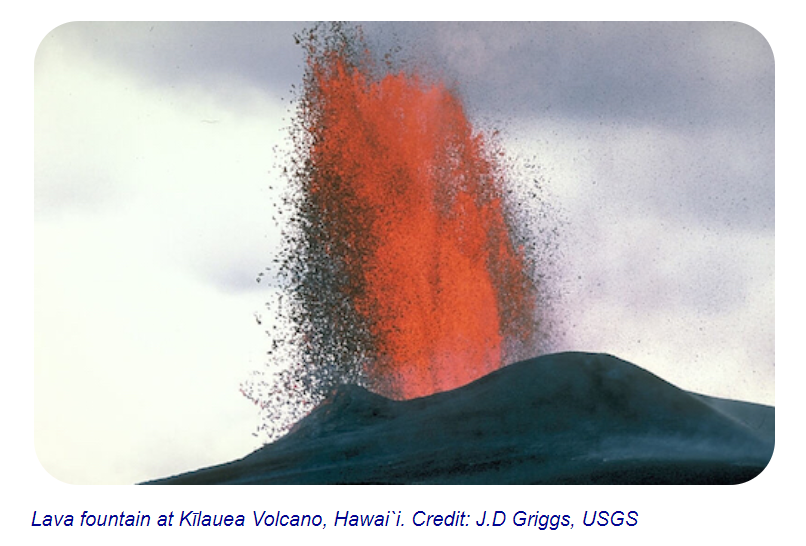
Image 1: Lava fountain at Kilauea Volcano, Hawai'i.
Image Credit: J.D. Griggs, USGS
https://mynasadata.larc.nasa.gov/sites/default/files/inline-images/fire%20eruption_1.PNG
-
Look at Image 1. What did you see in the first volcano image? Material escapes from the opening of a volcano called an eruption.
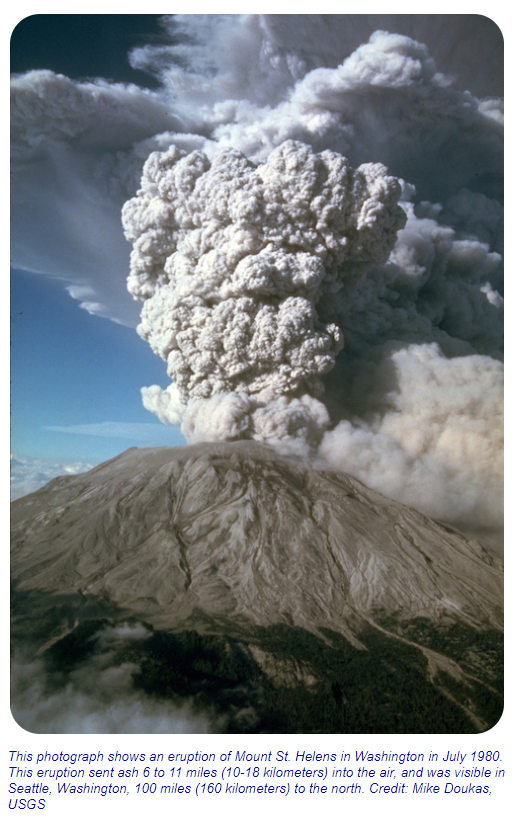
Image 2: Mount Saint Helens eruption, July 1980
Image Credit: Mike Doukas, USGS
https://mynasadata.larc.nasa.gov/sites/default/files/inline-images/Mount%20St%20Helens.PNG -
Look at Image 2. What did you see in the second volcano image? This eruption is explosive, sending material high into the sky.
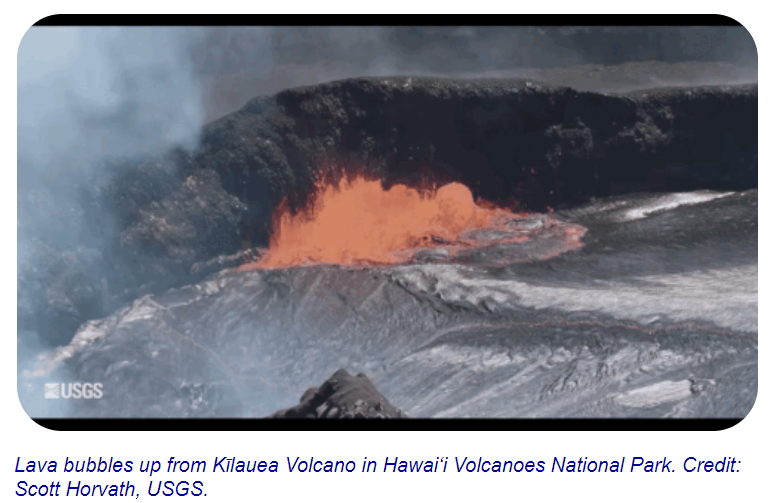
Image 3: Lava bubbles up from Kilauea Volcano in Hawai'i
Image Credit: Scott Horvath, USGS
https://mynasadata.larc.nasa.gov/sites/default/files/inline-images/Lave%20Bubbles.PNG - Look at Image 3. What did you see in the third volcano image? This eruption appears calmer than the others, with gentle flows of material.
- How are the three images different? The way the material erupts from the volcano is different. Also the kind of material appears differently.
- How are the three images similar? They are all volcanoes (an opening on the surface of a planet) that allows material warmer than its surroundings to escape from its interior.
Review the introductory information provided in "What is a Volcano?" available from NASA's Space Place to answer the following question.
- What are three ways magma can reach the surface of Earth There are three reasons why magma might rise and cause eruptions onto Earth’s surface.
- Magma can rise when pieces of Earth's crust called tectonic plates slowly move away from each other. The magma rises up to fill in the space. When this happens underwater volcanoes can form.
- Magma also rises when these tectonic plates move toward each other. When this happens, part of Earth's crust can be forced deep into its interior. The high heat and pressure cause the crust to melt and rise as magma.
- A final way that magma rises is over hot spots. Hot spots are exactly what they sound like--hot areas inside of Earth. These areas heat up magma. The magma becomes less dense. When it is less dense it rises. Each of the reasons for rising magma are a bit different, but each can form volcanoes.
-
- What is Albedo?
-
Link to What is Albedo? Mini Lesson
- Review the NASA Climate Bits: Albedo video and answer the following questions. (Check with your instructor on how to submit your answers.)
- What is albedo? The fraction of the incoming Sun's energy that is reflected.
- What do the colors represent in the weekly maps of reflected solar radiation for the past 10 years? Lighter colors show more reflection and darker colors show less reflection.
- How do these colors relate to albedo? Lighter colors represent a higher albedo than darker colors.
- Why is albedo important for Earth's climate? Incoming solar energy must equal outgoing energy. The amount of energy absorbed and reflected can impact this balance.
- What pattern did you notice? More reflected energy where there are persistent clouds, dust, smoke and pollution and snow and ice. Also, albedo increases at the poles during their respective fall and winter seasons and decrease in their respected summer months. Missing data peaks at the poles in their respective summers. Deserts have a higher albedo than areas with a lot of vegetation.
- Review the NASA Climate Bits: Albedo video and answer the following questions. (Check with your instructor on how to submit your answers.)
- What is Ozone?
-
Videos:
NASA eClips: Spotlites Ozone. Answers may vary, but can include the following: Ozone is made of 3 oxygen atoms, also known as O3. Ozone can be found in the stratosphere called the ozone layer. Parts of the ozone can have thinner layers than others. Ozone is responsible for absorbing some of the sun’s harmful Ultraviolet radiation. With a thinner layer, more radiation reaches the surface.
Tropospheric Ozone - Summers of smog. Answers may vary, but can include the following: Unhealthy air could become much more common in the U.S.A. A 70% increase is expected to occur by 2050. Ozone pollution produced near ground level by cars, industry, and utilities can be harmful. Rising temperatures due to climate change can create chemical reactions that lead to harmful ozone. Large cities with the highest pollution could face unhealthy air most of the summer months.
Ground Level Ozone: What is it? Answers may vary, but can include the following: O2 is oxygen. O3 is known as ozone. Ozone is essential to survival, but not for breathing. Natural ozone occurs in the stratosphere and blocks harmful ultraviolet rays from the sun. Ozone levels at lower levels in the troposphere, or ground level, can be harmful. Ozone become a toxic pollutant from burning fossil fuels which expel hydrocarbons. Ozone levels increase in higher temperatures. The National Ambient Air Quality Standards sets a range of air quality to help certain counties in the U.S.
Articles:
Satellite Tracks Ozone Pollution by Monitoring Its Key Ingredients. Answers may vary, but can include the following: Ozone pollution near Earth’s surface is one of the main ingredients of summertime smog and a primary cause of poor air quality. Satellites can measure the precursor gases that contribute to ozone formation. At high altitude, ozone acts as Earth’s sunscreen from harmful ultraviolet radiation. At low altitudes, ozone is a health hazard contributing to respiratory problems like asthma and bronchitis. Ozone gas is formed through complex chemical reactions initiated by sunlight and involving volatile organic compounds (VOCs) and nitrogen oxides (NOx). VOCs occur naturally, but they can also arise from paint fumes, cleaning products, and pesticides, and they are a by-product of burning fossil fuels in factories and automobiles. NOx are a byproduct of burning fossil fuels and are abundant in cities.
Fires Increase Surface Ozone. Answers may vary, but can include the following: Wildfires may pose a risk to those farther away who see little or no smoke. distant wildfires can raise ground-level ozone concentrations to unhealthy levels even at large distances from the fire location. Ground-level ozone released by burning can make breathing difficult, particularly for children, older adults, and people with lung disease or asthma. Wildfires can be detected by the Moderate Resolution Imaging Spectroradiometer (MODIS) on NASA’s Terra and Aqua satellites.
Ground-level Ozone Basics. Answers may vary, but can include the following: Ozone in the air we breathe can harm our health, especially on hot sunny days when ozone can reach unhealthy levels. Elevated exposures to ozone can affect sensitive vegetation and ecosystems, including forests, parks, wildlife refuges and wilderness areas. Air quality forecasts are often given with weather forecasts on handheld devices, online or in the paper or television.
- What is Particulate Matter?
-
Link to What is Particulate Matter?
Videos:
NASA's Earth Minute: My Name is Aerosol. Answers may vary, but can include the following: Aerosols can be found in dust storms from a desert, salt from ocean spray, volcanic explosion, forest fires, pollution. Aerosols can reflect sunlight and collect water vapor to form a cloud. Other aerosols can trap sunlight, heat the air, cause chemical reactions, damage ozone layer, and cause health problems.
What is Particulate Matter. Answers may vary, but can include the following: PM includes dust, dirt, soot, smoke, and liquid droplets. There are two common size categories of PM: 2.5 and 10. Health effects from PM include decreased lung function, aggravated asthma, respiratory disease, irregular heartbeat, nonfatal heart attacks, etc. PM is formed from construction, wildfires, powerplants, motor vehicles, and wood burning.
NASA Tracks Volcanic Ash With Satellites. Answers may vary, but can include the following: Particulate matter from volcanoes include volcanic ash and sulfur dioxide. Volcanic hazards can cause failure in airplane engines. NOAA Satellite used include Suomi NPP.
Earth from Orbit: Wildfire Smoke Blankets U.S. Answers may vary, but can include the following: Wildfires can be caused by extreme drought and heat. NOAA Satellites used: GOED-16/GOES-17 (monitors movement of smoke), NOAA-20 and Suomi NPP (collects aerosol data).
Articles:
Earth Observatory for Kids: Smoky Skies and Satellites. Answers may vary, but can include the following: Smoky aerosols from wildfires can create clouds with extreme weather conditions, cause respiratory health problems, and affect the environment. Wildfires can also diminish rainfall, such as the human caused fires in Africa, where aerosols prevent rain droplets from forming. The Environmental Protection Agency’s Air Quality Index (AQI) was designed to help people quickly understand how air quality is related to health risks in events such as wildfires.
Earth Observatory for Kids: Air Pollution. Answers may vary, but can include the following: Particulate matter, a type of air pollution, can come from cars, factories, power plants, wildfires, and other sources. PM2.5 are air pollution particles that are less than 2.5 micrometers or smaller in diameter, much smaller than the width of a human hair. Satellites can measure air pollution over large areas, and can help track particulate matter as winds blow it far from its original source.
NASA Earth Observatory: Particulates. Answers may vary, but can include the following: Air pollution is the fourth leading risk factor for death around the world. Fine particulate matter (PM2.5), is a result from direct emissions into the air and is less than 2.5 micrometers in diameter. The map synthesizes measurements of aerosol optical depth acquired by NASA’s Moderate Resolution Imaging Spectroradiometer (MODIS), Multi-angle Imaging SpectroRadiometer (MISR) and Sea-viewing Wide Field-of-view Sensor (SeaWiFS)—satellite instruments flying since the late 1990s. There is a large range in the average PM2.5 concentration and associated health risk for urban areas in different world regions.
- What is Space Weather?
- What is the Difference between a Solar Eclipse and a Lunar Eclipse?
-
Link to What is the Difference between a Solar Eclipse and a Lunar Eclipse?
Link to Teacher Key for "What is the Difference between a Solar Eclipse and a Lunar Eclipse?"
- What is the Sun's Corona?
- Why don't we have solar eclipses every month?
-
Link to Why don't we have solar eclipses every month?
Link to Teacher Key for Why don't we have solar eclipses every month?