STEM Career Connections
So, You Think You Can be a Solar Scientist
Job Title
Research Scientist
Michael Kirk Ph.D.
Your Skills
Consider if you ever practice any of the following skills:
Skill |
Examples |
|
|
|
|
|
|
|
|
|
|
|
|
|
|
|
|
All of these skills will be helpful to you if you decide to become a solar scientist! If you have not practiced any of those skills, it is never too late to start. Let’s meet a solar scientist, and we will see how your skills match up with his skills.
Meet Dr. Michael S. Kirk
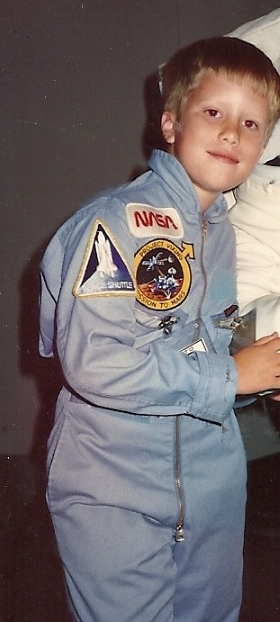
Franklin Institute in Philadelphia.
Credit: Michael Kirk
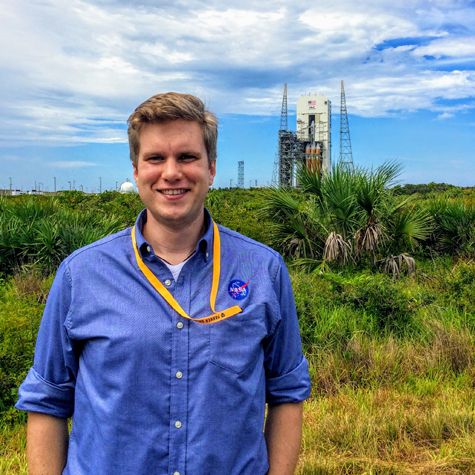
Michael is a solar scientist at NASA’s Goddard Space Flight Center. He grew up in a small city called McMinnville, Oregon. From a young age, he was fascinated by space and loved visiting local observatories to look through telescopes. He went on to study physics and astronomy at Whitman College in Washington. During school and after graduation, Michael worked a variety of jobs, like sorting cherries at a cannery, bailing hay, landscaping, and even cooking in restaurant kitchens.
Eventually, Michael landed a role as a scientific programmer for the Solar Dynamics Observatory (SDO) with Adnet Systems at NASA Goddard Space Flight Center. SDO is the first mission to be launched for NASA's Living With a Star (LWS) Program, a program designed to understand the causes of solar variability and its impacts on Earth. Michael’s supervisor encouraged him to pursue a Ph.D., which he did at New Mexico State University, focusing on studying the Sun.
After earning his Ph.D., Michael returned to work at NASA’s Goddard Space Flight Center on a fellowship. He says the connections he made during his first time at Goddard helped him get back in the door after finishing his degree. Later, he worked at Catholic University and then at Orion Space Solutions, a space company. After about two years there, Michael was invited to return to Goddard again, this time to lead the Heliophysics Education Activation Team, also known as NASA HEAT.
Michael says that the most interesting parts of his journey were the unexpected twists and turns. He believes that meeting new people and staying motivated can open the door to exciting opportunities.
What is Michael curious about?
Among many other things, Michael studies the Sun’s cycles. The solar cycle is the cycle that the Sun’s magnetic field goes through approximately every 11 years and scientists still don’t fully understand why.
Our Sun is a huge ball of electrically-charged hot gas. This charged gas moves, generating a powerful magnetic field. The Sun's magnetic field goes through a cycle, called the solar cycle.
Every 11 years or so, the Sun's magnetic field completely flips. This means that the Sun's north and south poles switch places. Then it takes about another 11 years for the Sun’s north and south poles to flip back again.
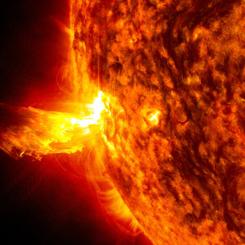
The solar cycle changes how active the Sun’s surface is. One example of this activity is sunspots, which form because of the Sun’s magnetic fields. As those magnetic fields shift and change, the number of sunspots and other activity on the Sun also changes.
For hundreds of years scientists have tracked the solar cycle by counting the number of sunspots. The beginning of a solar cycle is a solar minimum, or when the Sun has the least sunspots. Over time, solar activity, and the number of sunspots, increases.
The middle of the solar cycle is the solar maximum, or when the Sun has the most sunspots. As the cycle ends, it fades back to the solar minimum and then a new cycle begins.
The Sun goes through cycles where its activity changes. During the most active maximums, there are lots of sunspots and bursts of energy. There are also quieter maximums where there are fewer sunspots and less activity. Scientists study these cycles so they can predict how strong they will be and how long they will last. These predictions help us understand something called space weather—the conditions in space caused by the Sun.
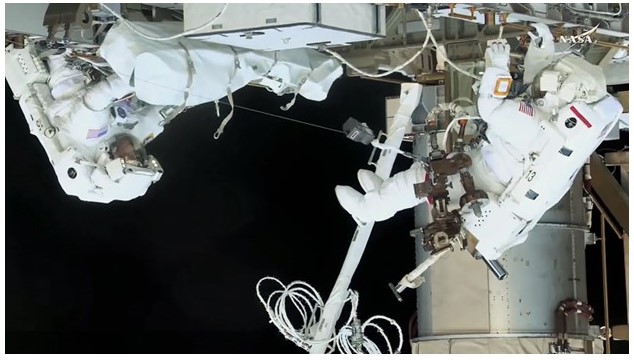
Space weather can affect life here on Earth and in space. For example, it can damage satellite electronics or shorten how long satellites last. It can also be dangerous for astronauts working outside the International Space Station because of the extra radiation. When scientists know a busy time in the solar cycle is coming, they can protect satellites by putting them in safe mode and keep astronauts safe by delaying spacewalks.
Michael's Skills
Now that you know more about solar cycles, watch the Science Update: space Weather on Our Approach to Solar Max video segment. Pay close attention to see if you can identify any skills that help Michael do his job. Fast forward to 0:45:24 and watch until 0:47:47.
Read the following text to learn more about what Michael does. Once again, see if you can spot any skills that help him do his job.
Michael Has Many Roles
Michael's work involves several key areas:
- Helioanalytics: He helps lead a center that uses data science, machine learning, mathematics, and statistics to make new discoveries about the sun and how it affects Earth.
- SunCET Mission: He's a Co-Investigator on the upcoming Sun Coronal Ejection Tracker (SunCET) Mission, a small satellite launching in 2026. He's responsible for writing the software that gets data from the satellite to scientists and the public.
- PUNCH Mission: He is the deputy mission scientist for the Polarimeter to Unify the Corona and Heliosphere (PUNCH), a new mission just launched in the spring of 2025. He helps to make sure scientists around the world can access and understand the new images to study solar storms.
- NASA HEAT (Heliophysics Education Activation Team): As the leader of this team, Michael focuses on helping the public understand and engage with heliophysics, which is the study of the sun and its influence throughout the solar system. He enjoys explaining complex science in a way that everyone, including his grandmother, can understand.
Your Shared Skills
Now you know more about what Michael likes to study and about some of his responsibilities/activities. So, it is time to complete the following table with examples of skills/activities that you and Michael use. Feel free to add any other skills you identify. You may also add examples of activities you would like to do to practice a new skill!
| Shared Skill | Example of How You Practice this Skill | Example of How Michael Practices this Skill |
| Ask questions | ||
| Look for patterns | ||
| Work collaboratively | ||
| Give presentations / explain something to others | ||
| Make predictions | ||
| Keep practicing even when something is hard | ||
| Try out new technology | ||
| Step us as a leader | ||
| (Add your own.) |
Just for Fun
What is your favorite ice cream flavor? Michael’s favorite ice cream flavor is marionberry! Whether or not you and Michael have the same ice cream preferences, you and Michael sure share many important skills!
Reflection
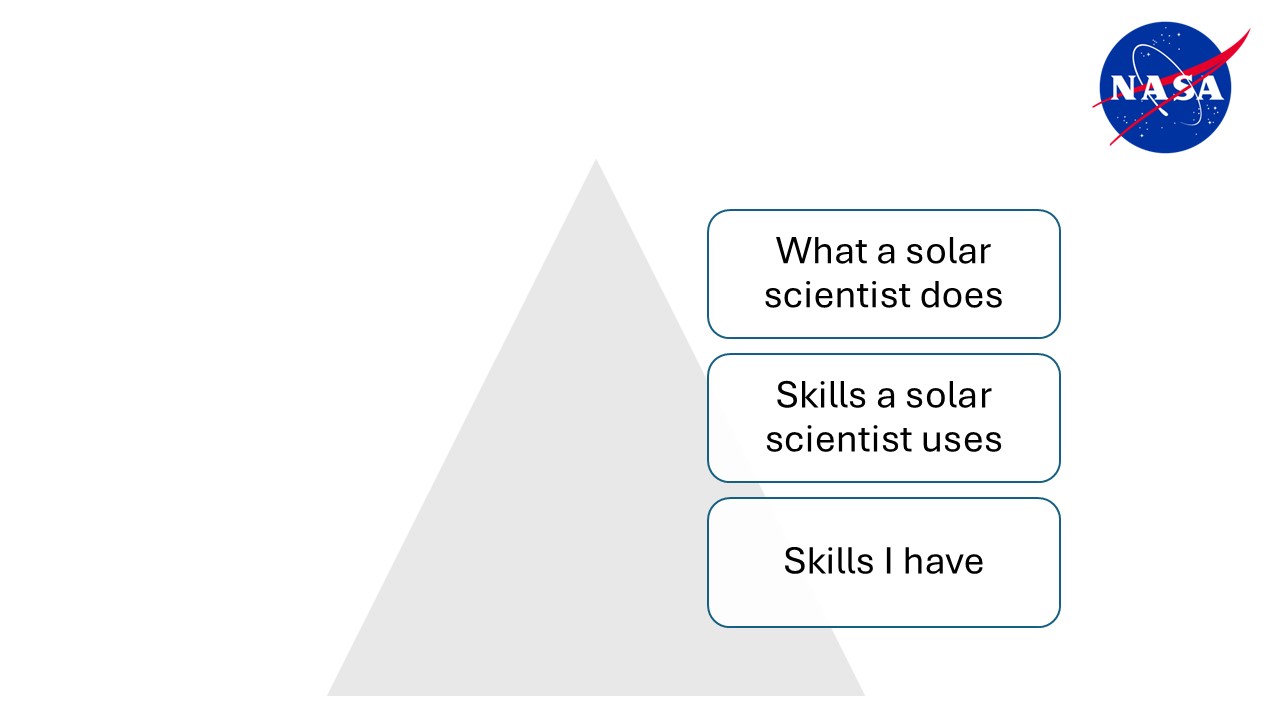
Many of your current activities are already preparing for a very bright future. If you are (or become!) curious about the Sun and space, you are practicing many skills that will help you succeed as a Solar Scientist. Feel free to use the diagram below to envision your Solar Scientist career. You can draw pictures or write on and around the diagram.