
Lesson Plans
STEM Career Connections Expo
Overview
Students become a STEM Professional Apprentice by matching their skills with those of a STEM Professional. Working in Career Apprentice Teams, they complete a STEM Career Connection activity to learn about the types of skills STEM professionals use to carry out their STEM practices in their scientific fields. Students share their knowledge about the specific STEM skills and practices with their classmates through a STEM Career Connections Expo. They personalize their learning by designing a STEM Career Connection Badge that highlights how their personal skills match those of one or more STEM professionals.
During the Expo, students visit each others Career Apprentice Teams. They complete an interactive learning challenge demonstrating their understanding how STEM skills connect to STEM practices. Once they connect their skill(s) to that of a STEM professional they receive a skills connection star to place on their personal STEM Career Connection Badge.
By the end of the Expo, students have collected three skills stars that illustrate a connection between STEM skills of professionals and the student's personal skills. Students conclude by reflecting on they can develop or improve upon their skills and how those skills can further their interest in pursuing a STEM career.
Materials Required
Per group of 4 students:
- A device with internet connection
- A poster board or easel sheets
- Markers
- Pencils
- Colored pencils
- Student Activity sheet for assigned STEM Professional Profile (1 per student)
- STEM Professional Investigation Sheet (1 per Career Apprentice Team)
- STEM Career Connection Badge (1 per student)
- Expo Interactive Guide (1 per Career Apprentice Team)
- Career Skills and Practices Sheet (1 per Career Apprentice Team)
- Star stickers (optional)
Procedure
Step 1: STEM Professional Career Connection Activity (~15 minutes)
Students will complete the STEM Professional Career Connection Activity Sheet for one of the STEM Professionals. Students will be introduced to necessary career skills identified by the professional. Students will also identify some of their own skills that relate to professional skills. The teacher might want to clarify that a skill is: the ability to do something that supports a practice. For example, playing basketball is a practice, jumping high is a skill because it supports the practice by doing something. It's best if students can self-select their STEM Professional, but it's also important that all of the STEM Professionals be included.
- STEM Professional Profile: Conservation Scientist - Accompanying Activity Sheet
- STEM Professional Profile: Oceanographer - Accompanying Activity Sheet
- STEM Professional Profile: Atmospheric Scientist - Accompanying Activity Sheet
- STEM Professional Profile: Data Scientist - Accompanying Activity Sheet
- STEM Professional Profile: Remote Sensing Scientist - Accompanying Activity Sheet
Step 2: Personalize a STEM Career Connection Badge (~10 minutes)
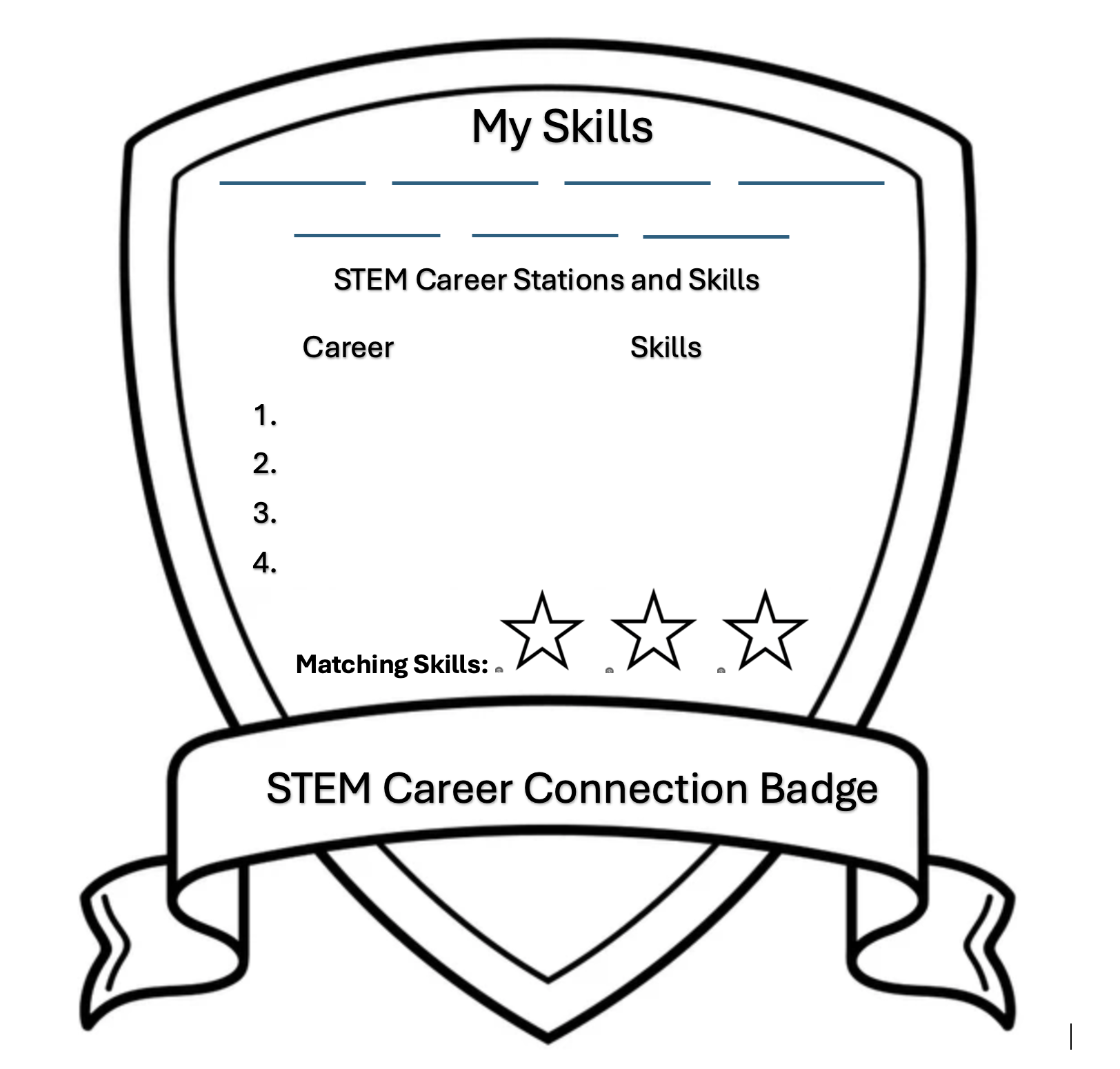
Now that students have begun to learn about skills, they will be given the task to reflect upon their personal skills and begin to personalize a STEM Career Connection Badge. They will identify up to seven personal skills and list them on their badge. A teacher can scaffold this portion of the activity by listing on the board the different skills the students learned from Step 1. The teacher might want to clarify that a skill is: the ability to do something that supports a practice. For example, playing basketball is a practice, jumping high is a skill because it supports the practice by doing something.
Students can use the template provided or design their own badge from scratch, either manually or digitally. It is important that the badge have room to list their self-identified skills.
Step 3: Become a STEM Career Apprentice (~20 minutes)
In Step 3, students will link STEM skills and practices. A skill is the ability to do something and practices are habits applying skills for a purpose. An example of how teachers can teach students the difference between a skill and a practice is provided in the link. This example provides the skills and practices of a sports coach.
Each student is assigned to a STEM Career Apprentice Team. Four students per team is ideal.
- STEM Professional: Conservation Scientist
- STEM Professional: Oceanographer
- STEM Professional Atmospheric Scientist
- STEM Professional: Data Scientist
- STEM Professional: Remote Sensing Scientist
Team members will collaborate to complete the STEM Professional Investigation Sheet for their STEM Professional. They will explore and identify the skills and practices for that profession. This step is similar to Step 1, but here they are working as a collaborative team and this time professional practices are included. The investigation sheet will ask them to complete a Connection Table to help them identify and connect STEM skills and practices for their assigned Career. Professional. The investigation sheet will also require them to answer questions about the "big ideas" that will apply to this activity.
- What does this professional investigate?
- Why is this work important?
- What STEM skills has this professional identified?
- Give 3 examples of how these skills connect to their STEM practices?
STEM Professional Investigation Sheet
Complete as a STEM Career Apprentice Team. Fill in the Connection Table below as best you can for the STEM Professional you are investigating. Match the STEM practice with specific skills identified by the professional. If a practice is not listed, write it in as “other”. REMEMBER: A skill is the ability to do something. Practices are habits applying skills for a purpose and continuing to improve the skills.
Career Title _________________________________________
Connection Table
|
STEM PRACTICE |
Skills Needed for this Practice |
Our STEM Professional did not mention this practice, but a skill they could use for this Practice is: |
|
Questioning/Stating the Problem |
||
|
Use Models |
||
|
Analyzing and Interpreting data (Results) |
||
|
Thinking/Calculating |
||
|
Explain/Design Solution |
||
|
Use Evidence |
||
|
Communicate |
||
|
Other: |
||
|
Other: |
- What does this professional investigate?
- Why is this work important?
- What STEM skills has this professional identified?
- Give 3 examples of how these skills connect to their STEM practices?
Step 4: Career Expo/Training Station Development (~15 minutes)
Students will work with their STEM Career Apprentice Team to complete the Expo Interactive Guide. Remind students to refer back to their STEM Professional Investigation Sheet to complete the guide. This Guide will ask them to:
- Complete a 2-3 sentence introduction to their STEM Professional (1 minute intro),
- Show a Short (2-3 minute) videoclip of their STEM Professional,
- Create a short interactive demonstration (about 2-3 minutes) that informs their classmates on one or two skills and practices of the STEM Career. Rather than creating a presentation, students will create a training station where their classmates can interact with the team. It is recommended that a student spend no more than a total of 7-8 minutes at a training station.
An interactive demonstration connects the career to everyday skills and/or practices. For example, if the skill is "organization" the training station can have a few playing cards at the station and ask the visiting classmate to arrange the cards in an order of their choice. By arranging the cards, their classmate has demonstrated the ability or skill to organize. Another example is for the skill "read maps". The station can have a map on the table and their classmate to explain what they see in the map (identify the features). The classmate has now demonstrated their ability to "read maps" as a skill. TA third example is for the skill to "build things". This can be demonstrated through a few building bricks.
Each station will have either star stickers or colored pencils. When a classmate connects one of their personal skills to that identified at the station, they receive a star on their badge for the skill connection.. If star stickers are unavailable, the team members can color in the star and circle the skill connection at the top of the badge with that color.
Expo Interactive Guide
Complete as a STEM Career Apprentice Team. Fill in the Interactive Guide for the Career Expo below. Your goal is to inform your classmates about the STEM Professional Career you have been assigned. You will create a short 3 minute interactive highlighting one or more of the skills and/or practices your STEM Professional has identified.
Career Title _________________________________________
First: Begin with an introduction of the STEM Career with 2 or 3 sentences: (1 minute intro during the expo)
Second; Show a short visual or videoclip (2-3 minutes during the expo) from the "So You Think You Can" Professional Profiles (E.g. Discovering Data with NASA Scientists - Desiray Wilson from the STEM Career Connection activity “So, You Think You Can be a Data Scientist “.
Third: Create an interactive demonstration connecting the career to everyday skills and/or practices. For example, if the skill is "organization" you can have a few playing cards at the station and ask your classmates to arrange the cards in any order or grouping. By arranging the cards, their classmates have demonstrated the skill ability to organize. Another example of an interactive is for the skill read maps. Your classmates can demonstrate the skill to read maps when they explain what they see in the map that you have at your station. The skill to build things can be demonstrated through a few building bricks.
Describe Your Interactive:
Step 5: STEM Career Connections Expo (~40 minutes)
If four students are on a Career Apprentice Team, two students from the team will visit other Career Apprentice Teams while the remaining two team members will stay at their training station and host their classmates. The team members that visit other training stations will rotate to at least 3 stations. After about 20 minutes, the two team members who rotated to other training stations will return to their team's training station while the other two teammates get a chance to visit the other stations of the Career Apprentice Teams. The first two students stay at their training station table and host their classmates.
At each station each student will:
- Learn about the STEM career and listen to a short video (about 4 minutes).
- Engage in the interactive at the station (about 3 minutes)
- Identify a skill they have in common with the STEM professional. (Note: if there is no skill match, they can find a match at the next training station.)
- Receive a star from the station when they identify a matching skill and place that star on their personal badge.
- Continue to another station until they have three stars (skills) that have been matched to STEM skills on their badge.
Step 6: Summary: Complete a Career Skills and Practices Sheet (~15 minutes)
After visiting as many of the Career Stations as possible, students will return to their training station with their teammates. As a class or team they will complete a STEM Career Skills and Practices Sheet. They will list the STEM skills associated with thae practices for each career. For example, if the Oceanographer uses the practice of asking questions, they will describe or give an example of a question and/or list the skills needed for that practice. It is possible that there will be skills that do not correspond exactly to the STEM practices.
(Students will quickly notice that some of the same STEM skills and practices appear in multiple careers.)
Students will reflect on their connections between skills of professionals and their skills.
- Which STEM Career Connection matches your skills the most?
- Which STEM skills appeared in almost every practice?
- Which STEM skill do you already use most often?
- Which STEM skill would you like to continue developing?
- Which STEM careers use skills that you already have?
- How has your thinking about STEM careers changed?
Step 7. Wrap up - Culminating Discussion (~10 minutes)
The teacher asks: "When we started, it looked like we were just studying five different STEM careers. After learning about these STEM Careers and their connections to skills and practices, what did you discover?"
Students engage in a class discussion towards the following ideas:
- Although STEM professionals investigate different things and work in different settings, they rely on many of the same habits of mind: observing carefully, asking questions, collecting and analyzing data, solving problems, collaborating, and communicating evidence.
- The career people choose sometimes reflects their interests, but many of them end up applying the same set of skills .
- These are not skills reserved for scientists—they are skills students are already practicing and strengthening every day.
Optional: Students brainstorm ideas on how they can advance there skills which can help them become STEM professionals. Examples:
- Get involved in citizen science programs.
- Join a club or team to collaborate with others that share their interests.
- Participate in science fairs.
- Volunteer at an aquarium, zoo, environmental or science center.
Disciplinary Core Ideas:
- ESS2A: Earth Materials and Systems
Crosscutting Concepts:
Science and Engineering Practices:
- Asking Questions and Defining Problems
- Developing and Using Models
- Planning and Carrying out Investigations
- Analyzing and Interpreting Data
- Using Mathematics and Computational Thinking
- Constructing Explanations and Designing Solutions
- Engaging in Argument from Evidence
- Obtaining, Evaluating and Communicating Information
- Explain the skills and practices of a STEM professional.
- Match STEM skills to STEM practices.
- Teach others about the STEM skills and practices of a STEM professional.
- Explore multiple STEM careers to identify shared STEM skills.
- Connect STEM skills to their own skills.
- Reflect on how their own STEM skills can continue to grow.
How do the skills I already have connect to the skills of STEM professionals?
This is an overarching lesson plan to engage students in relating their person skills to those of a STEM Professional. Often students don't see themselves as being "able" to be a scientists. By learning about the skills of a scientist and how those skills are used to carry out STEM practices, students can realize they already possess skills that can be of use in STEM careers.
- STEM professionals are "out-of-this-world"/ unreachable people.
- I can't become a STEM professional because I am not good at science or math.
- I don't have any STEM skills.
- My skills are not the same as a scientist.
- Internet Required
- One-to-a-Group