STEM Career Connections
So, You Think You Can be an Atmospheric Scientist
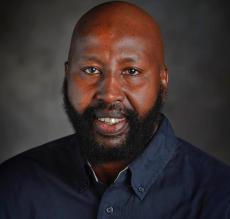
Dr. Ali Omar, Atmospheric Scientist
Your Skills
What would you say if someone told you that maybe you are already preparing for a career as an atmospheric scientist?
Consider if you ever practice any of the following skills:
|
Skill |
Examples |
|
Asking good questions. |
|
|
Using maps to locate a point of interest. |
|
|
Using techniques to focus on the right information. |
|
|
Reading instruction manuals. |
|
|
Choosing the appropriate file format for a specific purpose. |
|
|
Choosing the right photo quality. |
|
|
Asking for help or collaborating to solve a problem. |
|
|
Using a map to understand a place. |
|
If you have practiced any of the skills above, please know they can be very helpful for a career as an atmospheric scientist!
Meet Dr. Ali Omar
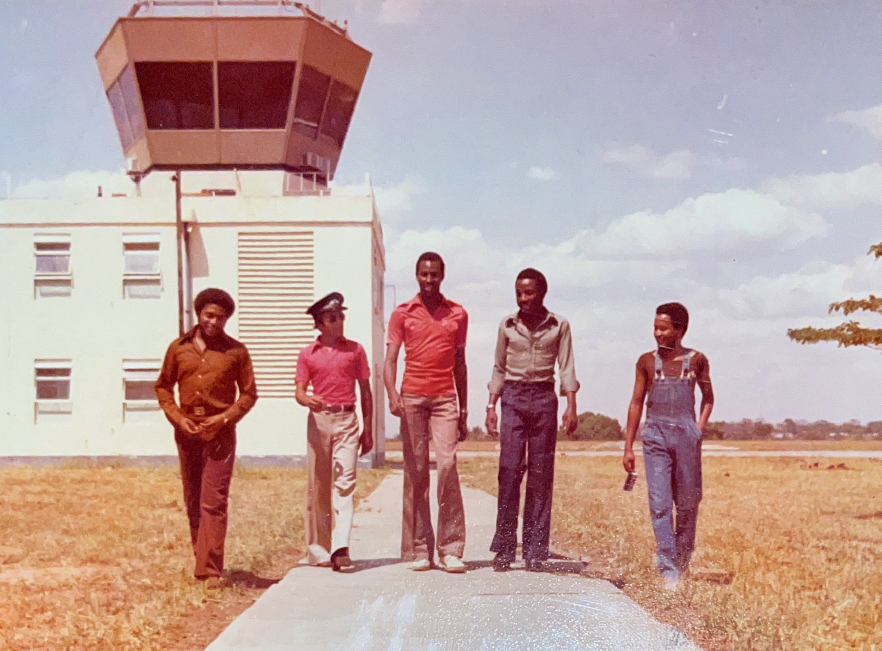
Ali and his classmates returning from aviation training, when Ali was 19 years old, at the East African School of Aviation. Credit: Ali Omar
Dr. Ali Omar became interested in aviation while growing up in Uganda. His high school was near an international airport, and he loved watching planes take off and land. After high school, he trained as an aircraft mechanic and later earned college degrees in aerospace and aeronautical engineering, as well as a doctorate in civil engineering. While studying the exhaust from airplane engines, he became interested in air pollution and how it affects the Earth.
After earning his doctorate, Ali worked on a project that used NASA's laser-based sensing technology to study high clouds. This tool uses quick flashes of light, like a pulse, to measure tiny particles floating in the air. Through this work, he connected with scientists at NASA Langley Research Center and joined NASA in 2002.
Today, Ali leads a team of 63 scientists and engineers who create laser-based sensors. NASA uses these sensors to obtain large amounts of data about clouds, air particles, weather, climate, and air quality.
One of Ali’s favorite projects was CALIPSO. Launched in 2006, the CALIPSO mission used a specialized laser tool called "lidar" to take detailed measurements of clouds and tiny particles in the air like dust, smoke, or sea salt, known as aerosols. Though it was originally designed to last only three years, the satellite operated for 17 years, providing scientists with a long-term record of how clouds and aerosols affect Earth’s climate. CALIPSO helped researchers understand important environmental issues, such as how Arctic ice changes and how smoke from fires or volcanoes spreads through the air. The mission ended in 2023, leaving behind a valuable set of data that continues to help experts improve weather and climate predictions.
Your Shared Skills
Next you will complete a table called Practices and Skills that shows the connection between skills and career practices. A skill is the ability to do something. Practices are habits applying skills for a purpose and continuing to improve the skills. It is possible for a skill to connect to more than one career practice. Ali and his team analyze large amounts of data to better understand Earth’s atmosphere. To learn a bit about how Ali makes sense of atmospheric data:
- Watch the video Discovering Data with NASA Scientists: Dr. Ali Omar
- Add examples of how Ali uses certain skills to obtain, manipulate, and analyze data to the following table.
- Think of a time when you used similar skills and add them to the table.
Practices and Skills
|
Career Practices |
Skill that Supports Practice/s |
Example of How Ali Uses This Skill |
Example of How You Use This Skill |
|
Asking Questions and Defining Problems |
Asking good questions. |
||
|
Analyzing and Interpreting Data or Using Models |
Using maps to locate a point of interest. |
||
|
Obtaining Information or Analyzing and Interpreting Data |
Using techniques to focus on the right information. |
||
|
Analyzing and Interpreting Data |
Choosing the right photo quality. |
||
|
Communicating Information |
Choosing the appropriate file format for a specific purpose. |
||
|
Engaging in Argument from Evidence |
Reading instruction manuals. |
||
|
Obtaining/Communicating Information or Analyzing and Interpreting Data |
Asking for help or collaborating to solve a problem. |
||
|
Planning and carrying out investigations
|
Using a map to understand a place. |
How might these Career Practices be important for this career?
Just for Fun
Ali enjoys playing volleyball and even started a volleyball team at NASA. Do you like playing sports or have a hobby you love?
Reflection
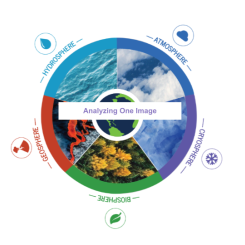
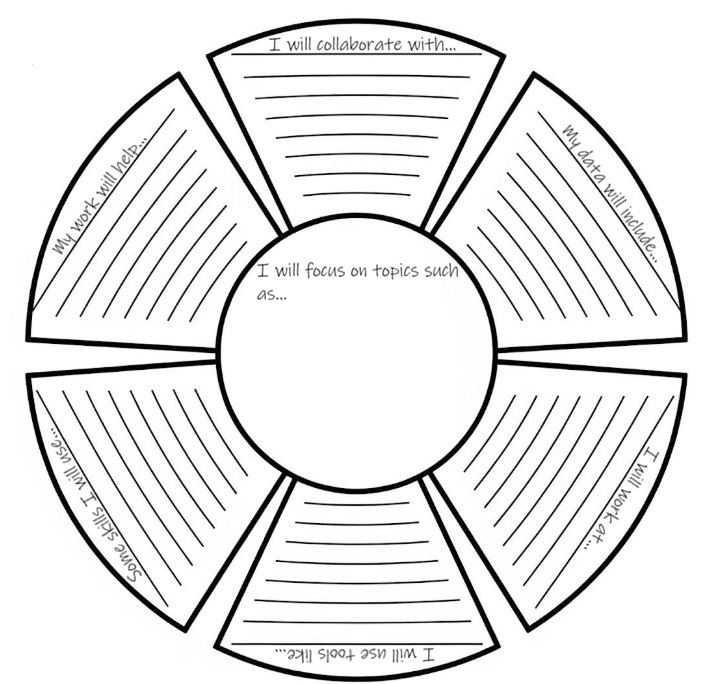
Many of your current activities are already preparing for a very bright future. If you are (or become!) curious about exploring the clouds, the air we breathe, or any other aspect of our atmosphere, you are practicing many skills that will help you succeed as an Atmospheric Scientist. Feel free to use the diagram below to envision your Atmospheric Scientist career. You can draw yourself as an atmospheric scientist in the center of the diagram!
Answer Key
Teachers who are interested in receiving the answer key, please complete the Teacher Key Request and Verification Form. We verify that requestors are teachers prior to sending access to the answer keys as we’ve had many students try to pass as teachers to gain access.